Double Elimination Bracket Calculator
Estimate bracket size, byes, winners and losers rounds, maximum matches, station pressure, and total tournament time for double elimination events.
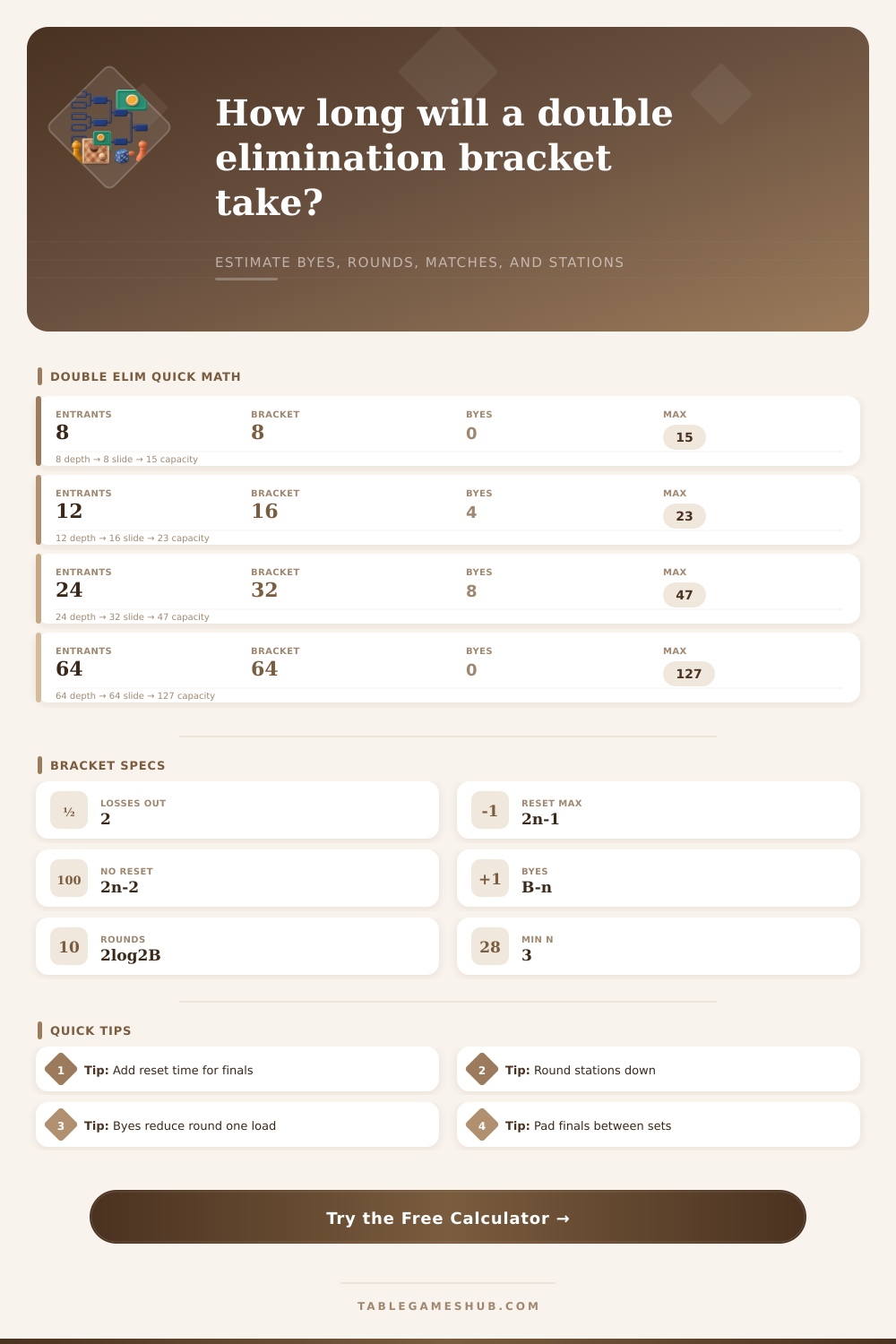
| Entrants | Bracket Size | Opening Byes | Max Matches | Rounds |
|---|---|---|---|---|
| 8 | 8 | 0 | 15 or 14 | 3 winners, 6 losers |
| 12 | 16 | 4 | 23 or 22 | 4 winners, 8 losers |
| 16 | 16 | 0 | 31 or 30 | 4 winners, 8 losers |
| 24 | 32 | 8 | 47 or 46 | 5 winners, 10 losers |
| 32 | 32 | 0 | 63 or 62 | 5 winners, 10 losers |
| 64 | 64 | 0 | 127 or 126 | 6 winners, 12 losers |
| Profile | Match Minutes | Buffer | Best Use | Schedule Risk |
|---|---|---|---|---|
| Quick board game | 20 | 4 | Small elimination nights | Low if reporting is simple |
| Card game best of 3 | 35 | 5 | TCG or trick-taking events | Medium with long finals |
| Miniatures skirmish | 75 | 10 | Scenario-driven tables | High without hard end time |
| Chess or abstract game | 50 | 5 | Clocked board games | Medium based on increment |
| Long tabletop set | 90 | 15 | Large game systems | High, plan fewer entrants |
| Stations | Parallel Matches | Good For | Pressure Point | Organizer Note |
|---|---|---|---|---|
| 2 to 4 | Small batches | 8 to 16 entrants | Losers round pileup | Use strict reporting windows |
| 6 to 8 | Normal club load | 16 to 32 entrants | Late bracket waiting | Reserve one finals station |
| 10 to 16 | Store tournament | 32 to 64 entrants | Score entry speed | Post next matches early |
| 20 plus | Convention load | 64 plus entrants | Pairing visibility | Use staff runners or screens |
| Metric | Formula | Meaning | Example at 32 |
|---|---|---|---|
| Bracket size | Next power of 2 | Seed slots including byes | 32 |
| Byes | Bracket size - entrants | Empty first-round seed slots | 0 |
| No reset max | 2n - 2 | Champion ends with one or zero losses | 62 |
| Reset max | 2n - 1 | Grand finals adds second set | 63 |
| Winners rounds | log2(bracket size) | Rounds to winners finalist | 5 |
| Losers rounds | 2 x winners rounds | Typical losers side waves | 10 |
Plan for the reset
If the losers finalist beats the winners finalist, many double elimination formats require a second grand final set. Keep the room and staff schedule open for that extra match.
Stations do not remove dependencies
More stations help early rounds, but late winners and losers rounds still wait on bracket dependencies. A realistic utilization target keeps estimates from becoming too optimistic.
Planning a tournament involve many different steps in the process. One of the most important step is to determine how much time the tournament will take. Because a double-elimination bracket allow every player to lose one match before being eliminated from the bracket, the number of matches required to play with a double elimination bracket is more higher than the number of matches required for a single elimination bracket.
Additionally, the matches within that bracket may lead to the tournament lasting long than the person might expect. A bracket calculator software tool can show the person the structure of the tournament prior to scheduling staff or a tournament venue. The first task in organizing a tournament is to determine how many player will fit into the specific size of the tournament bracket.
How to Use a Bracket Calculator to Plan a Tournament
Software that calculate the bracket will round the number of players that enter the tournament to the next highest power of two. Based on that number, the software will calculate the number of byes that the players will receive. Byes are important in that they determine the number of matches that occurs within the first round of the tournament, as well as the round in which players are sent to the losers bracket.
After entering the number of players who will enter the tournament, the software will output the size of the bracket and the number of byes. Knowing the number of byes will allow the organizers to determine whether the number of players is a perfect power of two, or if some player will receive a bye in the first round of the tournament. In addition to calculating the number of matches that will take place during the tournament, a bracket calculator can also determine the length of the tournament.
In order to calculate the length of the tournament, the organizer must first select the profile for the game that will be played during the tournament, or enter custom numbers for the length of each match and the turnover times between players. The software will take those parameter and calculate the number of hours that the tournament will take to complete, including time for players to check in and play in the finals. Both the number of stations and the utilization rates for those station can be changed.
Any change to either of these factor will change the hours that the tournament will take to play all of its match. A bracket calculator can also help to determine the difference between a reset grand final and a single deciding set for the tournament. If a reset grand final is allowed for the tournament, there will be one additional match to the number of matches that would otherwise be played in the tournament if there was a single deciding set.
This additional match is played at the end of the tournament, after the players have become tired from competing in all of the match, and after the staff member have finished preparing the playing area for the tournament. By displaying such a difference within the software for the organizer to see, the organizer can decide whether the extra time will be necessary for the tournament. The bracket can help to determine the way in which the station will be used during the tournament.
Specifically, the winners bracket will decrease in number as the tournament proceeds, but the losers bracket will contain all of the match in the middle of the tournament. These visual indicator within the software will allow the organizers to determine whether there will be a high volume of matches to occur at the same time as the winners are sent to the losers bracket. Such information is important in that it will allow the organizers to determine if more station will be required than calculated through the length of each match alone.
The breakdown section of the software will display the matches that will occur within the winners, losers brackets, and the dependency of each of the brackets. Finally, the software can display the complication that may develop during a real tournament. For instance, some player may arrive late to the tournament.
Additionally, it is likely that some matches will last longer than those calculated within the bracket. If the station designated to compete in a match should experience a twenty-minute delay in its functioning, the tournament will be delayed by twenty minutes as well. These complication are assumed to not occur within the calculation of the bracket and the organizers will ignore them.
In addition to calculating the length of the tournament and the number of match that will occur, the software will calculate the number of stations and staff that should be present during the tournament. The software will calculate the number of stations that will be used according to the number of available hour for the tournament and the utilization rates of the staff that will be assigned to each station. The number of stations that are recommended can be higher than the organizer might believe, since not all station can be occupied throughout the tournament.
Additionally, the number of stations that are needed during the early round of the tournament may differ from those that are needed during the later round. Consequently, the calculation of the number of stations that will be required will allow the organizer to plan for potential difficulty during the tournament. The formula that are used within the tournament bracket calculator are simple.
The size of the bracket is the next highest number that has the power of two. The number of byes is that number minus the number of player that enter the tournament. If the tournament feature the ability to hold a reset for the grand final, the total number of matches that will be held is two times the number of players minus one.
If the final of the match is a single match between the last two player, the total number of matches will be two times the number of players minus two. The number of rounds that will occur for the winner is the log base two of the tournament bracket size. The number of matches for the losers bracket is typically twice the number of match of the winners bracket.
Using a tournament bracket calculator is the most efficient means of calculating these formula for any amount of player. Additionally, another value of the tournament bracket calculator is its ability to allow the organizer to test various scenario that might occur during the tournament. For instance, the organizer can use the calculator to test the tournament with only thirty-two player instead of the number of players that entered the tournament.
Additionally, the number of station for the tournament can be tested. An organizer can test different number for the length of the matches, as well. These various scenario can be tested to determine how they may impact the tournament, and this information can then be used to plan the tournament accordingly.
A tournament bracket calculator will provide a realistic picture of the number of match that will occur during the tournament, as well as the time that will be required to compete in all of those match. While the calculator cannot communicate with the player that will enter the tournament, it will provide a starting estimate to the size of the tournament bracket and the number of match that will occur. By having a starting estimate of the bracket size and the number of match, the organizer will be able to make other decision for the tournament.