🧱 Domino Chain Reaction Time Calculator
Estimate how long a domino run will take from spacing, domino count, path complexity, curves, branch timing, and split delays.
| Spacing Ratio | Typical Pace | Timing Effect | Use Case |
|---|---|---|---|
| 0.20 to 0.35 height | Fast, about 6 to 8 per second | Quick contact with less visual pause | Short tabletop chains and speed runs |
| 0.35 to 0.60 height | Normal, about 4 to 6 per second | Reliable timing with clear falling rhythm | General floor and table layouts |
| 0.60 to 0.85 height | Slow, about 3 to 4 per second | Longer wave and more spacing sensitivity | Large visual paths with deliberate pacing |
| Over 0.85 height | Unstable, often below 3 per second | May require a test run before relying on timing | Only for special gaps or oversized pieces |
| Path Complexity | Formula Factor | What It Represents | Timing Note |
|---|---|---|---|
| Straight line | 1.00x to 1.04x | Low-angle contacts and predictable spacing | Best for timing a baseline pace |
| Gentle curves | 1.06x to 1.12x | Small turn losses and slight alignment drift | Common for tabletop display paths |
| Mixed route | 1.12x to 1.22x | Curves, crossings, ramps, and lane transfers | Use this when the line changes direction often |
| Showpiece maze | 1.22x to 1.40x | Gates, spirals, branch triggers, and tight turns | Branch delays matter as much as raw speed |
| Branch Mode | Total Time Formula | Best Match | Calculator Behavior |
|---|---|---|---|
| Parallel branches | Max of main run and longest branch window | Starbursts, splits, and simultaneous reveals | Adds only the delay needed beyond the main line |
| Staggered branches | Main run plus partial branch stagger | Branches that start at slightly different gates | Adds half of repeated branch delay to elapsed time |
| Sequential branches | Main run plus each branch window | Relay-style paths and one-after-another features | Adds every branch run and every branch delay |
| No branches | Main line only | Simple chains, speed tests, and straight runs | Ignores branch fields when branch count is zero |
| Comparison Setup | Domino Count | Spacing | Expected Run |
|---|---|---|---|
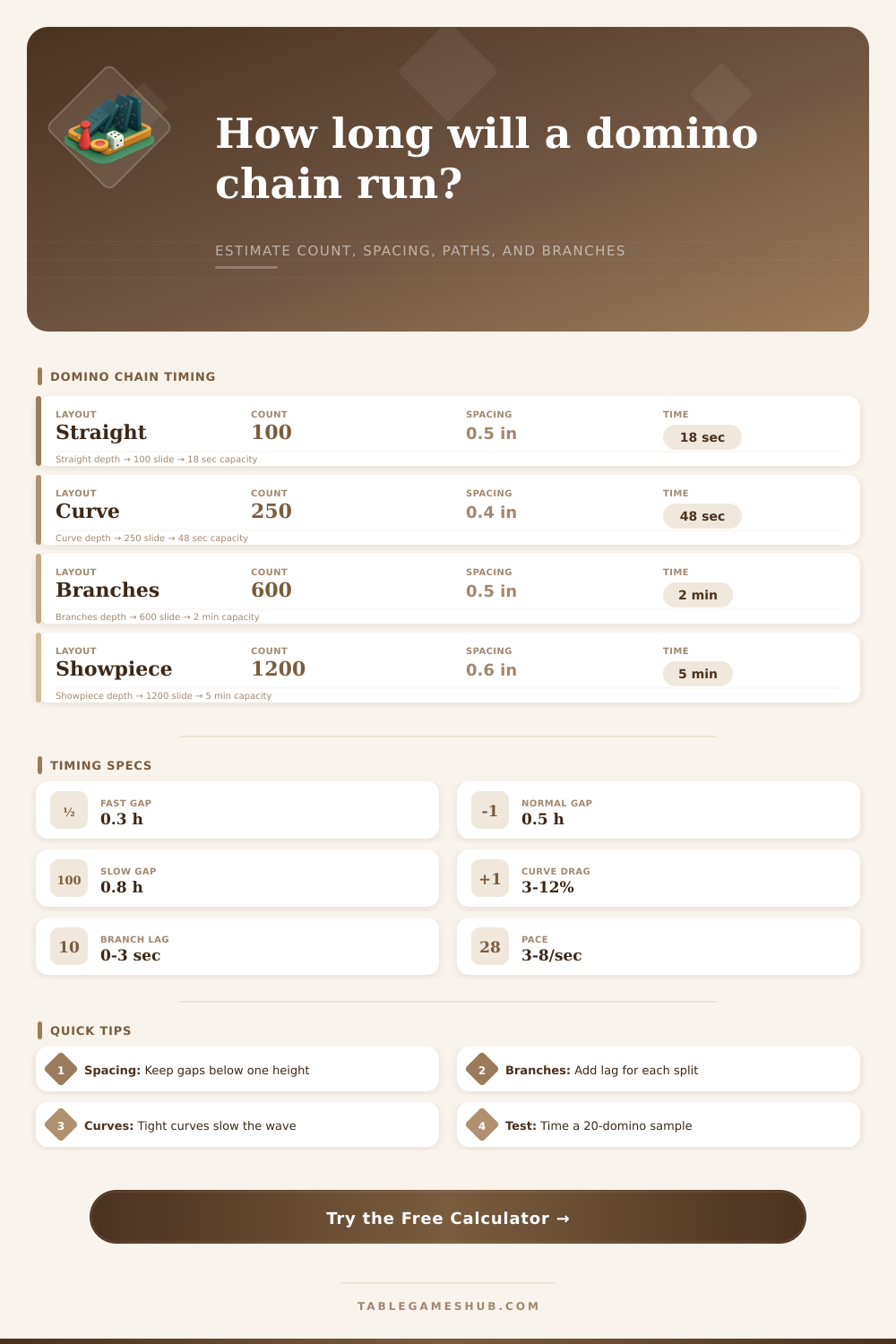
| Small tabletop demonstration | 50 to 120 dominoes | 0.35 to 0.50 height | About 10 to 30 seconds |
| Classroom or club chain | 200 to 600 dominoes | 0.40 to 0.65 height | About 45 seconds to 3 minutes |
| Branching floor display | 500 to 1500 dominoes | 0.45 to 0.75 height | About 2 to 7 minutes |
| Slow showpiece maze | 1000 or more dominoes | 0.55 to 0.85 height | Often 5 minutes or longer |
Tip 1: Time a sample before scaling
Set 20 dominoes at the planned spacing and time the reaction. Replace the default pace with a preset that feels closest to that test.
Tip 2: Branch delays accumulate quickly
A splitter that pauses for less than one second can still add minutes when many branches run sequentially.
To determine how long it will take for a person to complete their construction of a domino run, the person must take a few factor into consideration. The total time that a person’s domino run will take is not directly relate to the number of dominoes that they build in their construction. For instance, a straight line of 200 dominoes may be completed in under one minute, but the same number of dominoes arrange in a formation that includes branches and turns in its path may take more than three minutes to complete the same distance.
The main factor that influence the time that it takes for the dominoes to fall in a line is the spacing between the dominoes. If the spacing between each domino in the line is small, the falling domino will hit the next domino in the line quick. As a result, the time that it takes for each domino to fall is less.
What Affects the Time of a Domino Run
Conversely, if there is a large spacing between each of the dominoes in a line, the falling domino will have to travel a greater distance until it impacts the next domino. A large spacing between the dominoes will cause the time in which each domino fall to be longer. Additionally, the height of the domino can also influence the spacing of the line.
If the gap between the falling domino and the next domino is large in relation to the height of each domino, there will be a delay between the time in which each domino begin to fall. These factors can be tested with the calculator included on this page to allow a designer to determine the effect of spacing on the total time that the construction will take to complete. Another factor that can impact the time that a person’s domino run will take to complete is the number of curves that is included in that layout.
Any curve will add time to the total time required for a designer to complete their construction. Curves that are gentle will have little impact on the total time, but curves that are tight will require each of the dominoes to rotate as they fall along those curves. This rotation of each of the dominoes will add to the total time of that construction.
The calculator included on this page allows a designer to estimate the impact that the curves will have on the time that it will take to complete the construction. Another factor that will impact the time that a person’s construction will take is the use of branches. Branches will alter the time in which the domino run is completed.
If the two side branches created from the main path of the design are relatively short, they will even finish at the same time as the main design. However, if one of the branches is of a longer distance than the other branches created from the main path, the length of that long branch will be the main factor that determine the length of the entire project. Additionally, there are different timing modes for these branches.
If the branches are timed in a way where they are to be fired at the same time, the total length of the project will be the length of the longest branch. However, if the branches are timed in a way where they are created in sequence, each of the lengths of the branches will be added to the total length of the project. Additionally, each of the short delay of the branches will also have an impact on the total length of the project.
Each of these factors can be determined with the calculator included in this article. The reference table included in this article can provide designers with an understanding of the different time factors that are created by various spacing and path layout features in a project. The reference table makes clear the different gap ratio that will result in different falling times.
Additionally, the reference table helps designers to understand how various path layout designs will impact the total time of the project. These designs will allow designers to compare their designs to others before placing their dominoes. These tables will also allow them to understand that designs with various features will result in longer times for those designs.
Consequently, before placing their dominoes, they will have a better understanding of their projects. In addition, however, the reference table allows for designers to become aware that there may be other factor that influence the total length of their project. Thus, testing their layout prior to constructing it will be a helpful tool for those designers.
In actuality, there are other factors that will influence the length of a project that cannot be accounted for in the calculator. For example, the texture of the construction surface will impact how fast each of the dominoes fall. A floor that grips the base of the domino will slow the time at which they fall, but a flat surface that allow for the dominoes to slide will make the time that they fall shorter.
Another factor is humidity. High humidity levels will allow the thin dominoes to flex. These factors cannot be accounted for in the calculator.
To avoid the surprises that these factors can create, a designer can always create a test run of a small number of dominoes at the same spacing that will be used in the project. Testing a row of twenty dominoes will allow the designer to ensure that the time at which each falls will be reliable for the project. This time will allow the designer to calculate how long the rest of the project will take to complete.
Additionally, the calculator can be used as a tool to test how a change in the project will impact its length. Another common mistake with creating a project is treating each branch of a project as if it will have the same length as each of the other branches. For example, each of the side branches that are created from the main path of a project may be relatively short and even complete at the same time as the main path.
However, if there is a long branch compared to the other created branches, it will become the length of the entire project. Designers can use this information to even further adjust each of their projects. One of the best ways to do this is to compare the length of the main path of a project to the length of each of the branches.
This will allow them to ensure that each of the project’s features will have an equal impact upon the length of the project as a whole. The same principle can be used to analyze the impact of the curves in a project. For example, a project may include many curves for visual interest to the audience or participants in the project.
However, each of these curves will impact the length of the project as the time required for the falling of each domino to travel along those curves. Thus, designers can use the calculator to understand the impact that the curves will have upon the time required to complete the project. The same information can be used to determine whether the project will be too long if these curves are included.
Finally, while there is no way to account for the actual time that will be required for the project once it is created, the calculator will provide a designer with an understanding of whether or not the project will be brisk or slow when completed. Consequently, each of the features in the project can be examined with the calculator to determine whether they will impact the length of the project. The calculator will also allow the designer to determine whether or not each branch in the project will be created at the same time.
Additionally, the designer will also have an understanding of whether or not the length of the project will be as designed. Once the designer has constructed the project and the first domino has begun to fall, the project will be limited to the variable established prior to its construction.