101 Darts Calculator
Plan short-format 101 checkouts with double-out routes, one or two visit setup targets, bust-safe first darts, dart efficiency, and a recommended finish.
| 101 Start | Route Type | Common Route | Why It Fits 101 |
|---|---|---|---|
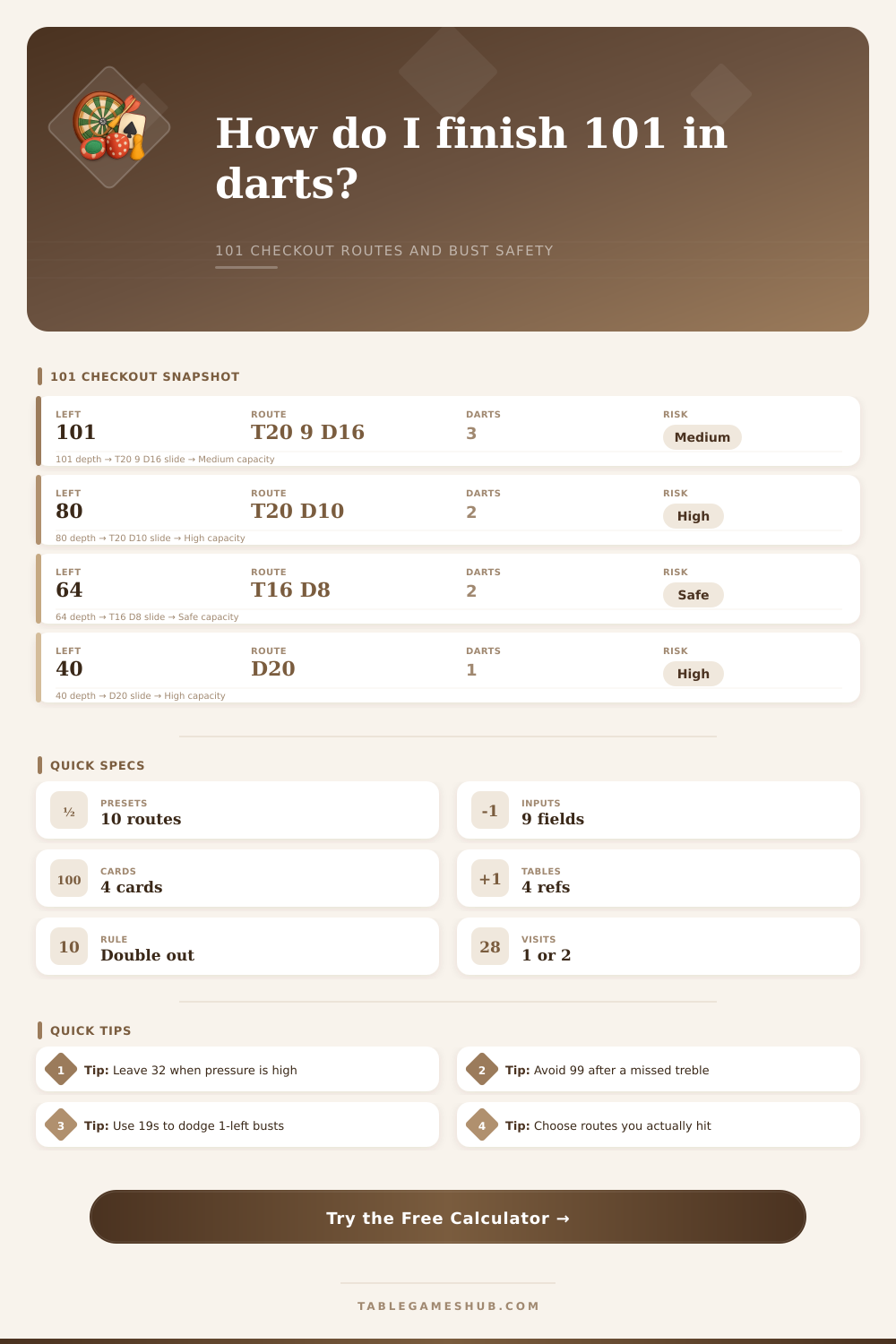
| Treble-first | Efficient | T20 9 D16 | Uses one treble and leaves a favored double. |
| 19s-first | Safer miss | T19 12 D16 | A single 19 leaves 82 instead of awkward 81. |
| Setup-first | Two visit | 61 to leave 40 | Builds a clean tops finish next visit. |
| Double-first | Pressure | Score then D20 | Works when opponent is already on a finish. |
| Leave | Preferred Double | Bust Safety | Short-Format Note |
|---|---|---|---|
| 40 | D20 | Low | Great if you like tops, but S20 leaves D10. |
| 32 | D16 | High | Clean split path through 16, 8, and 4. |
| 36 | D18 | Medium | Strong for players who prefer the left side. |
| 24 | D12 | High | Friendly rescue path through D6 and D3. |
| Score Band | First Thought | Bust Concern | Good Setup Leave |
|---|---|---|---|
| 101 | One treble plus double | Miss leaves awkward two-dart work | 40 or 32 |
| 81-100 | Treble path if available | Overshooting after first dart | 40 |
| 61-80 | Two-dart checkout | Leaving 1 after a single | 32 or 24 |
| 2-60 | Direct double setup | Odd leaves below 10 | Even number |
| Darts Left | 101 Goal | Route Priority | Calculator Bias |
|---|---|---|---|
| 3 darts | Finish immediately | One treble and a real double | Best route score |
| 2 darts | Finish if possible | Treble then double | Double preference |
| 1 dart | Hit a double or setup | Avoid score of 1 | Bust safe leave |
| Next visit | Leave comfort double | 40, 32, 36, or 24 | Setup target |
When a player has a score of 101 remaining in a game of darts, the player must decide how to use the three darts that remain to reach a winning double. There is a risk in scoring highly numbers for the players score with the three remaining darts, as well as in choosing numbers for the player to aim for that will leave the player with a remainder that is safe to finish with the last dart. A player may wish to aim with the three remaining darts for a treble to finish the game quick.
Alternatively, a player may wish to aim for smaller numbers so that if the player makes an error with one of the darts, the remainder of the game will still be manageable with the remaining darts. For instance, if the player aim for a treble 20 with one of the darts, but misses and hits a single 20 with the dart, the player will have a remainder of 81. Such a remainder is difficult for the player to finish the game with the remaining darts.
Ways to Finish 101 in Darts
Thus, many players choose to aim for the 19 with the three remaining darts; hitting a single 19 will leave the remainder of 82 for the player to aim for with the last two darts. The calculator that is provided to players allows for the player to input there accuracy with the darts, as well as the settings for how safe they want to be from busting out of the game. For instance, a more accurate player may wish to aim for the most challenging of the routes with the remaining darts, as compared to a player with lower accuracy with the dart game.
Furthermore, the calculator can account for bust safety mode for the player; bust safety mode accounts for the risk of scoring too many points with the remaining darts and go beyond the required score to win the game. Should a player bust out of the game, they must return to the previous score. Additionally, many players wish to avoid scoring an 1; should a player score a 1, they will fail to be able to finish the game with a double.
The calculator can perform these mathematical calculations in the player’s stead, so that the player dont have to perform such calculation while playing the game. Furthermore, dart efficiency is not just related to the number of points that a player scores with their darts. A player is considered inefficient if they score a high number of points but leave their opponent with a remainder of the game that is difficult to complete.
Thus, every player has a preferred number for their doubles; they will likely choose a route with their last three darts that will leave the remainder of their score with their opponent with that preferred double. For example, a player that prefers 16 will want to aim for numbers that will allow them to hit 8 or 4 if they should miss their shot at the double 16. Thus, aiming for a preferred double will increase the probability that the player will succeed in their efforts to win the game.
Another decision for the player is whether they wish to finish the game in one or two visits with their opponent. If the opponent is some distance from the players location, the player may wish to play it safe and aim for a score like 40 or 32. Such a strategy is safe and will allow the player to aim for a remainder of their opponents score that will be easy to finish on the next visit.
However, if the opponent is ready to finish the game, the player will have to play aggressive; the risk of not being able to finish the game on the next visit is greater then the risk of busting out of the game. The common miss pattern for a player may also factor into their decision of the route that they aim for their three darts. For instance, if a player commonly misses the trebles on their dartboard, they may want to aim for single numbers that are large but have a workable remainder; it is better to hit a single and leave a remainder that can be finished with the remaining darts than to miss a treble and leave a remainder that is very highly.
While the reference tables on this page may display the most common routes for players to aim for, it is important for players to understand why players have established those routes. For instance, a remainder of 32 is a good number to aim for; 32 includes a built-in safety net of doubles like 16, 8, and 4. Thus, by learning of these tools that the player can use to their advantage with the game of darts, the player can build a mental library of the routes that they can learn to recognize and execute automatic when playing the game with an opponent.
It should of been noted that many players find this easier when they practice regularily.