Weather Machine Score Calculator
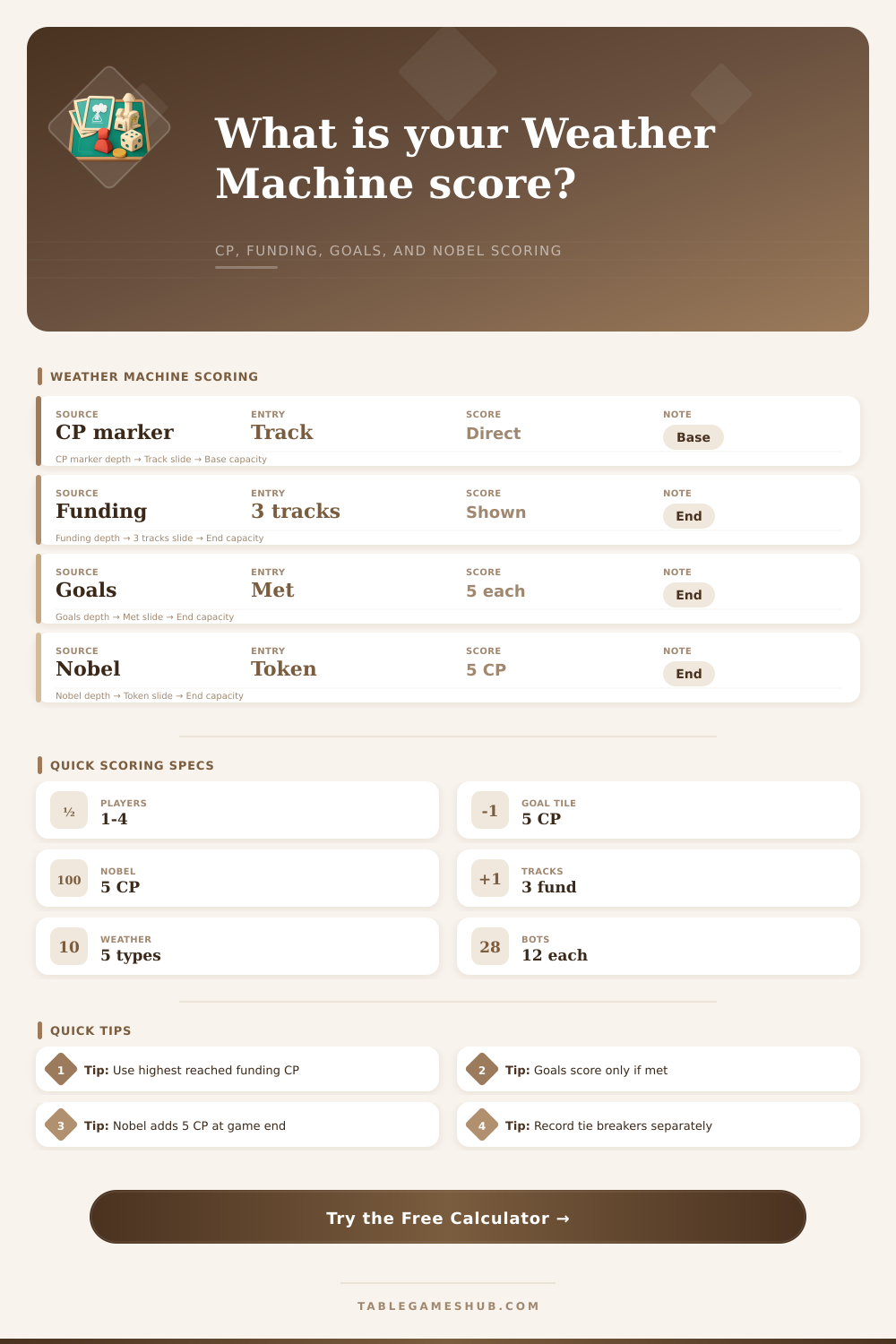
Total your Climate Points from the score marker, papers, prototypes, Government work, Funding tracks, Goal tiles, Investment tiles, and Nobel scoring.
⚙Score Presets
🧮Score Inputs
📊End Scoring Inputs
🧪Board State Context
🏅Tie Break Inputs
Score Results
Calculation Breakdown
🧩Component / Spec Grid
📝Final Scoring Reference
| Scoring Source | When To Count | Calculator Field | Scoring Note |
|---|---|---|---|
| Current CP marker | Before final scoring | Current CP marker | Use the value already reached on the Climate Points track. |
| Funding tracks | Endgame | Government, R&D, Lativ Lab Funding | Enter the CP value indicated by each track position. |
| Goal tiles | Endgame | Goal tiles met | Only satisfied Goal tiles score, at 5 CP each. |
| Nobel Prize | Endgame | Nobel Prize token | Add 5 CP if you hold the Nobel Prize token. |
🏛Government, Funding, And Voucher Checks
| Area | Common Item To Check | Score Impact | Calculator Use |
|---|---|---|---|
| Government | Placed bots, machine parts, Subsidy effects | May create CP or support track progress | Add unrecorded CP in Government / award CP. |
| Funding | Marker positions on the three tracks | Endgame CP from reached values | Enter each Funding CP value separately. |
| Vouchers | Location vouchers and Science flexibility | No direct endgame score by default | Use for readiness, not CP, unless a tile says otherwise. |
| Investment tiles | Unused or final scoring CP icons | Depends on the tile | Enter visible CP in Investment / final tile CP. |
🔬Lab, Experiments, And Prototype Inputs
| System | Track In Play | Important Count | Score Handling |
|---|---|---|---|
| Lativ Lab | Experiment columns and assistant timing | Bots committed to matching weather | Add CP only when the result has awarded CP. |
| R&D prototypes | Weather improvement and prototype builds | Machine parts, chemicals, and bots | Enter remaining prototype CP in the prototype field. |
| Research papers | Rows across weather token colors | Published papers and completed rows | Use paper CP and tie-break paper count separately. |
| Experiment timer | Lab tiles remaining | Experiment tiles left | Readiness context; it does not add CP alone. |
💾Preset Assumptions
| Preset | Main Engine | Expected Shape | Best Use |
|---|---|---|---|
| Balanced Scientist | Mixed papers, funding, goals | Moderate total, solid tie breakers | Baseline comparison after a normal multiplayer game. |
| Nobel Prototype Run | Weather fixes and Nobel | High prototype CP, strong award count | Checking a player who pushed three improvements. |
| Lativ Lab Engine | Lab experiments and papers | High Lab Funding, strong paper count | Comparing research-heavy endgames. |
| Voucher Combo Finish | Final action flexibility | High readiness, variable CP | Projecting the last round before final scoring. |
💡Scoring Tips
After a lengthy play on Weather Machine, you’re sitting down with a marker inches away from winning the game. Papers is all over the table. Tokens fill up board. Prototypes lie around everywhere. Somehow you know you have some points, just not where they are.
The score calculator compiles those scattered points into a single definitive point amount. No more debates over who wins what when it’s a tie because there will always be a score. Scoring punishes hesitation, but it also rewards bold moves.
How to Score Points in Weather Machine
Your baseline is your Climate Point marker. What you didn’t claim is where the real variance occurs. Stacks of paper gather. Prototypes sits in workshops. If you fail to log a government award, it loses value. This math are done for you by the calculator. This spares you the pain of adding five things at once. It reminds you that every action not logged are a possible point lost.
Does distance traveled equal distance scored? It is a common question from players. Are you thinking that advancing up the Research and Development track will give you a lead? Points based off position only count during end game scoring. A common question from players. Advance up the Research and Development track, thinking that will give you a lead? Only end game scoring counts points based on position.
The questions asks for your final spots on the Lativ Lab, R&D, and Government tracks. Those spot offer point values. It’s all about scoring. How far did you get doesn’t matter. Maybe you’re way behind in total CP, but your opponent forgot to fund their markers and you are ahead.
A Nobel Prize is a binary trigger. It doesn’t care how much effort went into it; it cares that you got one. A goal tile is worth five points or nothing at all. No partial credit for almost finishing. The calculator lets you turn these achievements on or off. This make it clear they are a binary trigger. If you can’t be honest with yourself about whether you should of the goal tile, you don’t deserve the points.
Tournaments is decided by tie breakers. You can have two people who finish tied on Climate Points. The tie breaker determine the winner. You lose. The calculator has fields to track how many Office Rows you complete, and how many published papers you’ve written. This do not alter your overall score. It’s a way of determining who wins in case the numbers match. By tracking it separately you can avoid panicking at eleventh hour. It helps to know that you might value publishing more papers than earning more points.
That’s where the board state section kicks in: connecting strategy with reality. What’s sitting on the shelf? How many bots is waiting in line? How many more vouchers do I need? None of these contribute points. But they illustrate your runway, your cushion for bad luck. You may be ready now, but you can still take one last step. That margin of error are shown by the calculator, which converts abstraction into something real.
Weather Machine: If you play Weather Machine, realize that no engine is ever perfect. There will always be resources left on table. The key is to know what counts and what’s merely clutter. A planned way to list results takes the emotion out of equation. It allows you to identify your advantages. Then it’s time to put away the debate and plan for the next game once you have the numbers.