D20 Advantage Disadvantage Calculator
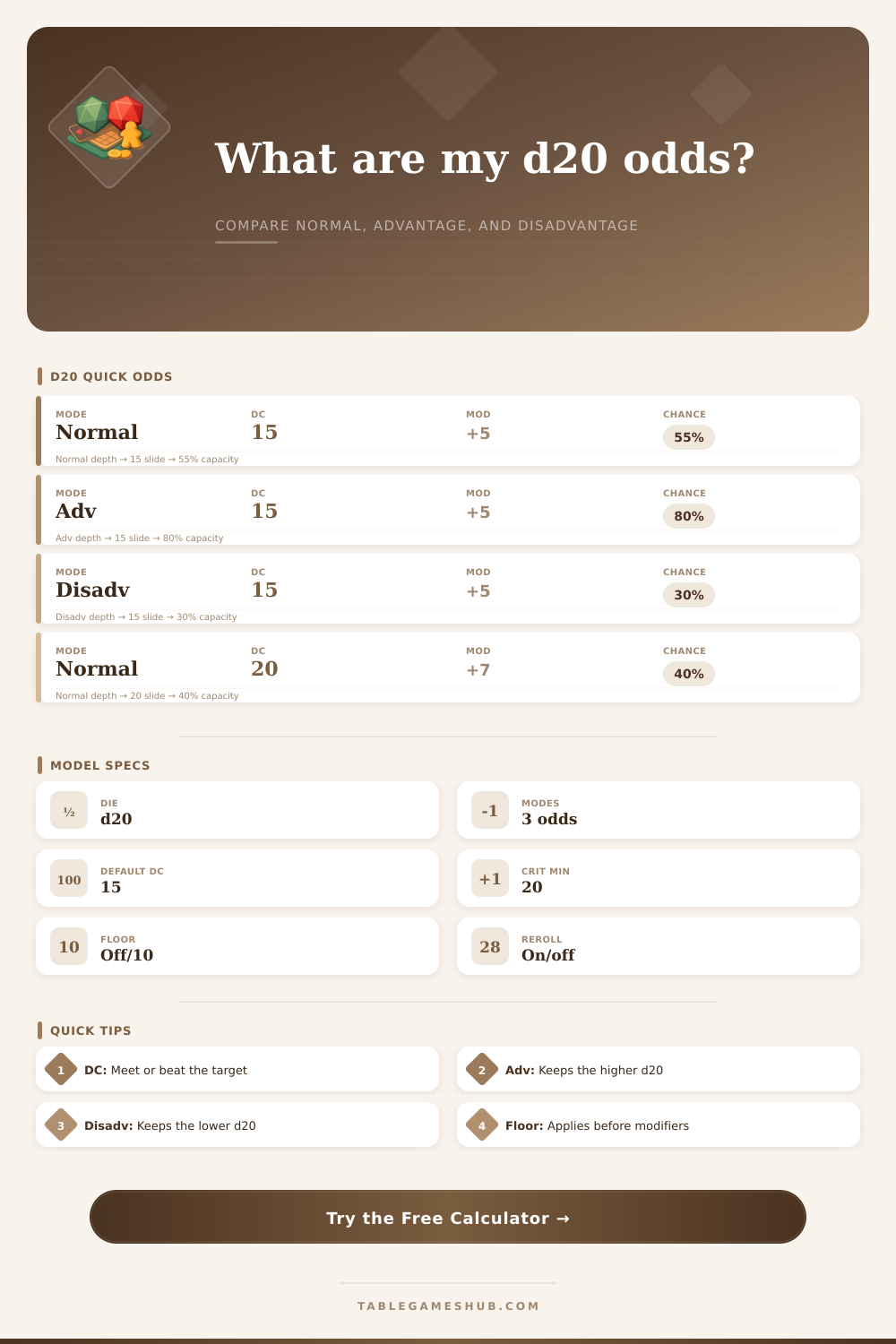
Compare normal rolls, advantage, disadvantage, DC targets, modifiers, crit ranges, reliable talent floors, and once-per-roll rerolls.
| Roll mode | Success chance | Needed kept d20 | Critical success chance | Critical fail chance |
|---|---|---|---|---|
| Normal | 55.0% | 10+ | 5.0% | 5.0% |
| Advantage | 79.8% | 10+ | 9.8% | 0.3% |
| Disadvantage | 30.3% | 10+ | 0.3% | 9.8% |
| DC band | Typical target | Needed with +0 | Needed with +5 | Needed with +10 |
|---|---|---|---|---|
| Easy | DC 10 | 10+ | 5+ | Always except overrides |
| Medium | DC 15 | 15+ | 10+ | 5+ |
| Hard | DC 20 | 20+ | 15+ | 10+ |
| Very hard | DC 25 | Impossible without nat-20 rule | 20+ | 15+ |
| Needed d20 | Normal chance | Advantage chance | Disadvantage chance | Advantage gain |
|---|---|---|---|---|
| 5+ | 80.0% | 96.0% | 64.0% | +16.0 pts |
| 10+ | 55.0% | 79.8% | 30.3% | +24.8 pts |
| 15+ | 30.0% | 51.0% | 9.0% | +21.0 pts |
| 20+ | 5.0% | 9.8% | 0.3% | +4.8 pts |
| Critical range | Normal | Advantage | Disadvantage | Natural results counted |
|---|---|---|---|---|
| 20 only | 5.0% | 9.8% | 0.3% | 1 face |
| 19-20 | 10.0% | 19.0% | 1.0% | 2 faces |
| 18-20 | 15.0% | 27.8% | 2.3% | 3 faces |
| 17-20 | 20.0% | 36.0% | 4.0% | 4 faces |
| Feature | Input | Math effect | Best checked with |
|---|---|---|---|
| Reliable talent style floor | Floor 10 | Kept d20 results below 10 count as 10 before modifiers | Skill checks with high modifiers |
| Reroll natural 1 once | Toggle on | Each die showing 1 is rolled again once, then the kept die is chosen | Features that replace a rolled 1 |
| Natural 20 succeeds | Nat 20 rule | A kept natural 20 can pass even if total is below the DC | Attack-like checks or house rules |
| Natural 1 fails | Nat 1 rule | A kept natural 1 can fail even if the modified total reaches DC | Save or attack table variants |
Advantages and disadvantage are mechanics that changes the way a player rolls a twenty-sided die, or d20. Advantage require the player to roll two d20s and keep the higher value of the two rolls. Disadvantage requires the player to roll two d20s and keep a lower value of the two rolls. Advantage and disadvantage change the probability of the player rolling high numbers on the d20. Advantage increases the chance of rolling a high number on an d20 while disadvantage decreases the chance of rolling a high number.
Advantage and disadvantage change the mathematical probability of rolling a specific number on a d20 when the probability of rolling that number are important to the game and when the advantage or disadvantage mechanic is applied to every die roll that is made by the player. The advantage and disadvantage calculator allow a player to see how advantage and disadvantage change the math behind the rolls of a d20. A player types in the target number and the total modifier for that roll into the advantage and disadvantage calculator. Advantage and disadvantage also interact with critical ranges and automatic success calculation for d20 rolls.
How Advantage and Disadvantage Change d20 Chances
Because these values are required for the advantage and disadvantage calculator, the advantage and disadvantage calculator is able to show players the way in which advantage and disadvantage change the chance of success for a player on a roll of a d20.
Certain character feature change the way in which advantage and disadvantage function. For instance, a reliable talent feature guarantee a minimum result on a d20 prior to the addition of modifiers. This feature changes the math of skill checks for a character that has the reliable talent feature.
Additionally, a feature that allows a player to reroll a natural one on a d20 allow that player to avoid an automatic failure on a roll. If the player adjusts these features in the advantage and disadvantage calculator, the advantage and disadvantage calculator will show if the reroll feature or the reliable talent feature provide significant protection to the player against failing on a roll of a d20 or if the reroll feature or the reliable talent feature only provide protection against the player rolling bad luck on a d20.
Critical range for a d20 interact with advantage and disadvantage. Critical ranges are sets of numbers on a d20 that result in a critical success on a roll.
For example, rolling a natural twenty on a d20 is a critical success. If the critical ranges are expanded for the d20, advantage becomes more valuable. Advantage will increase the chance of rolling a high number on one of the two dice rolled by the player with advantage.
Expanding critical ranges on a d20 will not help a player much if the player has disadvantage because disadvantage makes it unlikely for the lower of the two dice rolled by the player will land on a critical range. The advantage and disadvantage calculator display this information to the player so that they dont have to refer to separate tables to determine this information. A player may need to make multiple attempts with a d20. The advantage and disadvantage calculator can handle situations in which a player makes multiple attempts with a d20. For instance, the player may need to roll a single check with advantage or the player may need to make three attempts with disadvantage.
The advantage and disadvantage calculator can calculate the chance of success in a series of rolls because a player requires multiple attempts with a d20. The advantage and disadvantage calculator include the calculation of the chance of success for a player that must roll a d20 multiple times to succeed on a task. The value of advantage and disadvantage change based off the target number for the d20 roll. A character with a modest modifier and advantage will roll more often than a character with a high modifier without advantage.
This is especially true for characters that have target numbers in the medium range on a d20. Advantage will provide the most value for a player when the target number for a d20 roll is in the medium range. Advantage will provide little value for a player when the target number is very easy to roll on a d20 with a normal roll. Advantage will also provide little value to a player if the target number for a d20 roll is impossible to roll without the use of a natural-twenty rule.
The same is true for disadvantage. Many players make mistake when using advantage and disadvantage mechanics. For example, a player may always seek advantage with a d20 roll even if the target number on a d20 is very easy to roll.
In these instances, advantage with a d20 roll is a waste of resources. Similarly, a player may avoid disadvantage with a d20 roll at all costs even if the target number on a d20 is medium in difficulty to roll. In these instances, the player may miss out on available options for succeeding on the d20 roll.
The advantage and disadvantage calculator allow a player to compare different scenarios in the game. A player types in the target number and the total modifier for a skill check. The player can compare scenarios in which the target number is very hard to roll on a d20 or a skill check with scenarios in which the player has advantage with the skill check.
The player can also compare scenarios in which the character has a reliable talent feature to scenarios in which the character does not have the reliable talent feature. Finally, a player can compare scenarios in which there is a natural twenty rule in place for skill checks or not in place for those skill checks in the game. The advantage and disadvantage calculator allow a player to make decisions in the game.
For instance, if a fighter is trying to land a critical hit with their weapon, the advantage and disadvantage calculator will allow the fighter to determine the odds of landing that critical hit. If the party is facing a challenge that requires a number of skill checks to be successful, the advantage and disadvantage calculator will allow the party to determine the odds of failing on those skill checks with disadvantage on their rolls of a d20. The numbers on the advantage and disadvantage calculator will never replace the judgment of the games DM, but they will help to remove guesswork from the decision that is decisive between two options for the player characters. By understanding how advantage, disadvantage, floors, and rerolls affect the math behind the rolls of a d20, a player will have a better understanding of the decision that must be made for the players characters with these features.