🀄 Chinese Mahjong Calculator
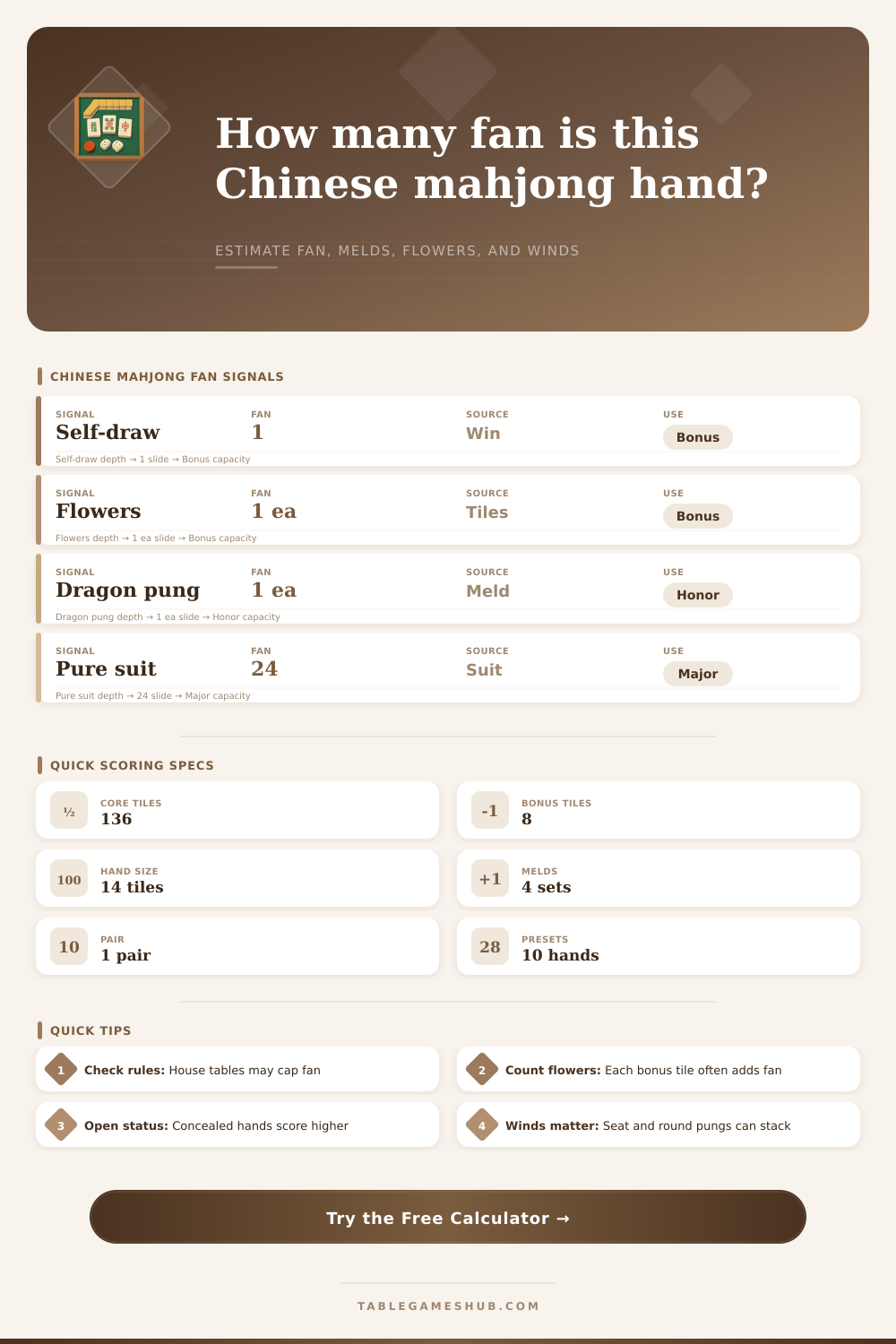
Estimate fan and hand value from base pattern, flowers, meld types, concealed status, winds, and winning method.
| Base Pattern | MCR Estimate | House Estimate | Typical Meaning |
|---|---|---|---|
| Regular four sets and pair | 0 fan | 1 fan | Base completed hand |
| All pungs | 6 fan | 3 fan | No chow sets |
| Mixed one suit | 6 fan | 3 fan | One suit plus honors |
| Pure one suit | 24 fan | 6 fan | Tiles from one suit |
| Seven pairs | 24 fan | 4 fan | Seven distinct pairs |
| Bonus Source | Common Fan | Input Field | Scoring Note |
|---|---|---|---|
| Flower or season tile | 1 each | Flowers | Usually additive |
| Self-draw win | 1 | Winning method | May affect all payers |
| Dragon pung or kong | 1 each | Dragon sets | Value honor set |
| Seat wind set | 1 | Seat wind | Player wind match |
| Round wind set | 1 | Round wind | Prevailing wind match |
| Meld Type | Tile Count | Fan Signal | Calculator Use |
|---|---|---|---|
| Chow | 3 tiles | Sequence | Checks hand shape |
| Pung | 3 tiles | Triplet | Adds all-pungs pressure |
| Kong | 4 tiles | Quad | Adds meld value |
| Pair | 2 tiles | Eyes | Completes normal hand |
| Tile Group | Types | Copies | Total Tiles |
|---|---|---|---|
| Bamboo, characters, dots | 27 | 4 each | 108 |
| Winds | 4 | 4 each | 16 |
| Dragons | 3 | 4 each | 12 |
| Flowers and seasons | 8 | 1 each | 8 |
Tip 1: Separate pattern fan from bonus fan
Score the main hand pattern first, then add flowers, dragons, winds, and winning-method fan so the breakdown is easy to audit.
Tip 2: Confirm the table rule family
Chinese mahjong scoring varies by house, Hong Kong, MCR, and Taiwanese tables, so use the closest profile and apply local caps.
Mahjong is a game in which individuals must collect specific sets of mahjong tiles. Due to the fact, however, that there are many differently rules related to Mahjong, the game can be somewhat confusing for the players when scoring each hand. There is a value to each of the hands, which is calculate through the use of an additive process.
With this type of process, the individual starts with a base value for their hand, and then continues to add values for other features of the hand. The base value of a hand is the foundation of that players score, and the bonus values are additional points that can be earn. These two component of the game can both vary from player to player with different rules within each tradition related to Mahjong.
How to Score in Mahjong
Within a game of Mahjong, the type of hand that is played establishes the base value of a player’s hand. A standard hand consist of four sets of three tiles of each type, and one pair of two tiles of the same type. Instead of creating such a standard hand, though, the player can also create specialized base value for there hand.
Examples of such specialized bases include an all-pungs hand, in which the player create a hand that consists of all triplets of the same type of mahjong tiles, and the thirteen orphans hand, which is a rare type of base value that contain specific types of tiles and yields a high value for the player who create such a hand. Besides establishing a base value for a player’s hand, there are also additional steps that can be taken to increase the total amount of fan that a player earns. Such actions may include the inclusion of bonus tiles, such as flowers and season tiles, which are added to any hand in play, or even additional honor tiles, like the dragon and wind tiles.
The value of each type of wind tile, for example, is not constant; its value change based off the seat of the player, and the round of the game that is being played. Similarly, the way in which a player wins the game also changes the total amount of fan that player can earn. For instance, a player that self-draws their winning tile will score more fan value than one that wins the hand by claiming a players discarded tile.
Additionally, the player may choose to play their hand either in a concealed state (without having claim any of their own tiles), or to play their hand in an open state. An open hand will allow the player to win the game more quick than a concealed hand, but a concealed hand earns more fan values. Overall, the use of a scoring tool can help players to calculate each of these values for their hand.
The tool will ask players to input the types of melds that they have made with their tiles, as well as the bonus tiles that they have collect, into the scoring tool. Based upon these insertions, the tool will calculate the total amount of fan for that player’s hand. Additionally, the tool can help players to understand how valuable their hand is, and, through understanding the value of their hand, to make sound decisions regarding which strategy to use during the game of Mahjong.
Thus, the use of such a tool can transition a player from guessing the value of their hand, to calculating the value of their hand. An understanding of the process through which fan values accumulate within each hand is essential for players to enjoy the game of Mahjong, and an understanding of such a process allow for players to more effectively manage the risks of the game.