Chinchon Score Calculator
Total a Chinchon hand with deadwood penalties, clean-hand discounts, seven-card run bonuses, target elimination checks, and re-entry notes for common table rules.
| Profile | Target | Clean hand | Pure Chinchon |
|---|---|---|---|
| Fournier-style | 70 or 100 | -10 | Often decisive |
| Classic 100 | 100 | -10 | House choice |
| Ludoteka ladder | 100 | -10 | Pure run wins |
| Playspace-style | 100 | -10 | -25 shown |
| Close type | Calculator value | Jokers | Score effect |
|---|---|---|---|
| Normal close | Deadwood | Any table rule | Adds penalty points |
| All cards melded | -10 default | No run bonus | Subtracts from closer |
| Run with one joker | -50 default | One joker | Large discount |
| Run with two jokers | -25 default | Two jokers | Medium discount |
| Card group | All-10 mode | Ranked mode | 8-9-10 mode |
|---|---|---|---|
| Ace | 1 | 1 | 1 |
| 2 through 7 | Face value | Face value | Face value |
| 8 and 9 | Deck-dependent | 8 and 9 | Deck-dependent |
| Jack, horse, king | 10 each | 10, 11, 12 | 8, 9, 10 |
| Reference | Used here | Default taken | Why adjustable |
|---|---|---|---|
| Fournier | Target and -10 clean hand | 70 / 100 target | Printed-table variants differ |
| Ludoteka | Joker-run bonus ladder | -10, -25, -50 | Bonus order is table-specific |
| VIPGames | 40-card deck and card values | 7-card hands | Some groups use 48 or jokers |
| GameVelvet | 100-point loss check | Lowest score wins | Re-entry changes survival |
The tension is math, not luck. You might think Chinchon is just another card game, but it turns out it’s actualy a game of precision where deadwood is your enemy and you’re in a race to zero points. When someone say they have a clean hand, it all hinges on those last three unmatched cards. And then you’re off racing each other to zero.
It’s all about leaving behind: The core mechanic are keeping your penalty under some number (say, one hundred or seventy for some rules). Any card not matched into sets stay in your hand; they count against you. That’s why having a way to track who crossed over elimination (or the other penalties) is helpful… Hence this calculator (above), which takes out the arithmetic and keeps score for you. All you have to do is know how many cards you had left at the end, and your position relative to the allowed layoff phase, if there was one. It figure out everything else, even taking into account things like someone coming back into the race, and when the special close bonus might apply.
Why Use a Chinchon Score Calculator
To understand why deadwood matters, consider how points is added up. If you’re playing on a seventy-point track with sixty-eight points, one ten-point card can send you over the edge. That’s part of why it is worth ditching high-value cards early even if it slows down your current run of a weak set. Holding on to a king is too risky; the penalty of holding a face card are too severe to complete a weak set. Many tables changes this by counting face cards as ten, eleven, and twelve. This adds some complexity that scoring presets can handle automatically without having to look each one up manually.
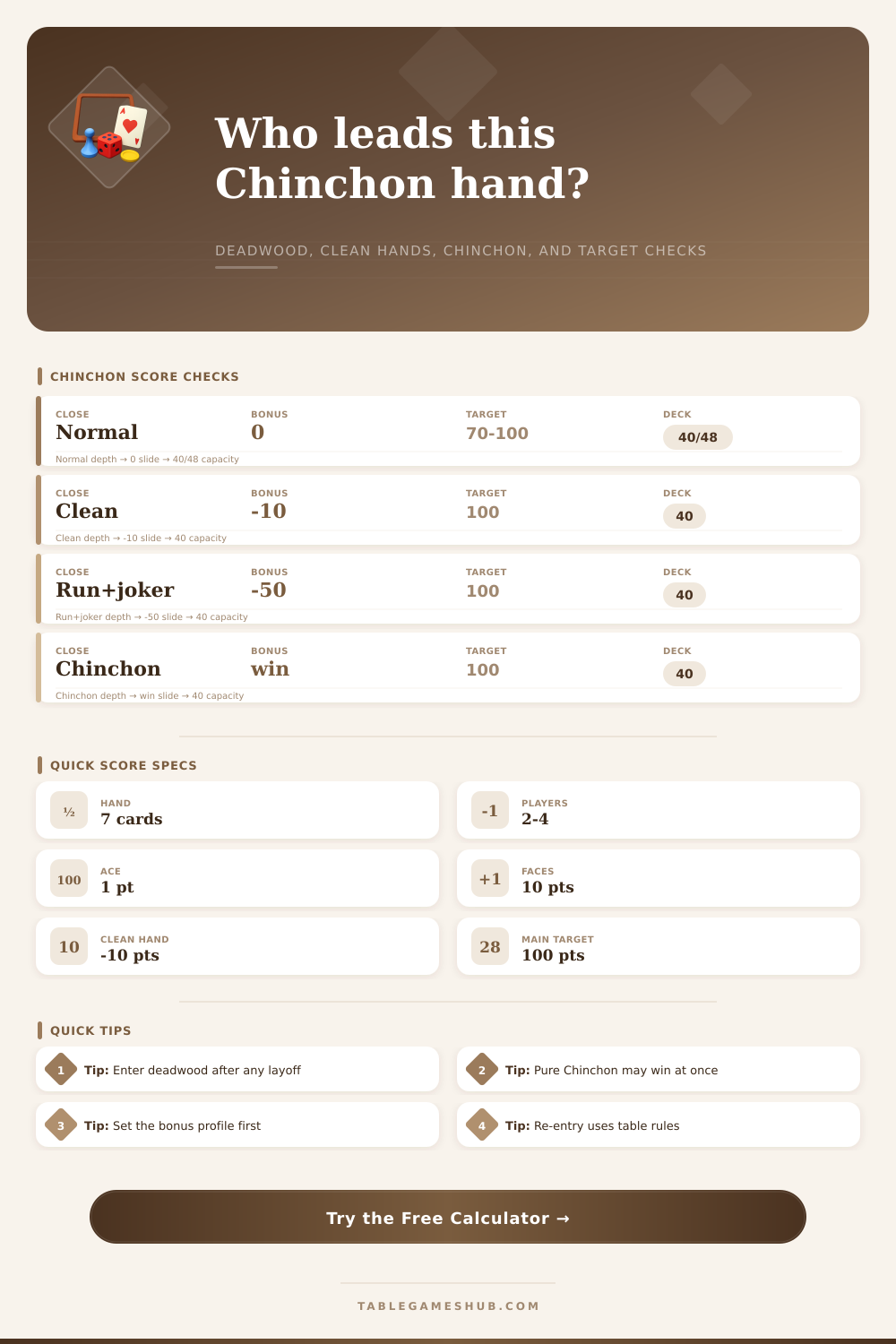
Where the game change is special hands. Typically, a special hand (where all cards are melded) will reverse the race, what was a penalty round turns into a recovery round. You subtract ten points from your score rather than adding them. And that’s not even getting into a pure Chinchon run, which can either apply a huge negative bonus or end the match right then and there. So making sure everyone know the rules before they deal is important, as this could be the difference between a point deduction and an instant win! Our tool includes a reference table showing those variations so there’s never any confusion about what happens when someone lays down a seven-card straight on the table.
Strategy is largely shaped by re-entry rules as well. Depending on the table, once a player has gone over their target score, they’re out unless it’s okay to re-enter at whatever the current high score is or one short of the limit. It change the aggressiveness players use in later rounds. With reentry, nobody is really out till the bitter end so everybody remains dangerous. Without it, players near the cutoff will play conservatively to avoid going over, while others may push for the bonus points. Use the calculator to enable or disable those options. This shows you exactly what happens with your own agreed upon rules instead of just guessing that normal elimination rules applies across the board.
In the transition between rounds, there is always a chance for mistakes to occur in updating scores and forgetting about bonuses. An unnoticed joker run bonus can throw the leader board way out of whack. At the same time, not accounting for a clean-hand discount can cost a player points they worked hard to earn. Tracking a running total on paper is possible but is susceptible to human error after many hours of play. By using digital tracking we can ensure each player has consistent adjustments from special close caps to face-value changes.
In the end, Chinchon is as much about memory and patience as it is about ability. You must remember which cards have been played and guess what others are holding. And then there is the math. Emotions will run high once scores come down close to the target and you have to rely on the math more than ever before. Whether playing for fun or competing competitively, it’s nice to know how you’re doing in a reliable way that lets you focus on strategy instead of scorekeeping disputes. When people agree on the numbers the game flows smoother. A tool to resolve the mathematics lets the true contest come to the front. Just as a clean hand sweeps deadwood from your table, a clean scorecard sweeps away doubts. This allows you to focus on the next hand without worrying if someone else is actualy leading.