🌾 Agricola Score Calculator
Track and calculate scores for all players across all scoring categories — instantly determine the winner
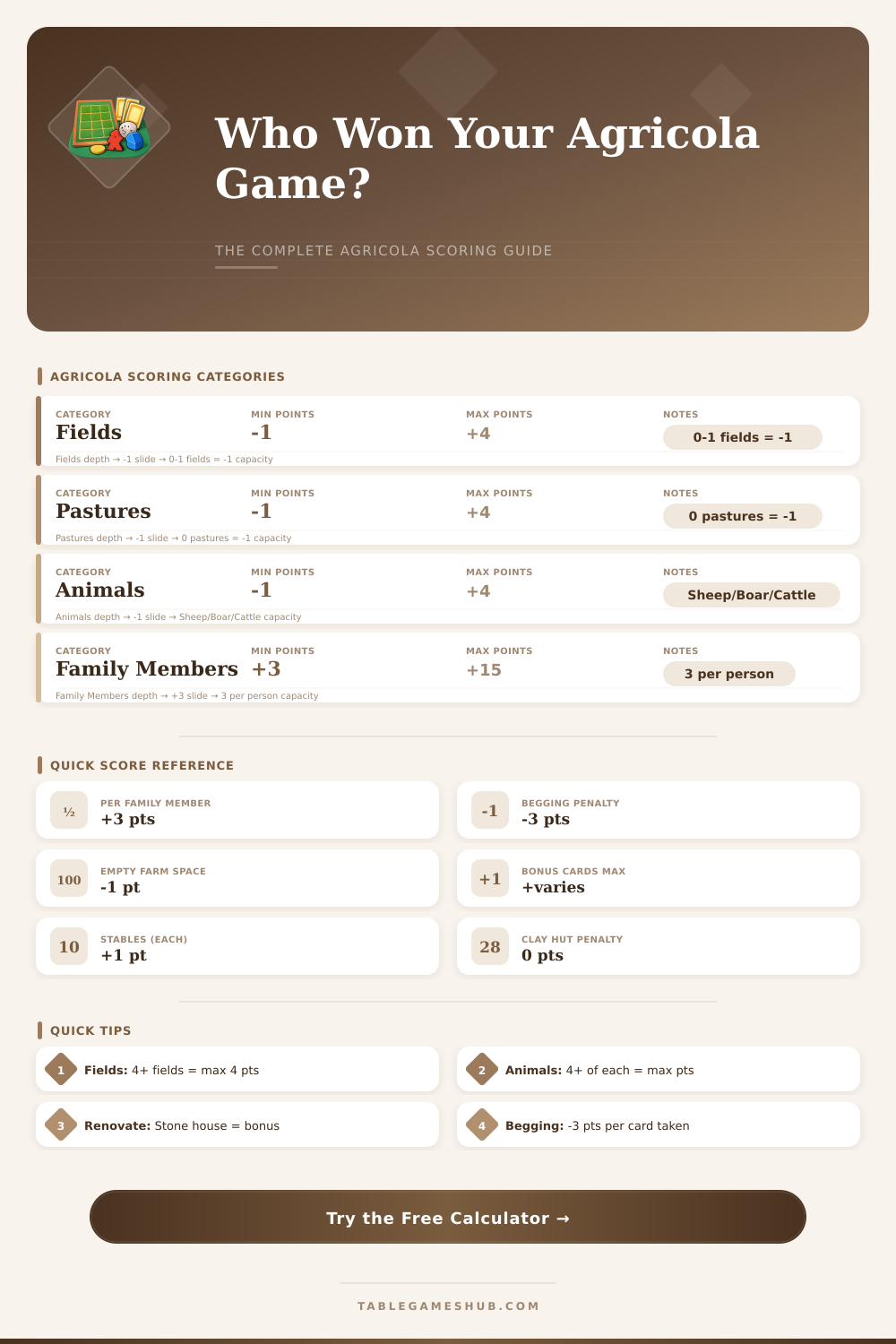
| Category | 0 / None | 1 | 2 | 3 | 4+ |
|---|---|---|---|---|---|
| Fields | -1 | 1 | 2 | 3 | 4 |
| Pastures | -1 | 1 | 2 | 3 | 4 |
| Grain (tokens) | -1 | 1 | 2 | 3 | 4 |
| Vegetables | -1 | 1 | 2 | 3 | 4 |
| Sheep | -1 | 1 | 2 | 3 | 4 |
| Wild Boar | -1 | 1 | 2 | 3 | 4 |
| Cattle | -1 | 1 | 2 | 3 | 4 |
| Unused Farm Spaces | 0 | -1 | -2 | -3 | -n |
| Fenced Stables | 0 | +1 ea | +2 | +3 | +n |
| Family Members | 0 | +3 | +6 | +9 | +3n |
| Component | Count (Standard) | Count (Revised) | Notes |
|---|---|---|---|
| Farm Board Spaces | 15 | 15 | 3x5 grid per player |
| Room Tiles | 2 (start) | 2 (start) | Max 5 rooms possible |
| Family Member Tokens | 2 (start) | 2 (start) | Max 5 members |
| Occupation Cards (per player) | 7 | 7 | Varies by deck used |
| Minor Improvement Cards | 7 | 7 | Shared deck available |
| Major Improvement Tiles | 10 | 10 | Shared, first-come basis |
| Action Spaces (base) | 17 | 20 | More in revised edition |
| Round Cards (stages) | 14 | 14 | 6 stages, 14 rounds |
| Player Count | Low Score | Average Score | High Score | Avg Game Time |
|---|---|---|---|---|
| 1 Player (Solo) | 20 | 35–40 | 55+ | 45 min |
| 2 Players | 18 | 30–38 | 50+ | 75 min |
| 3 Players | 15 | 28–36 | 48+ | 105 min |
| 4 Players | 12 | 25–34 | 45+ | 135 min |
| 5 Players | 10 | 22–32 | 42+ | 165 min |
Agricola is a board game by Uwe Rosenberg about farm life, in that you pass 14 rounds to build the farm of your family from nothing. The main idea is to turn empty ground into a blooming farm with crops animals and bigger buildings, while you make sure that your family does not go hungry. You place workers that you send across the board to gather resources or improve your land, and almost everything that you do affects your Score somehow or otherwise.
Mixing of parts gives you bonus points. The first grain that you gather changes your Score from minus one to plus one… So it is worth two points.
How to Score in Agricola
Later every extra grain brings less benefit. All your grains and vegetables count, whether they are planted or stored. Without any grain you lose one Score, but one grain gives one, four grains two, six three and eight or more give four points.
About vegetables the same happens: none costs one Score.
The buildings matter more than one would think. Clay sheds are worth each one point, so four clay rooms give four points. Stone houses jump too two points per room, which makes four stone rooms eight points.
Any ground that you leave without farming at the end of the game reduces your Score. And if you end with not enough sheep, that is yet one point cost.
Feed your family is not optional. The harvest happens in the 4th, 7th, 9th, 11th, 13th and 14th rounds. Every worker requires two food to last every harvest.
If you do not give them food, you take a begging card, that reduces your Score.
At the end of the game you add points from all those groups. The player with the highest total wins. There are online calculators and apps just for that, so you do not have to do the whole math yourself.
There is a Score card that works for the basic game and for Farmers of the Moor, which helps to save time for number work and gives more fun from the game itself.
The scores change based on your game. Experts commonly reach from high forties to middle sixties, and that depends on the number of players. Reaching sixty is a good achievement.
One player mentioned his record of fifty-nine. Passing fifty-five is a common target. Newcomers can end with twenty down to negative scores.
In a solo game it can be hard, with points commonly in thethirties and forties.
Agricola seems tough at the start, but a good Score later makes it worth it. The game has a lot of ways to score, so each game differs. You also have random job cards and small improvements, that change your plan every time, and that is why folks repeatedly play.