♟ Chess Puzzle Calculator
Analyze puzzle difficulty, piece combinations, move probabilities & pattern frequencies
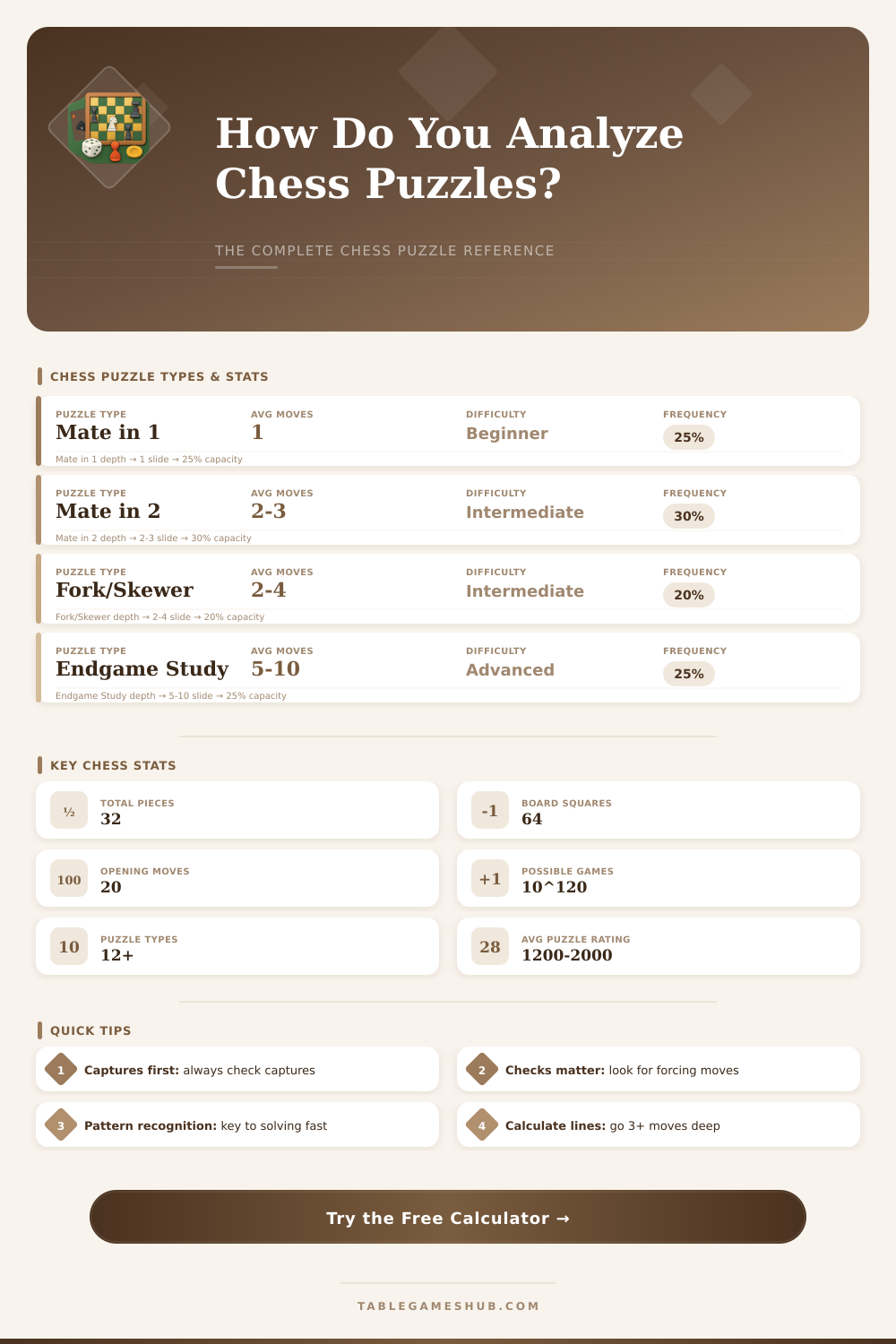
| Puzzle Type | Typical Depth | Rating Range | Avg Solve Time | Key Pattern |
|---|---|---|---|---|
| Mate in 1 | 1 move | 800–1000 | ~10 sec | Direct checkmate |
| Mate in 2 | 3 ply | 1000–1400 | ~60 sec | Forcing sequence |
| Mate in 3 | 5 ply | 1400–1800 | ~3 min | Combination |
| Fork / Double Attack | 2–4 moves | 1100–1500 | ~90 sec | Knight / Queen fork |
| Pin & Skewer | 2–3 moves | 1200–1600 | ~2 min | Line piece tactic |
| Discovered Attack | 2–4 moves | 1300–1700 | ~2 min | Unmasking |
| Endgame Study | 5–15 moves | 1600–2200 | ~10 min | K+P technique |
| Pawn Promotion | 3–6 moves | 1400–1900 | ~4 min | Queening race |
| Deep Combination | 6–10 ply | 1800–2400 | ~15 min | Multi-piece sacrifice |
| Defensive Study | 4–8 moves | 1600–2100 | ~8 min | Counterplay & draw |
| Piece | Point Value | Max Moves (open board) | Count Per Side | Special Moves |
|---|---|---|---|---|
| King | ∞ (infinite) | 8 | 1 | Castling |
| Queen | 9–10 | 27 | 1 | — |
| Rook | 5 | 14 | 2 | Castling |
| Bishop | 3–3.5 | 13 | 2 | — |
| Knight | 3 | 8 | 2 | Jumps over pieces |
| Pawn | 1 | 2 | 8 | En passant, promotion |
| Board Type | Square Size (in) | Square Size (cm) | Board Size (in) | Board Size (cm) |
|---|---|---|---|---|
| Tournament Standard (FIDE) | 2.17–2.36" | 5.5–6.0 cm | 17.3–18.9" | 44–48 cm |
| Club Standard | 2.25" | 5.7 cm | 18.0" | 45.7 cm |
| Casual / Travel | 1.5" | 3.8 cm | 12.0" | 30.5 cm |
| Vinyl Roll-up | 2.0" | 5.1 cm | 16.0" | 40.6 cm |
| Giant Outdoor | 4.0–6.0" | 10–15 cm | 32–48" | 81–122 cm |
| Computer Screen (HD) | ~0.8" | ~2 cm | ~6.4" | ~16 cm |
| Depth (half-moves) | Avg Branches | Total Nodes | Exact Positions |
|---|---|---|---|
| 1 (1 full move) | 20 | 20 | 20 |
| 2 | 20 | 400 | 400 |
| 4 | 30 | ~8,900 | 8,902 |
| 6 | 30 | ~9.1M | 9,132,484 |
| 10 | 35 | ~70B | ~7 × 10^10 |
| 40 (full game) | 35 | ~10^123 | Shannon number |
Chess Puzzle is made up of a Chess position, in that one uses logically the knowledge about pieces and rules for solving a problem about Chess. For instance it can involve something like “mate in two” or simply identify the best move. The origins of those Puzzle extend until the Middle Ages, and they continuously evolved from then until now.
Solving a Chess Puzzle commonly must find a sequence of moves, sometimes only one alone, that delivers to the player clear superiority. Such superiority maybe will be checkmate, capture of material or a final position much more strong for the whole army. One sorts Puzzle likewise as problems, those always attend in various forms.
How Chess Puzzles Help You Get Better
One platform offers more than 500 000 Puzzle for training with them. Between the options presents Puzzle-Run, Puzzle-Fight, daily Puzzle and saved Puzzle, where one chooses details about themes. Except that, various websites deliver free tactical Chess exercises online.
One from them include tactical training, used already by more than 20 000 players. For young players serve more than 50 000 problems fit for children, that ranges from beginning untli advanced levels.
Many websites about Puzzle update their content daily. One from them present three grades of difficulty. To enter the solution, one clicks the piece and draws it to the intended field.
During the weak Puzzle become roughly more difficult, what contributes to the sharpening of tactical spotting according to the time. Some Puzzle receive updates from daily sets of grandmaster training, so that everything stay fresh and so that the thought stay active.
Also speed plays a role. The more quickly one solves a Puzzle, the bigger becomes the score. One can trace progress and statistics to observe the growth according to the time.
One platform even takes wrong tactics from games and converts them in built-in courses, that stays always present. One repeats them so many times, as far as needed.
Coming to a Puzzle, it is useful to first calm yourself, check the material and clearly understand the threats of the opponent together with possible ideas, before one jumps to tactical patterns. Puzzle one best practises in a dedicated space. Even after one finds the right move, it helps to study it repeatedly.
Every Puzzle has one best move, and always exist reasons, of where the other possible moves fail. Learn to explain, because of what a certain move is the solution, builds skills, that directly apply in actual games.
Solving Puzzle teaches different tactical patterns. Spending time on Puzzle genuinely contributes to the improvement in Chess. The calculation matters especially in the middle and end phase of a game, and Puzzle exactly train that skill.
One player passed from low ranks between 800 and 1000 points until peak around 2100 in Puzzle, thanks to some months of focused practice. Some Puzzle come fromcomputer engines and later get filtered manually, while human run collections commonly feel more pleasant to solve.