Canasta Red Three Calculator
Score red threes as a bonus or penalty, add completed canastas, subtract black threes left in hand, and see the net score impact for the hand.
| Red Threes Held | If Team Melded | If Team Never Melded | Score Note |
|---|---|---|---|
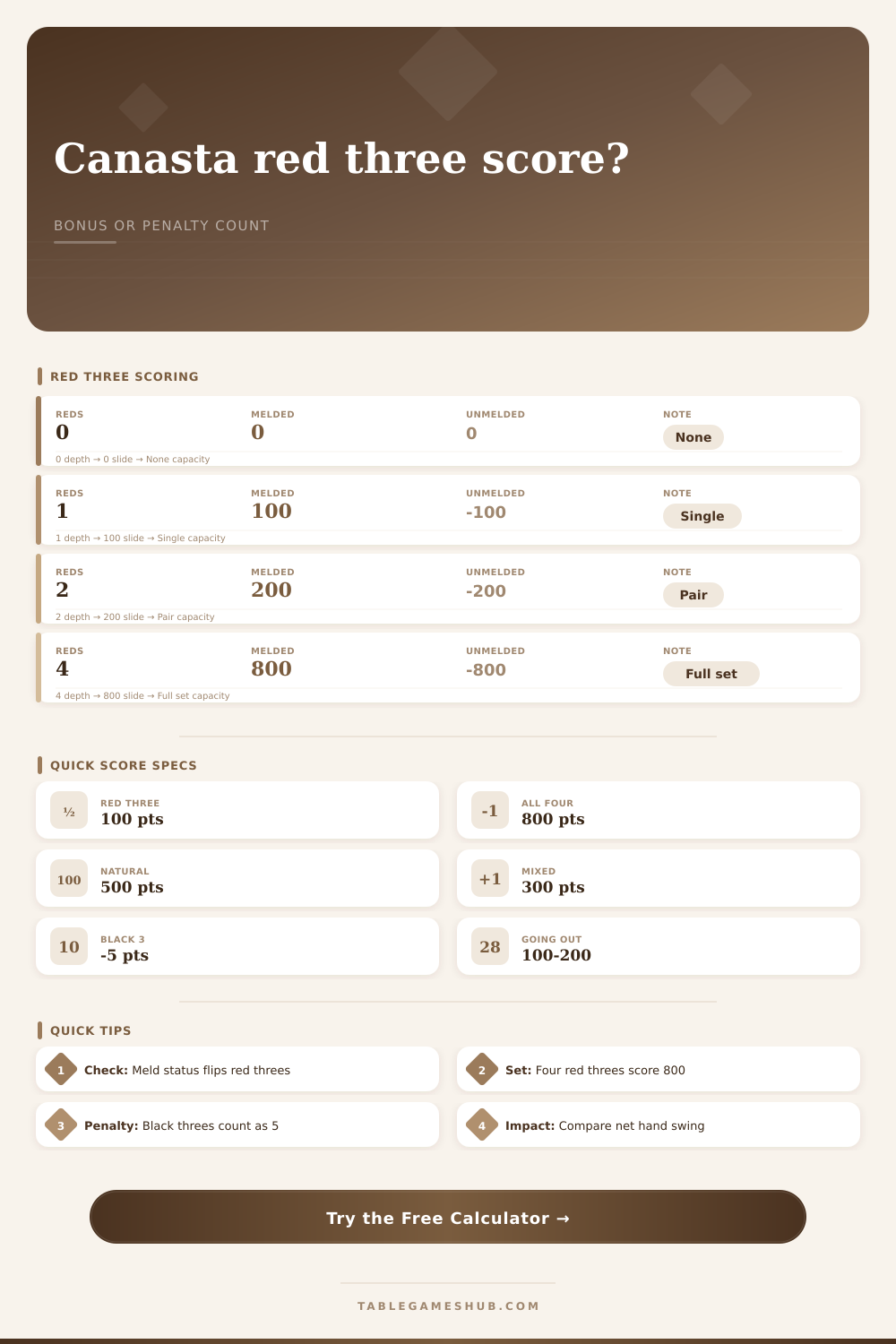
| 0 red threes | 0 points | 0 points | No red-three score is added or subtracted. |
| 1 red three | +100 points | -100 points | The meld status flips the sign of the red-three count. |
| 2 red threes | +200 points | -200 points | Each red three is counted separately unless all four are held. |
| 3 red threes | +300 points | -300 points | Three red threes do not receive the all-four total. |
| 4 red threes | +800 points | -800 points | Standard mode doubles the four-card set from 400 to 800 total. |
Some tables use a simple house count of 100 per red three. Choose simple mode when your score sheet does not award the four-red total.
| Score Item | Point Value | Counts With Red Threes? | Calculator Treatment |
|---|---|---|---|
| Natural canasta | 500 points | Yes | Multiplies by the number of natural canastas entered. |
| Mixed canasta | 300 points | Yes | Multiplies by the number of mixed canastas entered. |
| Going out | 100 points | Yes | Adds 100 when standard going out is selected. |
| Concealed going out | 200 points | Yes | Adds 200 when concealed going out is selected. |
The canasta and going-out values are kept separate in the breakdown so red-three score impact remains easy to audit.
| Black Threes Held | Card Count Value | Penalty Applied | Score Impact |
|---|---|---|---|
| 0 black threes | 0 card points | 0 points | No end-hand black-three deduction. |
| 1 black three | 5 card points | -5 points | Subtract five from the team's hand total. |
| 2 black threes | 10 card points | -10 points | Two black threes are counted as ten negative points. |
| 3 black threes | 15 card points | -15 points | Three black threes create a small card-count drag. |
| 4 black threes | 20 card points | -20 points | All four black threes still count by ordinary card value. |
Black threes are included only as end-hand card-count penalties here. This calculator does not score special table-specific black-three meld variants.
| Red Threes | Standard Melded | Standard Unmelded | Simple Melded | Simple Unmelded |
|---|---|---|---|---|
| 1 red three | +100 | -100 | +100 | -100 |
| 2 red threes | +200 | -200 | +200 | -200 |
| 3 red threes | +300 | -300 | +300 | -300 |
| 4 red threes | +800 | -800 | +400 | -400 |
The gap between standard and simple mode matters only when one team has all four red threes.
Canasta’s most poorly understood card is the red three. This card will either save your team or ruin it. It lies dormant on the table, ready to erupt and either add a hundred points to your score or subtract them. Most of the time, you’re holding onto it, waiting to use it to meld, treating it as a high-value asset when, in fact, it wasn’t part of a meld at all; suddenly you’ve got a hundred point deficit instead of a hundred point bonus. It is a mean trick that wrecks far more nights than any bad luck ever could.
Once you know where you stand with respect to your hand, the calculator above do the rest for you, eliminating the stress of having to second-guess yourself in front of an audience.
How to Score with Red and Black Threes
To understand what’s going on with the wild swing of red three, we have to look at meld status. Because this is the only card that determines friend and foe. As long as you’ve managed to place some cards down on the table then the red threes is considered positive points. You get a hundred for each one of them or eight hundred if by miracle you manage to pull off the whole set. That is an incredible score boost. This basically doubles potential points of these four cards in combination. On the flip side, if you never made it onto the table then these same cards turn into negative points. And the penalty matches the bonus point for point. The difference between having nothing and having something is pure skill in making that initial meld.
Most players easily overlook black threes, but they don’t realize it until it’s too late. When the round closes, any black threes in your possession has their five points deducted from your total. While five points may seem insignificant now, multiply this by several hands and it adds up. By default, the tool will deduct these cards automatically so you have a clear view off where you actualy stand.
A seemingly harmless hundred-point bonus for a red three does negate your little error in judgment somewhere else, right? Wrong. Two black threes chipping away at your winnings silently drain your advantage. This could turn a win into a loss over the course of the night; it is small, but it matters.
The final tally is also affected by Canasta bonuses. There are two types: five hundred points for a natural canasta (all natural cards) and three hundred for a mixed one (with wild cards). While they don’t affect the red three count, these bonuses does play into the strategy itself. You may be sitting there holding all four of the red threes. They look very nice, I’m sure. But unless you can use them to create a canasta so that you can go out, that red three bonus won’t be enough to offset points your opponents score. The red three’s a mercenary card. It pays well, but it won’t help you win the round alone.
The going out complicates things further. Going out with an open hand get a one-hundred-point bonus. Going out with a closed hand gets a two-hundred-point bonus. The going-out bonus is the reward for secrecy. Holding all four red threes and going out concealed is stacking maximum bonuses on top of each other: rare and glorious.
Usually you’re trying to limit the damage. Are you ahead or behind in the score? Do you have to know whether it’s safer to play defensively and get a little meld, or chase a large canasta, risking that you’ll end up unmelded? It’s well explained in the reference table on the page, it shows what each score changes to under the simple house rules and how it is different than standard. Some tables pays a straightforward hundred for each red three card, no matter how many you have. Others remain strict at eight-hundred total for all four. Before anyone deals the cards, it might of been best to check what version your table plays. One or two cards doesn’t change much, but if you get all four in a rare hand, the payoff can be large.
Red three isn’t just a matter of luck; it’s also a matter of timing. If you can learn when to play a wild card to help your partner in melds, then red threes stops being liabilities and start becoming assets. Keeping tabs on black threes is important, too, they should be discarded whenever possible so as not to incur the end-hand penalty. This involves managing risk. Each card in your hand have a story, and the red three is most dramatic of all. Play it well, and it will pay. Play it poorly, and it will cost. The difference between bonus and penalty is a fine one, but it is a line drawn by what gets on the table.