At Least One Six Calculator
Calculate the chance of rolling one or more six-equivalent results across dice pools, turns, rerolls, advantage modes, and exact count comparisons.
0%
chance of reaching target
0%
chance target does not happen
0%
chance of exact count
0.00
average six-equivalent results
At Least One Six by Pool Size
| Dice Pool | No Reroll | Reroll Misses | Pool Advantage |
|---|---|---|---|
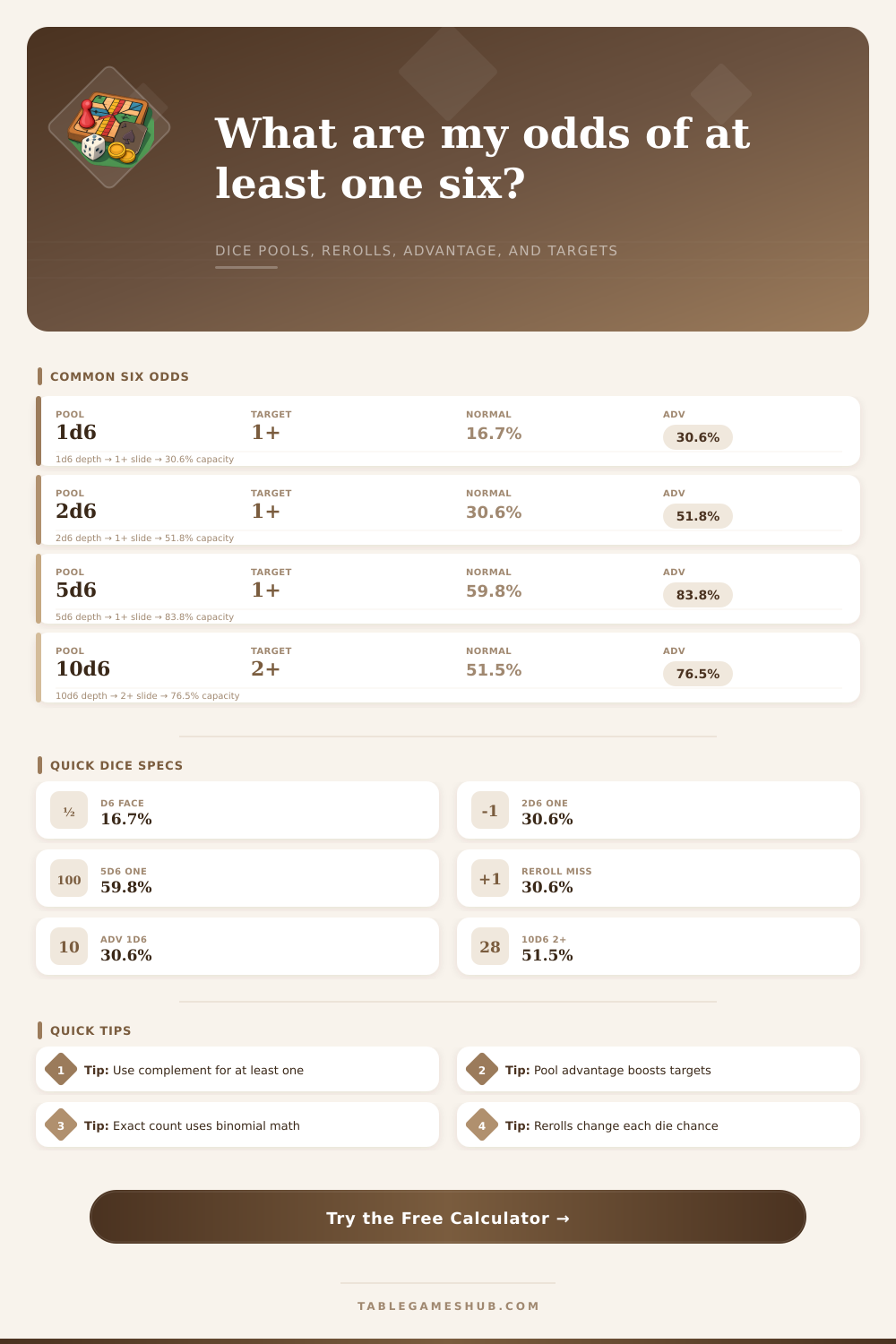
| 1d6 | 16.7% | 30.6% | 30.6% |
| 2d6 | 30.6% | 51.8% | 51.8% |
| 5d6 | 59.8% | 83.8% | 83.8% |
| 10d6 | 83.8% | 97.4% | 97.4% |
Six-Equivalent Face Setup
| Die Type | Six Faces | Single Roll | Use Case |
|---|---|---|---|
| d6 standard | 1 | 16.7% | classic six |
| d6 two symbols | 2 | 33.3% | custom icons |
| d10 special | 1 | 10.0% | rare symbol |
| d20 target | 1 | 5.0% | single face |
Reroll and Advantage Meaning
| Setting | Per-Die Model | Best For | Note |
|---|---|---|---|
| Reroll ones | p + 1/s x p | house rules | one face retries |
| Reroll misses | 1 - fail² | full retry | strong boost |
| Die advantage | 1 - fail² | single dice | keep success |
| Pool advantage | max of pools | target counts | compares totals |
Current Exact Count Distribution
| Six Count | Exact Odds | At Least | Status |
|---|---|---|---|
| 0 | 40.2% | 100% | sample |
| 1 | 40.2% | 59.8% | target |
| 2 | 16.1% | 19.6% | compare |
| 3 | 3.2% | 3.5% | tail |
You’ve rolled five dice. Maybe the stakes are only that high in your head. Yet now you require a six. One. And the tension isn’t in watching for whether any particular die will produce it. It’s in watching them all fail to do it together, here is the trap that our intuition betrays us most consistently.
Seeing that there is a small chance of any single success, we conclude that such modesty must exist across the entire group. But this time you’re not making a bet against some specific die being missed; you’re making a bet against them all being missed which stacks the odds faster then your gut can expect.
Why Dice Pools Work
That’s what the calculator above does for you after you input your pool and rules; it spits out the answer without forcing you to multiply fractions by hand till your brain revolts. Knowing how those numbers work, though, knowing why they work that way, are better than simply reading a number off the screen.
The fundamental trick here is this. It is the complement rule. You don’t have to count all the different ways you can succeed at something with one success, or two, or three; you only need to know the probability that you’ll fail at everything and then subtract that from 100% to get an answer.
It is a small thing but it makes a difference. Most folks attempt to total the chances of all the ways things could go right. Messy business. Ineptitude invites. The losing scenario are always the same. Everything goes wrong. Nothing goes right.
Adding in mechanics like advantage or reroll simply alters the starting probability before even doing the pool math. With a standard six-sided die, you have a one-in-six chance, a little over sixteen percent. Rerolling ones make it more likely that the lowest number will come up again. It makes a small difference, but it’s important to keep in mind: now that’s your new baseline and you’re going to multiply it by however many dice is in your pool. A slight increase in your odds-per-die amounts to a big increase in the odds of your whole pool.
You can see that in the reference table on the page. It shows exactly how much rerolling misses improves your odds for typical situations. It almost doubles those odds if you have small pools.
Pool advantage is different than die advantage. Both sound similar, but they work differently on the ground. For example, die advantage is where you re-roll each die individually and keep whichever die rolled best. Pool advantage is where you roll all of your dice at once, then do that again (and keep the best pool of dice). So there’s a little nuance to it, but when you’re trying to hit some specific target, say, needing at least two sixes, versus one or more. It makes a big difference. One protects every single die against bad luck. The other provides a backup plan if your whole attack goes south.
The curve also flattens out as your pool increases which is important to note. In absolute terms, going from one die to two doubles your success chance, but going from ten dice to eleven adds very little because you were already likely to succeed with ten. You are more or less guaranteed a success by then. But this law of diminishing returns is key for strategic play and game design.
The largest pool isn’t always what you should of aim for. You want the most efficient pool that gets over your probability threshold. For example: Hitting 1+ targets vs. You are hitting exactly n targets. For instance, in some table top games, you get something extra if you hit exactly 3 (as opposed to any number above). The tool can distinguish this and allows for separating out overall success from that sort of scoring event. Knowing the distribution exacty lets you avoid over-estimating your odds for those sort of bonuses on the edges.
At the end of the day, though, dice pools are all about mitigating risk with redundancy. You’re exchanging volume for reliability. One die is pure variance. Ten is almost certain. And it’s the gap in between where the magic lies, where changing one rule or count can make the difference between something being likely or unlikly. Because it’s not just about rolling well; it’s about constructing your rolls such that there is no statistical likelihood of missing anywhere.
That transition from hoping to expecting is the difference between making an informed strategy versus making a casual guess. You move from whether you will be lucky to knowing how likely you are to win.