Altiplano Warehouse Calculator
Plan storage row starts, corn pressure, village timing, and overflow reserve before you lock goods into your warehouse.
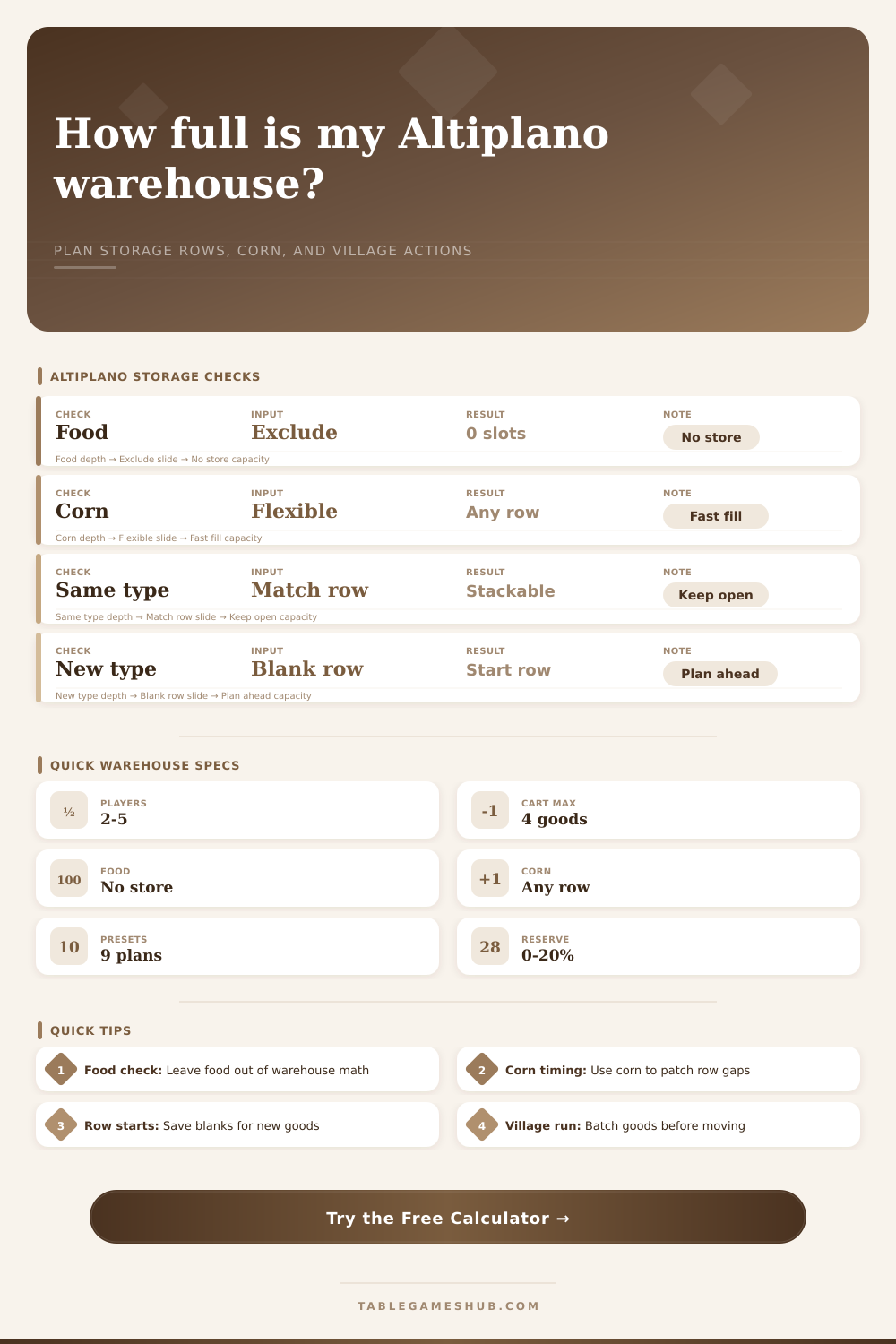
| Storage element | Warehouse effect | Calculator input | Planning note |
|---|---|---|---|
| Food | Excluded from warehouse scoring and placement | Leave out of waiting goods | Do not spend rows on it |
| Corn | Flexible warehouse filler | Corn entering now | Best used to patch odd row pressure |
| Same goods type | Works with an already matching row | Open matching rows | Preserve matching rows when possible |
| New goods type | Needs a new row start if no match exists | Empty row starts | Scarce near the end of the game |
| Village action | Turns waiting goods into warehouse progress | Goods waiting and profile density | Batch goods before visiting the village |
| Altiplano goods profile | Common cargo | Action density | Storage pressure |
|---|---|---|---|
| Alpaca and wool start | Alpaca, wool, cloth | 2 goods per run | Low if one row is open |
| Harbor fish and stone | Fish, stone, wood | 3 goods per run | Medium from mixed types |
| Mine ore to silver | Ore, silver, stone | 2 goods per run | High when silver arrives late |
| Cacao market hold | Cacao, cloth, glass | 2 goods per run | High if rows are already named |
| Completed order spillover | Corn plus leftover goods | 3 goods per run | Variable, corn absorbs gaps |
| Storage situation | Good mix | Suggested timing | Calculator warning |
|---|---|---|---|
| One matching row open | Mostly same type | Delay until two or more goods collect | Usually low |
| No matching row open | Two or three new types | Store before adding more variety | Medium to high |
| Corn enters with goods | Corn plus leftovers | Use corn where row shape is awkward | Risk drops if blanks remain |
| Endgame compression | Several unmatched goods | Reserve blank rows for valuable types | High when blanks run out |
| Preset | Typical goods | Warehouse shape | Use when |
|---|---|---|---|
| Beginner Alpaca Row | Alpaca, wool, cloth | One match, two blanks | You are starting your first scoring row |
| Harbor Fish Pair | Fish and stone | Two matches, one blank | Harbor goods are already cycling |
| Mine Ore Silver | Ore, silver, stone | Few matches, two blanks | Mine output arrives unevenly |
| Order Completion Corn | Corn plus leftovers | Corn-heavy, mixed goods | An order creates storage spillover |
But eventually, after enough games that you notice your warehouse is overflowing with different wares; after you’ve realized you can’t fit anything else into any row because all the rows are taken… Altiplano ceases to be a logistical conundrum and becomes instead a snare.
You’re in the village now, carrying three distinct kinds of cargo, yet you only have two open spots on the shelf and none of them match what you’re holding. It’s high-stress, panic-inducing stuff. Yet if you shove things anywhere just to make them fit? You lose points. You get points. And that’s the distinction between having a scoring engine versus a chaotic storage round: foresight. Or rather, it is anticipating exactly how many empty rows you will need long before you reach the village tile.
Plan Your Storage Before You Play
Storage is something most players think about AFTER putting tiles down on the table. Wood came from somewhere so I’ll grab some wood. Fish came from somewhere too so I’ll grab some fish. Never mind that I need two different types of slots to store both wood and fish! If you don’t have one row dedicated specifically to fish, and another row dedicated specifically to wood, you’re going to have to start taking corn to make room or wasting actions.
Corn is the great equalizer. It goes everywhere and can act like duct tape in your warehouse strategy. But when you use duct tape, that means you’re fixing problems rather than executing a plan.
When you input your existing inventory, this little tool (above) do the math for you. You won’t have to run through all the different combinations of rows and items in your head to see if you’re one row away from bottling up. The tool will let you know whether your existing mix is sustainable or not.
What is the most critical input? It is not the total amount of goods, but the number of different kinds of goods. It’s simple to manage a stack of ten identical wool tiles; all you need is one row start. On the other hand, having a single tile of each, a wool tile, a fish tile, and an ore tile, is a nightmare. That requires three row starts.
Early in the game, there are plenty of blank rows, and you can afford to get messy with them. Mid-game, there isn’t many. Late game, they’re a luxurios resource, something you should never use for one-off items.
This is where the calculator points out the struggle between your available blanks and your new types. When it tells you you’re short on starts, don’t ignore it, that warning will show up as your future scoring potential crashing.
What about food? You may ask why I leave out food completely. Food doesn’t exist in the warehouse; it is consumed or ignored. Leaving food out of your mind will help you focus on what matters: compressing your non-food stuff into as few rows as possible.
That’s where the presets will help; they’re moddern models of some common strategic lines, such as the mine silver chain, or the harbor fish cycle. What makes those chains work is that they predict how goods will flow. If you’re headed towards silver, you probably want ore before silver. If you have a row for ore, there’s a good chance you’ll be getting a row for silver soon. Making plans for that line helps you avoid starting over.
That’s assuming they aren’t doing something else, like upgrading their market or building their house. Storage trips to the village are actions. So you want to try to batch them up. If you only need one more item to complete a row, wait until then before going to the village. Or if you can use one of those flex slots on corn, wait until you get there. That will save you an action.
But you don’t want to wait too long (risking overflow). If your warehouse is full, and you draw an item that you can’t fit, you’ll be forced to pass or discard. The risk setting in the tool lets you adjust for this buffer. Ten percent is generally safe. Twenty percent is paranoid, but wise when the board is tight.
Bad planning kills in the endgame. As the supply of goods runs out, what’s left is usually a mix of valuable and diverse goods. There is no room for starting new ones! What do you need? Flexibility. Matches. Corn.
That’s why, if you’ve been matching and saving blanks, you’ll sweep through the final round easily. If you’re picking up what’s needed at the moment, your opponents will be scoring points as you shuffle tiles. It’s simple math. Following it requires a lot of self-discipline. And that’s the difference between the winners and everyone else.
Plan for the rows, not just the goods in-hand.