Bridge Quick Trick Calculator
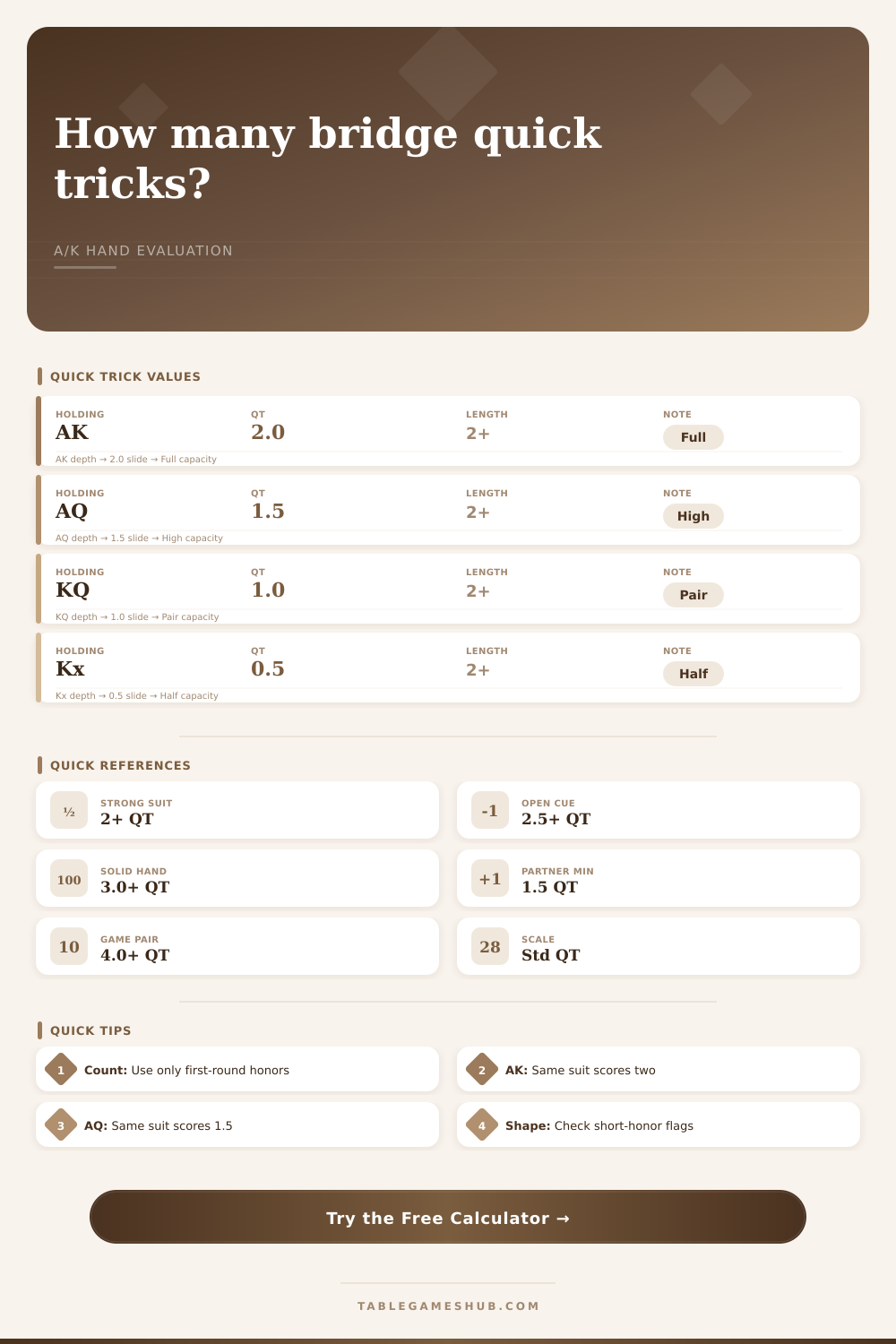
Total quick tricks from A/K suit holdings, AK/AQ/KQ combinations, suit length, and a partnership combined estimate for numeric bridge hand evaluation.
| Holding entered | Base quick tricks | Length note | Calculation meaning |
|---|---|---|---|
| AK or AKQ in one suit | 2.0 QT | Works with 2+ cards | Counts the first two rounds as controlled by ace and king. |
| AQ or AQJ in one suit | 1.5 QT | Works with 2+ cards | Ace is one full quick trick plus queen support as a half. |
| A only | 1.0 QT | Any length with ace shown | Ace control counts as one immediate quick trick. |
| KQ in one suit | 1.0 QT | Usually needs 2+ cards | King-queen sequence is counted as one quick trick. |
| K guarded | 0.5 QT | Needs length in guarded modes | A king with another card is counted as a half quick trick. |
| No A/K holding | 0.0 QT | No immediate control | Queens and jacks alone are outside this quick-trick scale. |
| Length entry | Shape status | Honor audit | Calculator treatment |
|---|---|---|---|
| 0 cards | Void | No holding should be entered | Strict and guarded modes reduce suit QT to zero. |
| 1 card | Singleton | Ace can count; K, AQ, KQ conflict | Strict mode limits non-ace combinations. |
| 2 cards | Doubleton | AK, AQ, KQ, Kx are structurally possible | Full standard quick-trick values are available. |
| 3 cards | Three-card suit | All listed holdings are possible | No length reduction is applied. |
| 4 cards | Four-card suit | All listed holdings are possible | Used in the shape total and top-suit display. |
| 5+ cards | Long suit | Honor value still uses first two rounds | Length is flagged separately from quick tricks. |
| Combined estimate | Numeric band | Hand total share | Use in calculator |
|---|---|---|---|
| Low combined controls | 0.0 to 2.0 QT | Few first-round controls | Displays as a low partnership control total. |
| Moderate combined controls | 2.5 to 3.5 QT | Typical mixed A/K assets | Displays as a moderate partnership total. |
| Strong combined controls | 4.0 to 5.0 QT | Several ace or AK sources | Displays as a strong partnership total. |
| Very high combined controls | 5.5+ QT | Multiple top-honor combinations | Displays as a very high partnership total. |
| Preset | Core holdings | Length pattern | Numeric focus |
|---|---|---|---|
| Balanced two-ace hand | A, A, K guarded | 4-3-3-3 | Shows aces plus a half trick. |
| AK plus AQ opener | AK and AQ | 5-3-3-2 | Highlights 3.5 hand quick tricks. |
| Two KQ suit pairs | KQ and KQ | 4-4-3-2 | Separates sequence tricks from aces. |
| Long spade AK focus | AK in spades | 6-3-2-2 | Shows length is audited separately. |
| Short king warning | K with short length | 1-5-4-3 | Demonstrates guarded or strict reduction. |
That’s why you’re sitting there, staring down at those kings and aces as if they will magically fix your bidding woes. They don’t. That is lesson number one: How to evaluate bridge hands.
So what if you’ve got 12 high card points? Normaly you’d open, right? But maybe those points is stuck in the middle of a couple long suits, no immediate winners. Then you are flying blind.
How to Check Your Quick Tricks
Immediate control is measured in quick tricks. Does your partnership really has a chance to take first few tricks before defense gets moving on them? The calculator up top do the math for you after you input suits you hold. This saves you from having to guess value of that singleton king; is it dead weight or does it count for something?
After all the jargon is stripped from it, the concept is surprisingly simple. Your side is going to play a trick that will be an immediate winner (or at least on following round), no matter what they have in their hands.
The undisputed champ in this category are an ace. Win on the first try. That’s always a full quick trick.
Next up is a king. Unless it’s guarded, a king is only half a quick trick. In other words, unless the opponent cards are something else like an ace and a 10 guarding the king, it’ll probably win the second time around (assuming the ace hasn’t gone yet), or assuming the suit breaks right.
If you have nothing but a king, then it’s essentially zero. Maybe you’ll get lucky if the opponents ace is doubleton. But don’t count on it. It is a hope, not a fact.
Honor combos, When you get an honor combo it multiplies the value of the honors sitting next to each other. The value varies by combo, an AK is worth two, an AQ is 1.5, and a KQ is one.
One for the ace on the first round and one for the king on the second. That’s two solid tricks. No fumbling around.
The Ace and Queen are worth one and a half tricks. The King can be awkward sometimes. Otherwise, the Ace will grab the trick, and the Queen should of been strong enough to win next one.
The King & Queen is only worth a single trick, and it is usually a quick one. The source doesn’t mention anything about a jack messing things up. But this is a good sequence.
And these are some of core elements of a good hand. A hand have immediate winners or stoppers to keep the other team from running away with the set.
That said, suit length matter a bit differently depending on the type of suit. You might have a long suit with lots of potential winners, or you might have suits where you only need to worry about two rounds, known as quick tricks. If you hold an ace and six spades, this doesn’t translate into three quick tricks. It translates into one quick trick plus a long suit that has potential to develop sometime later.
The calculator distinguishes between these things. You can enter your shape to see if you’re consistent, but it won’t pad your quick trick number because you happen to have a six-card suit. Many people overrate their long suits too early in bidding, and then forget that a long suit represent potential, not instantaneous power.
This is where checking your partnerships becomes important. Rarely do you bid by yourself. You’re bidding both hands together. If you think you’ve got two fast tricks, you’re probably hoping your partner has another so you can bid game in a major suit without fear. If not, you’re falling into a trap.
To help with this, you can use the combined estimate feature on the page. Estimate how many controls each of you have and then combine them to see if you meet requirements for a safe contract. It’s not perfect, but certainly much better than guessing from just point counts.
They think it’s all about points: They look at the points too much and do not look enough at the texture of the hand, which most people get wrong. The texture tells you about the quick tricks in the hand. Its timing. The points tells you about total strength of the hand.
You may have a strong point count with a hand full of queens and jacks, but not one ace or king. No quick tricks. Guess what? Your opponents set up their tricks first while you wait to set up your tricks. It’s a race, and quick tricks help you get ahead.
You can play around on the page with built-in presets. Try one of them. You have two aces in your hand. How does the score change when you swap an ace for a king-queen pair? How about replacing it with a queen and a king?
You’ll see the number doesn’t change, but the composition do. And that’s the lesson: it’s not just about the number, but about how they’re distributed.
For example, consider a hand with an Ace-Queen and an Ace-King versus a hand containing two aces and a king alone. Both hands has the same quick trick count. Yet one is more flexible; the other is far more vulnerable to a bad break.
So the bottom line: Quick tricks are a safety net. They are not a substitute for judgment. They don’t convey defensive strength or distributional advantage. But they will let you know whether you have enough resources in short term to compete.
Before jumping up to a big bid, look at your quick tricks. If you’ve got few, tread carefully. If you’ve got lots, you’re entitled to be aggressive. A small thing, maybe, but it matters.
The engines in your hand are your aces and kings. Fuel them up before you take off.