Bananagrams Tile Count Calculator
Estimate opening tiles, peel and dump pressure, remaining bunch size, letter distribution, and average letters per player for a standard 144-tile Bananagrams setup.
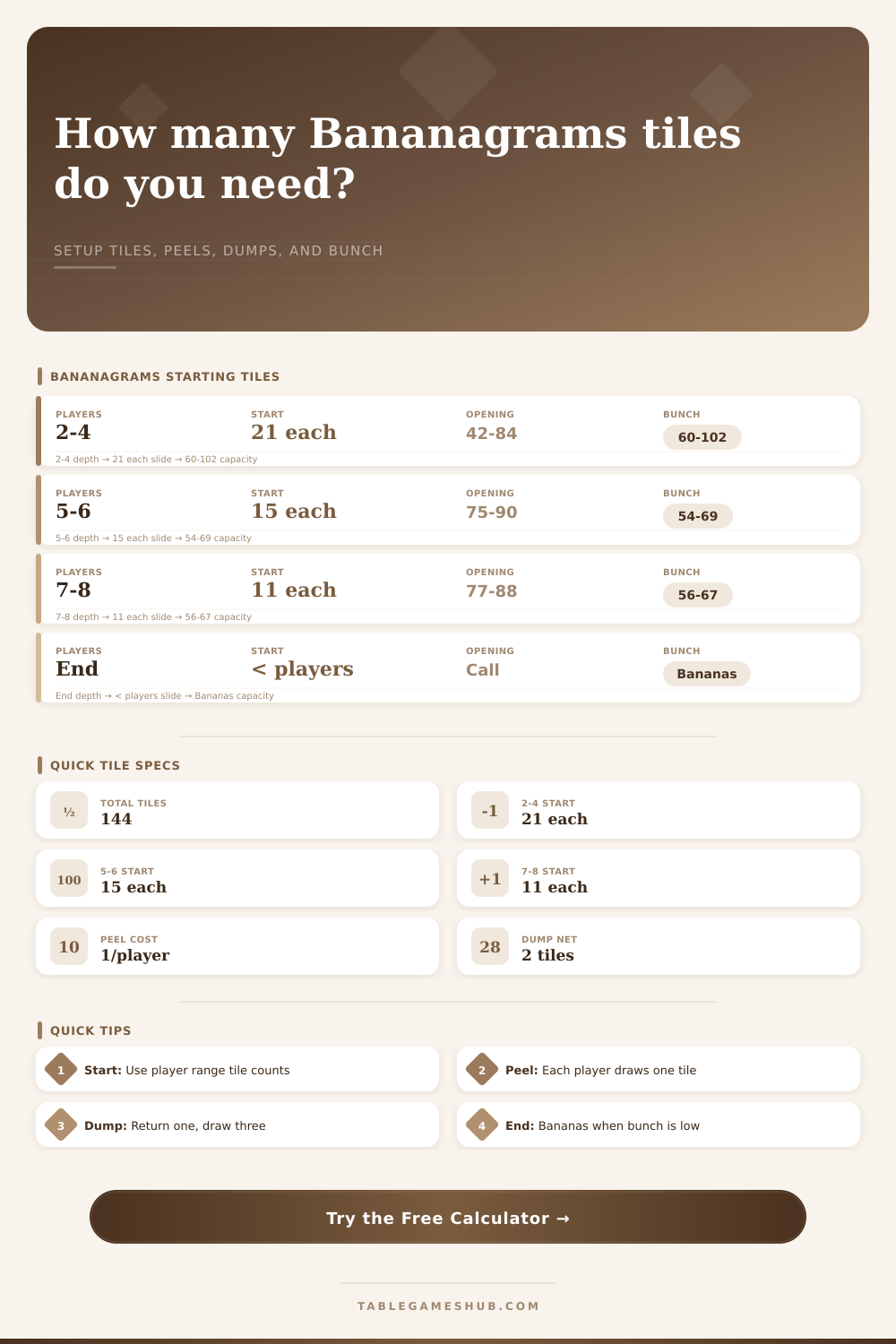
| Player Count | Tiles Each | Opening Tiles Used | Opening Bunch From 144 |
|---|---|---|---|
| 2 players | 21 each | 42 tiles | 102 tiles remain |
| 3 players | 21 each | 63 tiles | 81 tiles remain |
| 4 players | 21 each | 84 tiles | 60 tiles remain |
| 5 players | 15 each | 75 tiles | 69 tiles remain |
| 6 players | 15 each | 90 tiles | 54 tiles remain |
| 7 players | 11 each | 77 tiles | 67 tiles remain |
| 8 players | 11 each | 88 tiles | 56 tiles remain |
| Action | Bunch Change | Player Tile Change | Count Note |
|---|---|---|---|
| Starting draw | Minus players × start tiles | Each player gets 21, 15, or 11 | Depends on player range |
| Peel | Minus one tile per player | Every player gains one tile | Use total players, not caller only |
| Dump | Minus two net tiles | One player returns one and draws three | Net table gain is two |
| Bananas check | Bunch has fewer tiles than players | One player uses every tile | Round can end at this threshold |
| Letter Group | Tiles In 144 | Share Of Set | Setup Use |
|---|---|---|---|
| Vowels A, E, I, O, U | 53 tiles | 36.8% | Best quick check for playable racks |
| Common consonants N, R, S, T, L | 44 tiles | 30.6% | Useful for expected word-building density |
| Rare letters J, K, Q, X, Z | 8 tiles | 5.6% | Track when checking missing or damaged tiles |
| Full alphabet coverage | 144 tiles | 100% | Use for full bag audit and replacement counts |
| Letters | Counts | Letters | Counts |
|---|---|---|---|
| A, E | A 13, E 18 | I, O, U | I 12, O 11, U 6 |
| B, C, D, F | B 3, C 3, D 6, F 3 | G, H, J, K | G 4, H 3, J 2, K 2 |
| L, M, N, P | L 5, M 3, N 8, P 3 | Q, R, S, T | Q 2, R 9, S 6, T 9 |
| V, W, X, Y, Z | V 3, W 3, X 2, Y 3, Z 2 | Total | 144 tiles |
To keep the game moving, track tile counts. Enter what actions happened and how many player there are into the calculator, which will do the math for you. This way, you can grow on the grid without worrying about counting in your head. Knowing how few or how many tiles you have shift the game for you.
For groups of two through four players, there are 21 tiles per player (standard). For five or six players, there is 15 tiles; for a table of eight, there are only 11. More players mean fewer tile per person, but total demand on the bunch remains high. That means lots of demand on the bunch: How many tiles are in play compared with how many remain in the bag? That’s the pace-setting ratio you has to understand. With a smaller bunch, you’ll play faster. With a bigger one, you can take your time. The official standard has a handy little reference table lying all this out… You should of check yours against theirs.
Track Your Tiles to Win
Peels and dumps adds additional complexity. When someone does a peel (i.e. Each player grabs one tile off the bunch), the four-player game drain four tiles instantly. Because most don’t consider the net loss when it comes to their own hand, they neglect that drain on the bunch. Even more effective is the dump (you draw three, return one). You lose two tiles from the bunch, so over ten dump calls, you’ve removed twenty tiles from the pool. That’s twenty tiles out of the bunch! It makes the game seem like it’s gone by quicker than with more players.
The calculator will track each action one by one so you’re able to get a sense of how fast things is adding up. The other aspect of this is letters themselves. Nearly thirty-seven percent of typical one-hundred-and-forty-four-tile bag contains vowels, while there are close numbers for consonants such as S, R, T, and N. By design, rarer letters (Q, X, Z) appears less often. When keeping track of tile counts, consider the remaining letters. If the bunch is low on vowels, the game stall. A lack of high-value consonants will make the grids both wider and slower. With a letter distribution focus, the tool will help you know what kinds of words are still available. It’s a bit of strategic calculation that turns a random draw into a way to stop guessing and begining to plan.
It’s impossible to prepare for a big event like a party or a tournament without ensuring every tile is accounted for. That means knowing exactly how many there are in the bag before setting it down. A few well-placed double checks can save a lot of frustration if you find out halfway into the game you’re one short (or one too many).
You can customize the number of tiles in your set based off your house rules and any furnitures that might be broken. So whether you’ve got a full 144-tile set, or have only 90 left after some unfortnate incidents, it will know what to expect. Great for quick matches or long family games… Whether you’re playing with family, friends, coworkers, or acquaintances, knowing the exact tile count prevent disputes. With the ability to tell you exactly how many tiles are in play, it eliminates potential fights about who has final tile.
The round ends when there is fewer tiles in the bunch than players. That’s the key moment (it means the end game). Once you realize you’re getting close, you play more aggressively: you want to complete a word instead of expanding your board, so you save fewer tiles. Your strategy shifts based on knowing how much closer you are to this point, and the calculator tells you exactly how many peels remain until that happens. The switch from building to clearing is sudden; you don’t build anymore; you finish words. When you know you’re about to make that switch, you’ll have a better chance at victory… or you’ll wait.
Spelling alone isn’t the skill set (tile management are also included). Knowing the exact number of tiles remaining in your own supply gives you the ability to control the pace and know when to push for a win and when to conserve. With these tools you no longer have to guess. The data’s there. Play smarter.
Next time you sit down to play, check the count first, that may be all you need to get the edge. The clock is the pile of tiles.