Mexican Train Hub Calculator
Plan the center hub, player trains, Mexican Train lane, markers, starting hand, boneyard, and table footprint before the tiles come out.
🚃Presets
⚙Hub Setup Inputs
📊Results
🧮Setup Metrics
🗂Hub Comparison Grid
4-arm travel tray
Best for two or three players. It is compact, but a four-player game usually needs a separate Mexican Train lane.
6-arm hub
Comfortable for up to five players because the shared Mexican Train uses the sixth lane.
8-arm hub
The flexible default for double-12 nights, with room for seven players plus the shared train.
10-12 arm hub
Useful for double-15 and double-18 groups where the table needs more seating edge and a clearer center.
📋Reference Tables
| Domino set | Total tiles | Common players | Typical opening hand |
|---|---|---|---|
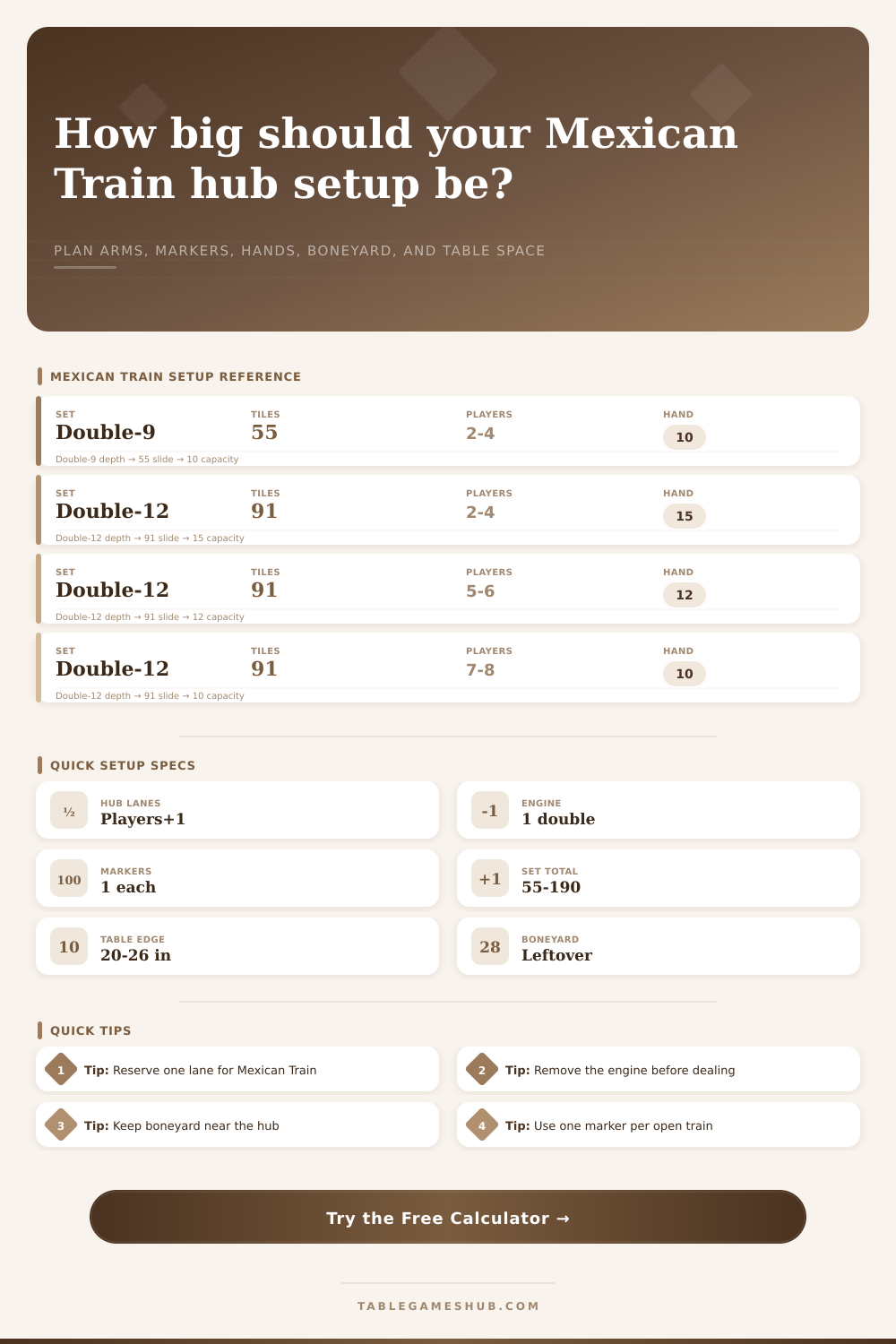
| Double-9 | 55 tiles | 2 to 4 players | 10 tiles per player |
| Double-12 | 91 tiles | 2 to 8 players | 15, 12, or 10 tiles by group size |
| Double-15 | 136 tiles | 6 to 10 players | 11 to 15 tiles per player |
| Double-18 | 190 tiles | 8 to 12 players | 11 to 15 tiles per player |
| Player count | Hub arms needed | Marker target | Table edge target |
|---|---|---|---|
| 2 players | 3 lanes | 3 markers | 40 to 52 in edge |
| 4 players | 5 lanes | 5 markers | 80 to 104 in edge |
| 6 players | 7 lanes | 7 markers | 120 to 156 in edge |
| 8 players | 9 lanes | 9 markers | 160 to 208 in edge |
| Starting double | Set requirement | Engine tile | Logistics note |
|---|---|---|---|
| Double-9 | Double-9 or larger | 9-9 | Good for short compact sessions |
| Double-12 | Double-12 or larger | 12-12 | Most common family setup size |
| Double-15 | Double-15 or larger | 15-15 | Needs a bigger boneyard area |
| Double-18 | Double-18 set | 18-18 | Best with a wide hub and long table |
| Table profile | Edge per player | Tile gap | Best use |
|---|---|---|---|
| Compact | 20 in | 0.10 in | Travel trays and small tables |
| Standard | 22 in | 0.15 in | Most home tables |
| Roomy | 24 in | 0.22 in | Open hands and easy drawing |
| Wide racks | 26 in | 0.30 in | Large groups and tile racks |
💡Setup Tips
The coffee table’s not big enough for all those player you invited, so now you want the game to flow smoothy. The dominoes pile up, private trains collide with the shared Mexican Train. Because there is no set space for boneyard, someone knocks it over.
The calculator above will help you match table footprint, boneyard room, hand size, markers, hub arms, engine double, domino set and player count. Before tiles hit wood, it transforms spatial chaos into a plan.
Plan Your Domino Game Space
It’s basic math at its heart, but a concept often overlooked: each player have his/her own lane; so does the common Mexican Train. Four players? There are five center lanes. Eight arms per plastic hub, right? Sounds like plenty! Until you invite three additional friends. Suddenly, you’re elbowing for room. To correct this, the tool simply tallies exactly how many hub arms is required for your group size.
It further considers starting double, aka the engine located smack-dab in the middle; which you’ll remove from the pile prior to dealing. This, however, decrease the overall number of tiles up for grabs, which becomes important when determining whether or not your boneyard will empty mid-game.
The secret ingredient in domino hosting is tile density. There’s only fifty-five tiles in a double-9 set, so it’s not too bad. You might even manage to get an entire game onto a small square table without incident. Now hop up to a double-12 set. There are ninety-one tiles. Multiply that by however many people is playing. Now you’re looking at dozens of tiles per player. The calculator does some number crunching with your inventory, figuring out both the number of tiles left in the boneyard and how many will end up in hands. When the boneyard empty long before the game finishes, tensions rise. People begin hoarding their moves. The fun leaks from the room. By knowing how deep the boneyard will be beforehand, you’ll either know when to alter hand sizes or select a bigger set in order to keep flow.
The table geometry is as significant as the tile counts. And the geometry matters too; most folks think the classic round table is the ticket, and it is, provided the diameter is large enough. To do so, our page has a reference table that provides a guideline based off how much edge to give per player. So maybe you have a small space. Maybe you only have twenty inches of edge, which is good for a fast game but tight for a long session where hands grow messy. The sweet spot for most home games are twenty-two inches, which is why we call that a standard. With a big game like ten players with a double-18 set, you need some breathing room there. Otherwise trains begin to intrude upon one another’s space and it’s no longer clear visually who gets to be where. That’s what most people mess up. They think about the tiles, not real estate.
There are also small things like markers. There should of been at least one marker for each lane of trains in play. Use markers to show where those lanes end. Or you don’t bring enough pawns or pennies, which can lead to misplaced tiles and arguments. Or you don’t carry enough pawns or pennies. Next thing you know, there’s arguments and people pointing fingers and lost tiles everywhere. This one keeps track of how many markers you have left compared to lanes. It ensures you have a spare or two. But it makes a difference. Because a game with unclear markers is a game with no rules.
In the end, though, it’s all just physics, the physics of the game. There is space for tiles. There is space for players to think. It is a home for boneyard. When you match your table size to your tile density and line up the arms on your hub to the number of players, the game doesn’t feel like a fight anymore. It gets back to what the game should be: a chill, competitive evening where everyone relaxes while the dominoes click into place, with no snacks knocked over in the process. The hub keeps it together; literally and figuratively.