Mahjong Wall Tiles Calculator
Plan the tile-count logistics for a mahjong wall: set size, player hands, dead wall, dora indicators, rinshan draws, live wall remaining, and draw budget per player.
| Seat | Opening Hand | Live Draw Budget | Total Tile Touches |
|---|---|---|---|
| Dealer | 14 | 18 | 32 |
| Player 2 | 13 | 18 | 31 |
| Player 3 | 13 | 17 | 30 |
| Player 4 | 13 | 17 | 30 |
| Set Type | Total Tiles | Common Starting Hands | Count Note |
|---|---|---|---|
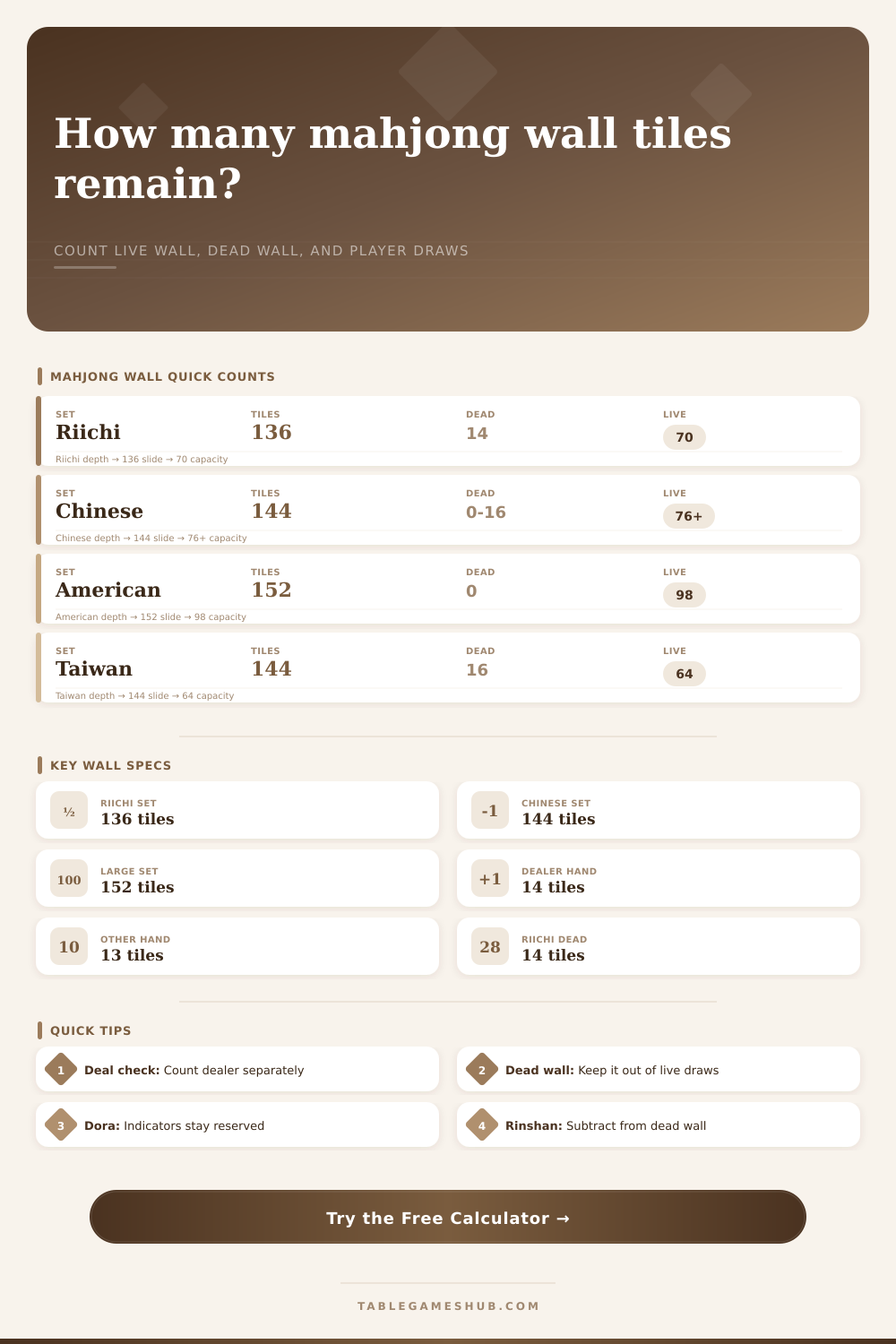
| Riichi / Japanese | 136 | Dealer 14, others 13 | Four suits and honors only; dead wall usually remains 14 tiles. |
| Chinese with flowers | 144 | Dealer 14, others 13 | Eight flower or season tiles expand the physical wall count. |
| American style set | 152 | Dealer 14, others 13 | Often includes flowers and jokers; reserve rules vary by table. |
| Taiwan-style hands | 144 | Dealer 17, others 16 | The larger opening hands leave a shorter ordinary live wall. |
| Reserved Item | Typical Count | Subtracts From | Calculator Treatment |
|---|---|---|---|
| Dead wall block | 0 to 16 tiles | Total wall before play | Removed from ordinary live-wall draw capacity. |
| Dora indicators | 0 to 5 visible | Reserved wall availability | Tracked as visible markers, not live draws. |
| Rinshan draws | 0 to 4 common | Reserved wall availability | Counted as supplement draws from the dead wall. |
| Replacement flowers | House-dependent | Reserved or live stock | Use prior live draws or rinshan draws according to table procedure. |
| Scenario | Total Tiles | Initial Deal | Live Draw Tiles |
|---|---|---|---|
| Riichi start, 14-tile dead wall | 136 | 53 | 69 before first discard cycle |
| Chinese 144, 16 reserved tiles | 144 | 53 | 75 after all starting hands are removed |
| Chinese 144, no reserved wall | 144 | 53 | 91 available for ordinary draws |
| 152-tile set, standard hands | 152 | 53 | 99 minus any table-specific reserve |
The deal is what gets people nervous about setting up mah jongg: How many tiles are left? And why does it matter? Because the physical logistics of playing mah jongg, how it’s dealt, where pieces go on the table, etc., determine the pace and level of strategy of a match.
If you don’t know how many tiles are left in the wall then how can you gauge your chances of drawing that specific tile? The calculator above do this for you. It removes math from calculating the reserve wall. This leaves you free to concentrate on playing the game instead of doing the math behind it.
Why Tile Count Matters in Mahjong
Playing mahjong is a game of diminishing returns. It starts out broad and open, with a full wall and infinite possibilities. Then the tiles are drawn down and some is discarded, reducing the pool of available options. Not all sets of rules experience this reduction uniformally.
For example, a riichi game played with a standard 136-tile set starts narrow… A handful of tile held in reserve, with only so many left in the pool from which to draw in the course of a round. By comparison, switching to a Chinese set with 144 tiles or an American expansion with 152 pieces will completely alter the math. The bigger your set, the longer it take the wall to run thin; the thinner the wall, the more often anyone has to be conservative and the greater the risk that they’ll draw a useless tile.
Additionally, there’s the dead wall (the wall of tiles kept back during gameplay) that must be considered. While the tiles on this wall can’t be drawn normally, they’re used for some pretty important things. They contain dora indicators (for determining bonus), as well as supplement draws that is used when a player announces a kan.
Unless you’ve mentally separated this reserved tile section from the rest of the wall, you’ll lose track of what you still have available. This handy little tool keeps all of those categories nicely distinct, so you know exactly how many tiles are available to draw for every player rather than just how many is stuck away for scoring purposes. It is a small detail, but it makes all the difference between guessing and knowing.
Now consider what this does for the dealer. For most four-player versions, the dealer begin the game with an additional tile in his/her hand. That single tile make all the difference in the initial deal, as it provides the dealer with a (slightly) fuller hand while leaving him with (slightly) fewer tiles on the wall for the other players. The calculator takes that unequal deal into account and breaks it down by player, allowing you to calculate how much of the wall each seat should of expect to get through during their turn(s).
If you’re looking to make sure your tournaments is fair or consistent, or if you’re playing some serious home games, this will come in handy. Again, you don’t need math wiz skills to understand the concept but laying everything out in numbers helps stop any confusion during set-up.
This is shown in the table of references on the page where various styles across regions are compared side-by-side. Notice the smaller live wall that results from the Taiwanese rules (with their bigger starting hands). There is no time to waste waiting for particular tiles. The game must be played more aggressively with less time. By contrast, the riichi game has more time (longer wall) and can therefore be played more deliberately. Knowing the structure behind the game will help you understand when to change strategy.
The number of tiles in the wall give you an idea of what should (and shouldn’t) be available. How much room do you have for a potential winning combination? When you switch rule sets, knowing the wall count will help you readjust your expectations around tile availability and hand length.
But it’s all in the name of removing friction from the game. Knowing exactly how many tiles remain allows you to more easily decide when to push for a victory, when to hold back, and when to discard. Because the calculator does the grunt work of keeping track, you’re free to focus on the rhythm of each match.
It takes a source of potential confusion and transforms it into a clear set of facts. You understand just how much room you have in the wall. That gives you a clearer picture of what the strategic landscape look like.
There’s only so much space on that wall. There are only so many tiles. Having a firm grasp based off the number adds something that can’t be attributed to luck: a quiet edge, something you’ve prepared for.