Playoff Magic Number Calculator
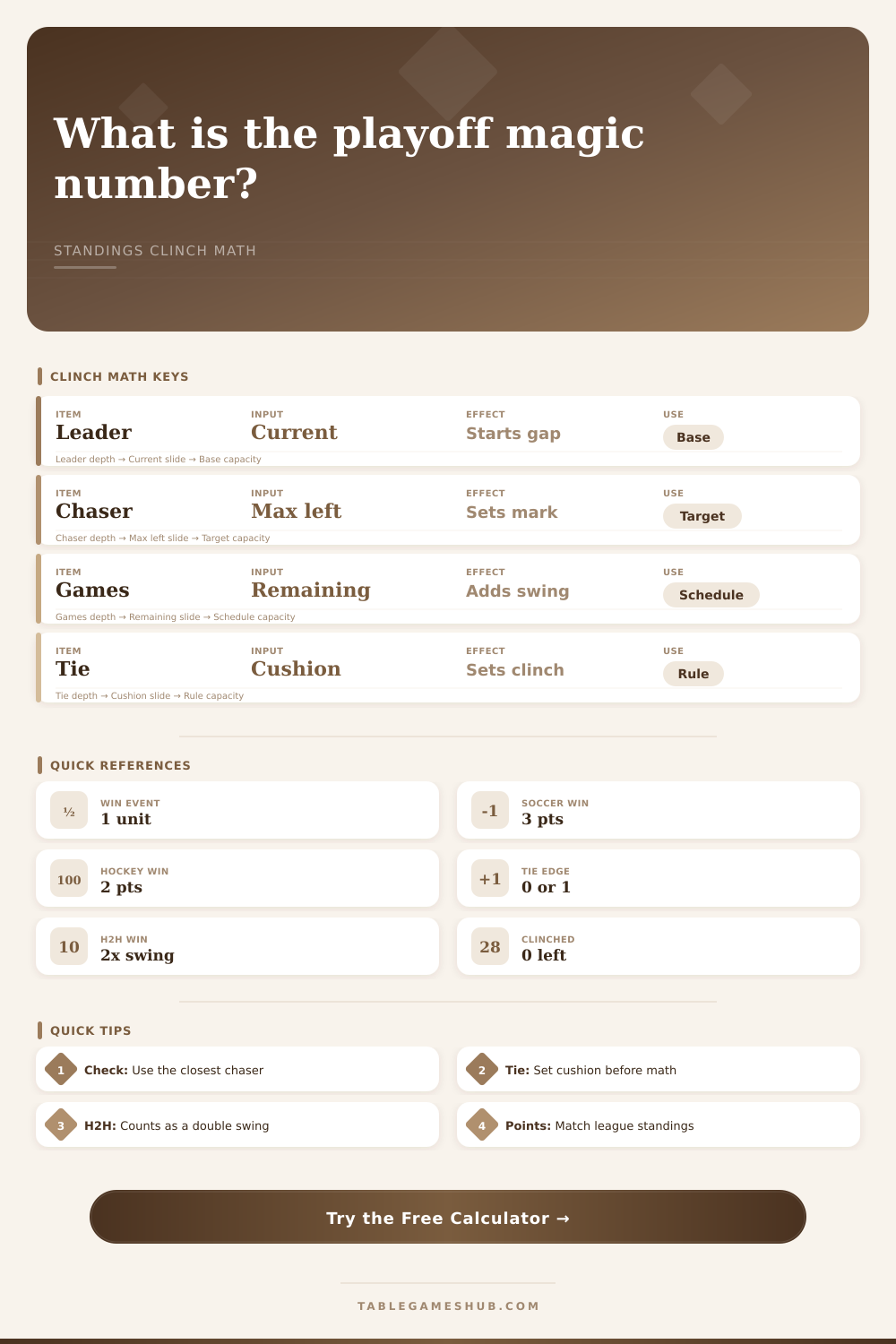
Calculate a standings clinch number from leader wins or points, chaser maximum, games remaining, tiebreak cushion, and head-to-head schedule swing.
| Step | Formula | Meaning | Calculator output |
|---|---|---|---|
| Chaser maximum | Chaser current + remaining games x points per win | The highest finish the chaser can still reach. | Chaser Max card |
| Clinch threshold | Chaser maximum + tiebreak cushion | The leader total that cannot be caught under the selected tiebreak. | Clinch Threshold card |
| Magic units | Threshold - leader current | Standings units still needed from leader gains or chaser dropped maximum. | Breakdown row |
| Magic number | Ceiling of magic units divided by points per win | Win-equivalent events left before the clinch. | Magic Number card |
| Head-to-head swing | Leader win adds points and removes chaser maximum | A direct leader win moves the clinch twice as fast. | H2H Shortcut card |
| Standings format | Common win value | Use this when | Clinch interpretation |
|---|---|---|---|
| Win-loss standings | 1 win unit | Baseball, basketball, many tournament tables | Magic number equals wins plus chaser losses. |
| Soccer table | 3 points | League tables using win-draw-loss points | Magic events are rounded to win equivalents. |
| Hockey table | 2 points | Standings with two points for a win | Chaser maximum assumes full remaining points. |
| Custom league | User entered | Club ladders, table tournaments, custom formats | Use the exact standings unit from your table. |
| Draw-heavy format | Set max win value | When draws exist but you want conservative math | Chaser is assumed to take every maximum result. |
| Tiebreak setting | Cushion added | What it assumes | When to use it |
|---|---|---|---|
| Leader owns tiebreak | 0 units | A tie at the chaser maximum still clinches. | Head-to-head, goal difference, or league rule favors leader. |
| No tiebreak edge | 1 unit | The leader must finish strictly above the chaser. | Unknown tiebreaks or cautious public standings notes. |
| Chaser owns tiebreak | 2 units | The leader needs extra room beyond a simple tie. | Chaser has the decisive tiebreak advantage. |
| Multi-team chase | Manual cushion | The selected chaser is only one part of the cutoff picture. | Run the calculator against each live chaser separately. |
| Schedule item | Leader result effect | Chaser result effect | Magic number impact |
|---|---|---|---|
| Leader independent win | Adds one win value to leader | No direct chaser change | Reduces magic by one event. |
| Chaser independent loss or missed max | No direct leader change | Lowers chaser maximum | Reduces magic by one event. |
| Leader head-to-head win | Adds leader points | Removes chaser maximum points | Reduces magic by two events. |
| Chaser head-to-head win | Leader misses available points | Chaser keeps maximum alive | Does not reduce the magic number. |
| Unplayed schedule gap | Only matters if leader can still reach threshold | Sets the upper bound for chaser max | Flags impossible clinch if games run out. |
This time of year, the last week of a championship season realy messes with your mind. You have several tabs up on your browser, each on a different page of standings. You click refresh every ten seconds. You try to run through every potential scenario in your head. Your team has to win. The rival needs to lose twice. Another team draw. It’s all mathematical gymnastics done under a racing pulse.
That’s where the magic number comes in. It solves the equation. It’s no longer some box score stat. It’s a solitary integer that reduces an elaborate maze of contingencies down to one achievable goal. You don’t have to follow every game across entire league. Just enough to know where you stand.
How to Use the Magic Number Calculator
In theory it’s simple, but in practice it gets messy because every sport measures success differently. In reality, it gets messier because sports measure success in different ways. Baseball teams tracks wins. Soccer team track points. Hockey teams track a complex blend of regulation wins and overtime losses.
Plug the rules of your own league into the calculator above. It’ll do the math for you. That way you don’t have to waste time trying to figure out conversions or coefficients.
Understanding what you’re measuring is key here. That is not about how good your team are. What you’re measuring is how far away from closest threat your team is.
There’s one fatal flaw that most fans make: Only considering their own team’s record. And thinking “if I win my next five games…” Yeah, that won’t do it very often. The second part of the equation is the chaser. How many points could they possibaly get with a perfect run? That is the ceiling. That is what you have to beat.
Now let’s say that the chaser has 10 more games and he plays in a three-point win game. He can jump over you by thirty points. That’s the ceiling you’re trying to overcome. Your magic number isn’t just based off your current lead.
Then there’s that tiebreak cushion. That’s the one folks miss. A tie isn’t necessarily a tie in most leagues. It’s a decision. And depending on who has the head-to-head over the chaser, you may simply have to match their final score. Or you may have to beat their final score. The calculator takes care of that nuance as well. Depending on who wins the tie, you put in the cushion. And it matters a lot. Because sometimes one point changes a press conference about the coach getting fired into a parade.
Games against each other, head-to-head games speed things up. If it’s you vs. If it’s you versus them, then a win is twice as good. Not only do you get the point but you deny them an opportunity to get it. In those games, the schedule swing is huge. How many direct wins will you need to get into the spot quicker then just hoping someone else stumbles? It reminds you that not all games left on the schedule are equal.
Yes, winning against a playoff-bound team is good. But winning against the team chasing you keep you alive. But then there’s the thing about multiple chasers. When you’re in a tight division, it’s not like one team is chasing you and one isn’t. Usually it’s two or three. And this is where the math take some patience. You’ve got to run the numbers on each threat individually. Only the biggest magic number of them all matters. All the rest don’t matter until the big one goes away. That’s where the presets can help out.
Whether we’re talking about an MLS final spot or a seed hold in the NBA, the logic’s the same. Identify the nearest competitor. Run the max. Subtract where you are now. Add the tiebreak buffer.
Endings make seasons, but they’re formed upon the framework of steady play. A magic number is simply a reflection. It mirrors everything that has been accomplished over the last several months in one obvious digit. It removes all the noise, all the emotion. It shows you exactly how much is needed to remain in the discussion.
From there, the nerves dissipate. You move past the whole league and focus on the immediate game. The math should of been calculated. Now it’s about executing.