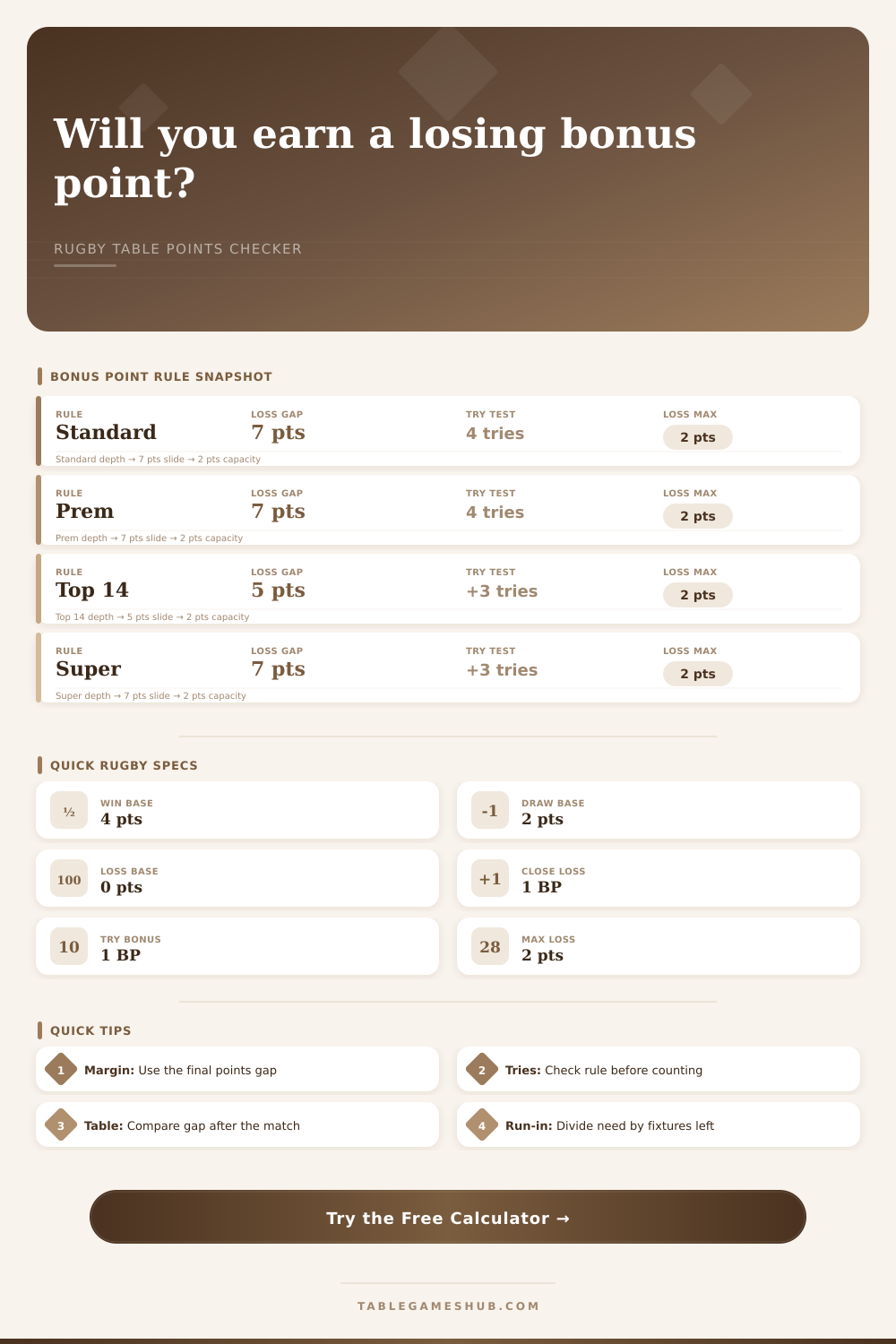
Losing Bonus Point Calculator
Calculate rugby match points from margin, tries, base result, bonus rule, table gap, and remaining fixtures.
| Rule Profile | Loss Margin Test | Try Bonus Test | Points On This Score |
|---|---|---|---|
| Standard | <= 7 | 4+ tries | Run calculator |
| Rule Selector | Losing Bonus Point | Try Bonus Point | Best Use |
|---|---|---|---|
| Standard rugby | Loss by 7 points or fewer | Score 4 tries or more | Common league table modeling |
| Six Nations style | Loss by 7 points or fewer | Score 4 tries or more | International championship pools |
| Premiership style | Loss by 7 points or fewer | Score 4 tries or more | English league table checks |
| Top 14 style | Loss by 5 points or fewer | Score 3 tries more than opponent | French-style defensive and attacking bonus math |
| Super Rugby style | Loss by 7 points or fewer | Score 3 tries more than opponent | Try-differential competitions |
| Base Result | Base Points | Bonus Tests Available | Typical Match Total |
|---|---|---|---|
| Loss | 0 | Losing bonus plus try bonus | 0 to 2 points |
| Draw | 2 | Try bonus only | 2 or 3 points |
| Win | 4 | Try bonus only | 4 or 5 points |
| Close loss with tries | 0 | Both bonus tests may apply | Up to 2 points |
| Need Per Fixture | Run-In Reading | Bonus Point Meaning | Table Use |
|---|---|---|---|
| 0.0 | Target already covered | Bonus is table cushion | Protect ranking |
| 0.1 to 1.5 | Manageable gap | One close-loss point can matter | Track every fixture |
| 1.6 to 3.0 | Needs solid returns | Try bonus adds real leverage | Compare rivals weekly |
| 3.1 to 5.0 | High-pressure run-in | Missed bonus points are costly | Wins likely required |
When you are on the wrong side of the result with a few minutes left of a rugby game and there’s a chance to grab a bonus point, it makes for a tense last few minutes. There’s a small part of you that hopes they won’t run up too many points. It is not out of pride but out of cold arithmetic. In today’s rugby, this losing bonus point are a great leveler. It transforms a loss into a tactical draw in the league table. It changes how coaches manages the clock. It changes how fans read the game if the margin of victory is small.
Depending on the league, rules change massively, so know what that line mean for your competition. These are the complicated calculations behind these different scoring systems, which the calculator above figure out for you. Memorizing all the variations from region to region isn’t necessary. Depending on it’s philosophy toward rugby, each union has adjusted the rules governing bonus points slighty.
How Rugby Bonus Points Work
Some prefer to reward more attacking flair and need a team to score four or more tries to get the bonus point. Some others don’t like games getting too out of hand and will punish those with a large losing margin with same type of bonus. You can choose the version of the rules that match your league’s. (Even within rugby there is a wide range of bonus point versions, as well as whether teams lose two points instead of one for losses.)
It’s important because the difference between a mid table standing and a playoff position might depend on this one extra point. If you lose by six, it counts as a bonus point win in one league but a flat zero in the other. The try bonus also adds another layer of strategy beyond just the margin which is frequently ignored by casual viewers. Regardless of the score line, if you get four tries then you gets the bonus point in most formats. So it incentivizes the side to continue scoring even if they are behind in the match.
Unfortunately, certain new variations such as found in the Top 14 or Super Rugby have changed this to differential based rules. Where you must score three additional tries than your opponent. That is a far more difficult target to achieve from a losing position. You need to be dominant in the play and pile on the points ruthlessly to pick up that valuabel table point. The calculator takes all of these details into consideration, allowing you to plug in not only the margin but how many tries each side has score.
After calculating the points you can expect to earn in the match, here’s where it gets interesting, and where this table movement feature is so useful. On its own, a bonus point is nothing but a number. But put it into context, like an actual chance at making something happen (and it become a lifeline). Here, you input how far behind your goal you are (that could be another team, a safe spot in the standings etc.) and what place you’re currently in. Then it breaks down that deficit based off how many games is left.
What does that tell you? How much do I need to score on average each week to make my way up? And that number say a lot. Do you really only have three points per game on average? You basically must win every match with no dropped bonus point. If you score anything under one, you have some wiggle room. That changes the focus from match-to-match to more of a season-long view.
There’s a big mistake that many fans and junior analysts alike make: viewing one loss in isolation. It’s a loss; they write off the weekend. Consistency is king in a long season, however. And the currency of consistency are bonus points. Dropping a point from a loss is often easier than stealing it from a win against a strong opponent. Clever managers account for this when planning their fixtures. They will know the games where they believe the result could easily be a runaway loss or just as easily go down to the wire. They’ll manage their tactics and lineups accordingly, increasing bonus point chances. That may well involve running more risk of a bigger loss to gain the try bonus.
The tool models the run-in precisely so you can play out these scenarios yourself. It’s all about points and inches in rugby. One loss doesn’t mean it’s over. You still have the chance to win a bonus point if you lose narrowly. It keeps things close, it keeps the season alive all the way down to the last minute of the last match.
How do they work? What are the points for? And how do they impact what you know about your upcoming fixtures? Knowing this isn’t any less vital than knowing what is happening out on the pitch. The battlefield is between the margins. The war is played out in the table.