Away Goals Calculator
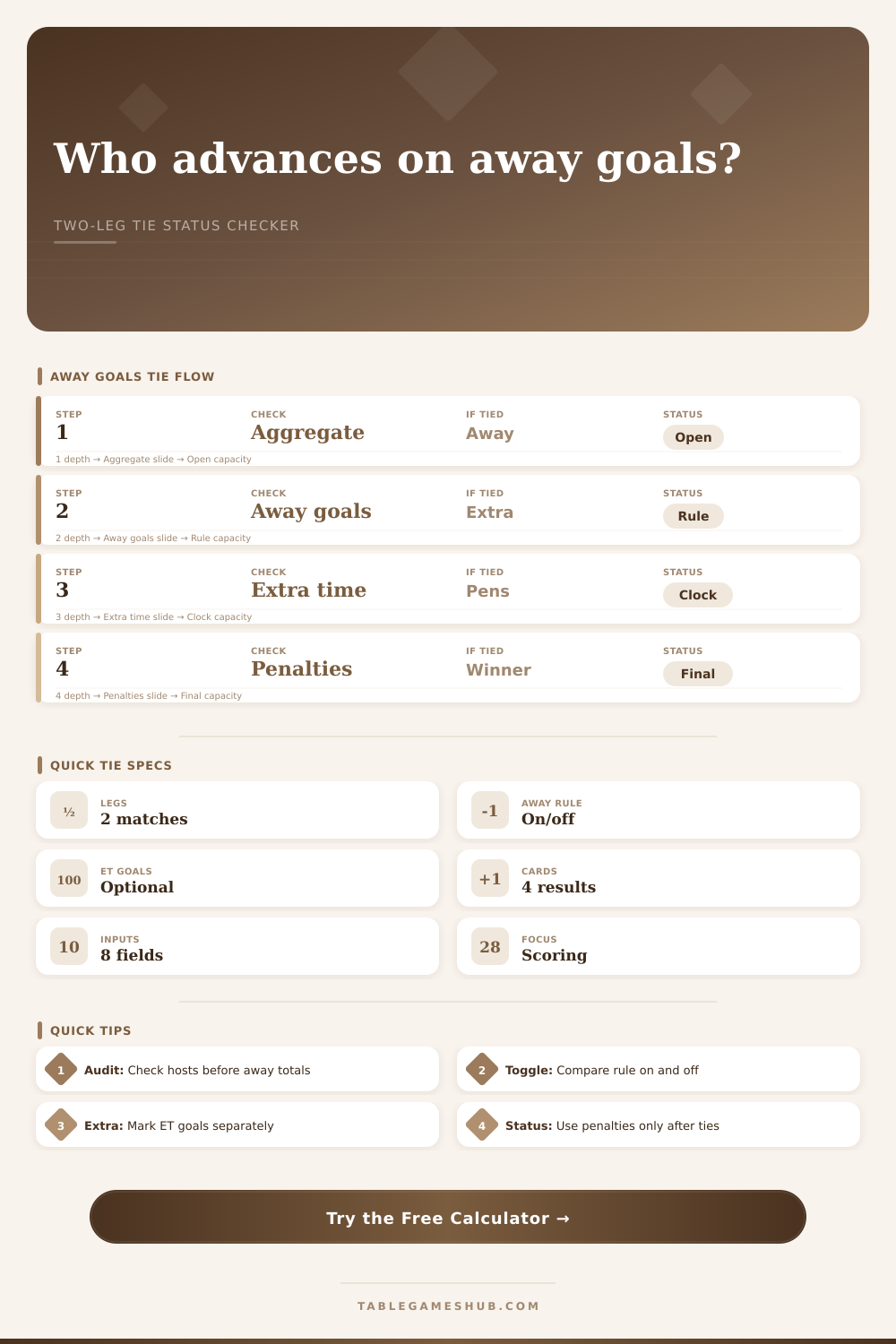
Check a two-leg tie from the host order, regulation scores, away-goal rule setting, extra-time goals, and the resulting advancement or penalty status.
| Decision layer | Checked score | When it decides | Calculator status |
|---|---|---|---|
| Regulation aggregate | Leg 1 plus leg 2 after 90 | One team has more total goals. | Advances on aggregate. |
| Regulation away goals | Team A away in leg 2 vs Team B away in leg 1 | Aggregate is level and away rule is active. | Advances on away goals. |
| Extra-time aggregate | Regulation aggregate plus ET goals | Extra time is played and one team scores more overall. | Advances after extra time. |
| Extra-time away goals | Only Team A can add ET away goals in leg 2 | Competition allows away goals to apply in ET. | Advances on ET away goals. |
| Penalty shootout | No goal totals change here | All selected scoring tiebreaks remain level. | Penalties required. |
| Handling option | Use when | Away-goal effect | Procedure effect |
|---|---|---|---|
| No extra time recorded yet | The second leg is at or before full time. | No ET away goals are added. | Reports extra time or penalties as next step. |
| Straight to penalties | The competition skips extra time. | Only regulation away goals can matter. | Level ties move directly to penalties. |
| Extra time, away ignored | Rules count ET goals only for aggregate. | ET away goals do not break a level tie. | Level after ET moves to penalties. |
| Extra time, away can apply | Rules extend away goals into extra time. | Team A ET away goals can be included. | Level aggregate can still be decided by away goals. |
| Score field | Host team | Away team | Away-goal tally |
|---|---|---|---|
| Leg 1: Team A home goals | Team A | Team B | Not an away goal for Team A. |
| Leg 1: Team B away goals | Team A | Team B | Adds to Team B away goals. |
| Leg 2: Team B home goals | Team B | Team A | Not an away goal for Team B. |
| Leg 2: Team A away goals | Team B | Team A | Adds to Team A away goals. |
| Extra time in leg 2 | Team B | Team A | Team A goals may count as ET away goals only if selected. |
| Leg 1 | Leg 2 after 90 | Aggregate | Typical status |
|---|---|---|---|
| A 1-1 B | B 0-0 A | 1-1 | Team B advances if away goals apply; otherwise extra time or penalties. |
| A 2-0 B | B 3-1 A | 3-3 | Team A advances on away goals when the rule is active. |
| A 0-0 B | B 0-0 A | 0-0 | No away-goal edge; extra time or penalties are required. |
| A 2-2 B | B 2-2 A | 4-4 | Away goals equal; continue to the selected procedure. |
| A 3-1 B | B 2-0 A | 3-3 | Team B advances on away goals if active; otherwise tie remains level. |
There is something about that knockout football format: Two venues, two legs, one winner. It’s tense. Teams can be dominant at home and fall apart elsewhere. Or vice versa. Only half the story appear on the scoreline.
And then the other half gets explained by the away goals rule; this mechanism that rewards attackers when they is playing on foreign turf. But it also complicates things and confuses analyst and fan alike.
How the Away Goals Rule Works
Once you plug in your scores into the calculator above, it will do all the math for you, sparing you having to keep up with which goal is counted for whom.
What’s clever about it. Though also deceptively simple, is that “aggregate score” mean just what it sounds like: the number of goals gathered over two matches. So if Team A wins with an aggregate of 3-1, they’re through. But where things get exciting is when total score is tied, which is when the away goals rule kicks into effect: Because we assume it’s tougher to score away from home than it is at home, the away goals rule say the team that scored more goals away is better.
It sounds small but in high stakes ties, it makes all the difference.
“People keep making the wrong choice on which team was the home team at each leg, so make sure you look closely at host team for each leg. So if Team A is the host team of the first leg, then goals scored by them are not away goals for the first leg, while goals scored against them ARE away goals for the first leg (same goes with Team B). To avoid any confusion, we’ve put it all on the page in tables. After you get the host list down, everything else falls into place logically. You input the regulation score and it immediately spits back how many away goal there were and what the aggregate is. That way you can tell whether the game will be decided by the away goals rule or if it will require extra time.
The beauty of this is that all competitions aren’t alike: some have dropped the away goals rule altogether, if it’s still 0-0 after full time, into penalties we go; others consider away goals only at the end of regular time but not in extra time. You can switch those on and off in the calculator, and that’s vital. An away goal in the 110th minute could be the decider in one league, but it could be utterly meaningless in another. Just as much as being aware of the score, you need to know how it will play out based off your particular competition.
And then there’s extra time: When total score is even and the away goals remain knotted, we go to 30 more minutes of play. Some versions account for away goals in that extra half hour; other versions don’t. The app separates out those inputs, letting you model either scenario. It will help you see what a late goal in extra time could mean. That difference confuses many non-fans, who assume all goals has an equal tiebreaking influence. They don’t. It depends on when and where they come.
But ties are also full of story: something a spreadsheet doesn’t represent. Playing defensively is often encouraged by the away goals rule. Teams up a goal or two on aggregate tend to park the bus because they don’t want to concede an away goal and lose their home-goal lead. The result is either a cautious stalemate between two sides that know how to defend. Or, it is a chaotic battle for goals from side that must attack at all costs to get back into it. Before kick-off, the rule influences strategy. Before the whistle even sounds, it has turned a football match into a game of chess being played out on legs.
If nothing changes, it’s time to bring out some penalties: the calculator can detect when both teams are tied after every procedure, marking the end of the skills portion and the start of the nerves portion. It presents a clear description of what happened, either a winner by away goal, an aggregate win, or referral to the penalty shootout. That makes it easy to quickly parse what went down without cracking open your rulebooks.
To conclude. The away goals rule is fair, or rather, it appears fair. It seeks to even out the playing field between the comforts of home and the hostility of the away atmosphere. And does it work? We could of discussed that another time.
For now all you need to know is how it works in the context of your match analysis. Enter some data, adjust the settings, let the calculator crunch the numbers while you tell the story. It is that simple. The rules are complicated, and the calculation is clear.