Correspondence Rating Calculator
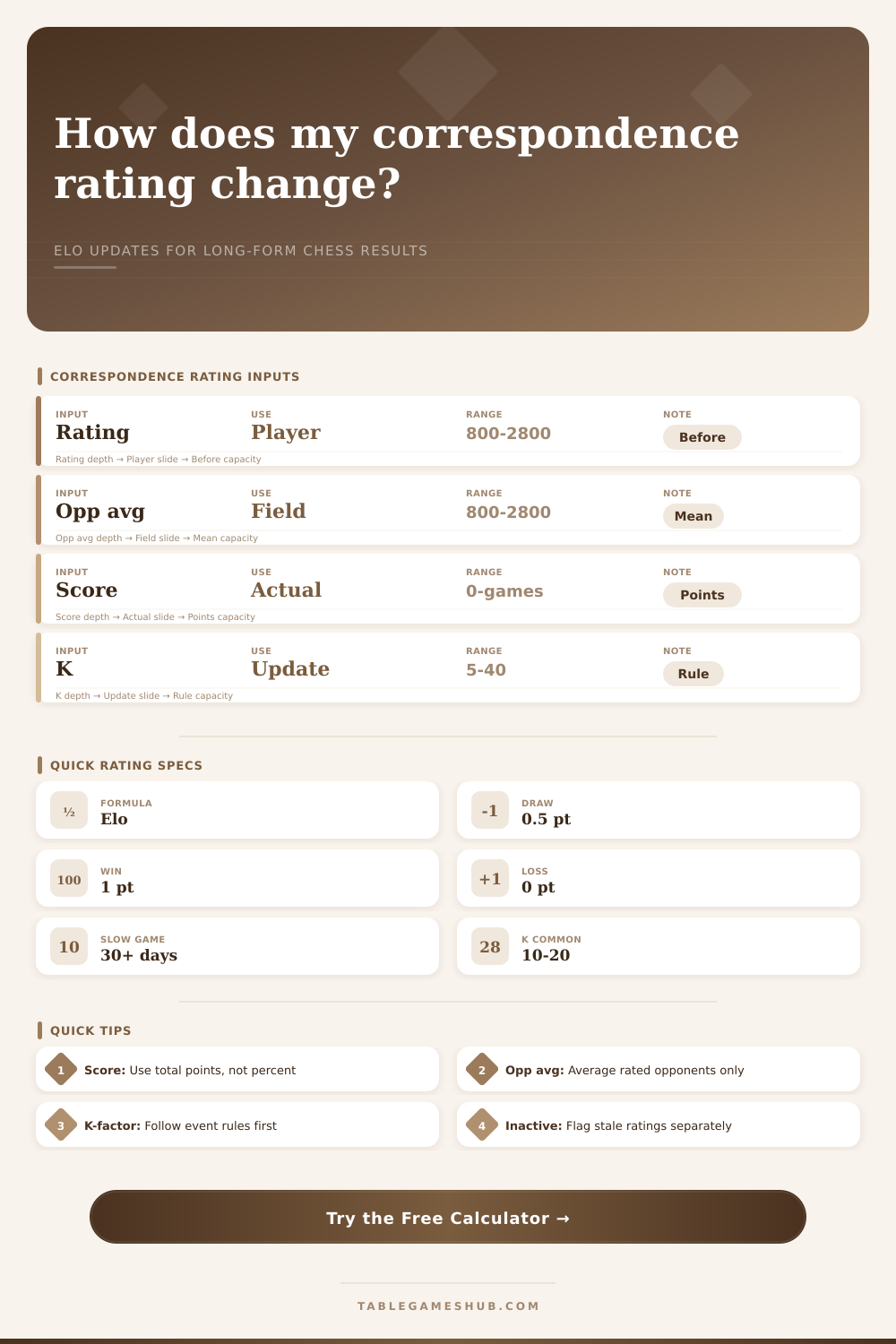
Estimate Elo expected score, rating change, new rating, and activity context for completed correspondence chess or long-form table-game matches.
| K-factor band | Common use | Typical effect | Calculator note |
|---|---|---|---|
| 5 to 10 | Established master lists | Slow movement | Best for mature correspondence ratings |
| 15 to 20 | Club and server ladders | Moderate movement | Useful for recurring rating updates |
| 24 to 32 | Developing or provisional lists | Fast movement | Check whether the list caps game count |
| 40+ | Early calibration | Very fast movement | Use only when the rating system states it |
| Time-control category | Typical rhythm | Batch behavior | Rating note |
|---|---|---|---|
| Postal correspondence | Weeks per move | Few games close together | Ratings may lag current strength |
| Email correspondence | Days to weeks | Small section updates | Opponent average matters strongly |
| Server correspondence | Days per move | Several games finish in waves | Batch score should match closed games |
| Daily chess | One to several days | Frequent completions | Higher K can swing visible ratings |
| Game result mix | Score entry | Example for 4 games | Use in calculator |
|---|---|---|---|
| All wins | Games x 1 | 4.0 / 4 | Enter 4 score, 4 games |
| Win and draws | Wins + half draws | 2.5 / 4 | Enter the point total |
| Even split | Half of games | 2.0 / 4 | Often close to stable vs peers |
| Loss-heavy batch | Low point total | 1.0 / 4 | Expected score shows if it was normal |
| Inactivity span | Label | Interpretation | Action before publishing |
|---|---|---|---|
| 0 to 5 months | Active | Recent games support the rating | Use normal update notes |
| 6 to 11 months | Watch | Rating may be slightly stale | Record the date range |
| 12 to 23 months | Stale | Strength may have shifted | Add an inactivity note |
| 24+ months | Returner | Old rating needs context | Check provisional return rules |
Sometimes it takes three months for a game of chess to end. Sometimes you think about that move over your lunch break. Maybe you look at email way past midnight.
Then there’s this moment when the rating comes through. This is judgment, right? You gain or lose points. It is a number on a screen. A statistical estimate of how you performed against a specific group.
Understanding Your Chess Rating
Here’s the truth: your correspondence rating isn’t a picture of your soul. It’s just a statistic. It is a guess based off how well you played these other players in this particular period. Understanding math behind that update removes the anxiety and turns it into useful data. Math explain why it doesn’t matter. It is just data instead of something to be anxious about.
This system is driven by what’s called the Elo formula. Your rating are compared with strength of the people playing against you. Here’s how it works: there’s a calculator on the page that does the math for you. First, the system looks at your expected score. So if you’re rated 1800 and you play against opponents rated 1800 then you’re expected to win half the time, or score fifty percent of the points. When you go in and beat someone, you’ve outperformed that expectation. You lose a game? Then you’ve underperformed it.
Next, the system calculate the gap between your actual score and the one it expects. Then it multiplies it by a K-factor. That number is essentially how much your rating swings. The higher the K-factor, the wider the swing.
For example, new players can benefits from a high K-factor. They don’t know their true strength. This provides a nice balance for established players, the people who want stability in their rating. On most serious correspondence lists, the K-factor will be somewhere between fifteen and twenty. That’s a fine balance. Your rating will drift towards your actual level of strength. But you won’t have one good result decides your season.
One common mistake is failing to take into account opposition average. The tendency among players is to consider only their own performance in isolation. If you beat a grandmaster but lose three games to beginners, your performance might still be below expectation. The system considers the average rating of all the people you played. So even though you beat a grandmaster, if you then lost three games to beginner, you might have done worse than expected.
That’s where the K-factor bands come from in the reference table. Masters who has established themselves tend to use a lower K-factor: maybe five or ten. They don’t need as much correction because their rating is solid already. Players with provisional status can gets a K-factor up to forty. That will cause there rating to leap up rapidly. The system will learn more rapid what their level is. Know which category you fall into.
There’s more: there’s also inactivity. Chess moves slow in correspondence. Games take months. A year without play? That doesn’t mean your rating will match your skill today. Maybe you’ve studied and gotten better. Maybe life got in the way; maybe you’ve fallen behind. There’s a note about that in the calculator. It alerts you when it finds those situations. In other words, it’s aware of the situation but keeps the raw Elo-update math unchanged. It warns you. It warns your opponent.
Someone who hasn’t played in a while should of been treated skeptically. Their rating may not reflect their current ability due to improvement or decline. It’s a fossil. It is an artifact. It is not a prediction for the future.
Correspondence chess is not about the final score. It’s about the length of the fight. It’s about the quality of thought behind it. The rating system exist to pair you up with suitable competition. It does not represent how good of a human being you are.
Next time you recieve an updated rating, look at your performance indicator. Did you outperform expectations in a tough field? You deserve the increase. Did you lose to lesser players? That’s a downward adjustment. Treat the fluctuations as data points for measuring improvement. Don’t treat them as an assessment of your soul. For that there are the games themselves, those long strings of reasoning and counter-reasoning; the points nothing more than a receipt.