Average Rating Opponents Calculator
Compute tournament ARO, included game count, score percentage, simplified performance rating, and rating group comparison from the opponents you actually played.
| Score share | Simplified dp | Performance effect | Tournament reading |
|---|---|---|---|
| 0% | -800 cap | ARO - 800 | Finite cap used because a true Elo solve is open-ended. |
| 25% | about -191 | Well below ARO | Comparable to a heavy under-score against the field. |
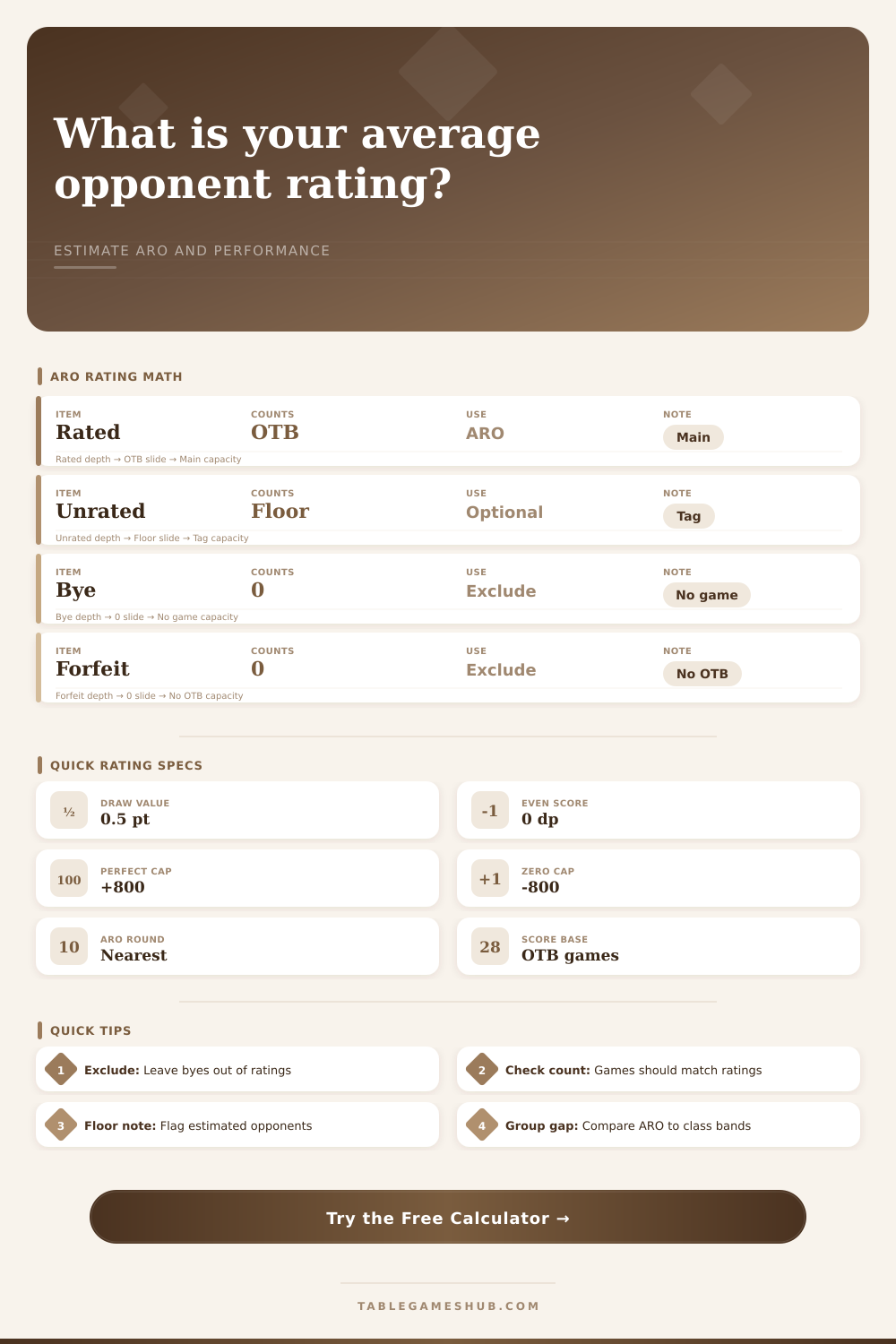
| 50% | 0 | Equal to ARO | An even score performs at the average opposition rating. |
| 75% | about +191 | Well above ARO | Strong score versus the schedule actually faced. |
| 100% | +800 cap | ARO + 800 | Finite cap used for a perfect score estimate. |
| Group band | Approx rating range | Compare with ARO | Compare with performance |
|---|---|---|---|
| Developing field | Under 1200 | Schedule may be entry-level. | Look for clean positive scores. |
| Club field | 1200 to 1599 | Common local Swiss section. | Upsets can move PR quickly. |
| Class field | 1600 to 1999 | Solid tournament opposition. | 50% score already preserves ARO. |
| Expert field | 2000 to 2199 | Strong section or top board. | Plus scores imply high event form. |
| Master field | 2200 and up | Norm-style schedule territory. | Performance threshold matters most. |
| Result type | Include in ARO? | Score denominator? | Calculator assumption |
|---|---|---|---|
| Rated opponent, game played | Yes | Yes | Use the listed pre-event or published rating. |
| Unrated opponent, game played | Optional estimate | Yes | Use the event floor only when your event publishes one. |
| Full-point bye | No | No | Track as excluded because no opponent rating exists. |
| Forfeit or default win | No | No | Exclude unless your rating authority explicitly counts it. |
| Unplayed withdrawal pairing | No | No | Do not add a rating just to fill the round count. |
| Preset | Game profile | Why it is useful | Watch item |
|---|---|---|---|
| Weekend Open | 5-round chess Swiss | Checks a common plus score against mixed ratings. | One high opponent can lift ARO. |
| Scholastic Board One | Team or school chess | Highlights upset-heavy top board pairing. | Small sample swing is large. |
| FIDE Norm Chase | 9-round invitational | Tests ARO plus score against a master-heavy field. | Use official tables for norms. |
| Rapid Section | Mixed rated and unrated | Shows how a provisional floor changes ARO. | Mark estimated opponents clearly. |
| Junior Open | Bye in one round | Keeps a bye out of the opponent average. | Game count and round count differ. |
Then it’s the end of a weekend tournament and you’re left feeling unsure whether you realy improved because your score felt solid but your rating didn’t budge much. Someone else scores fewer points yet their rating leaps significantly, because it’s not always as simple as the score, but rather who you played. The average rating of those you’ve played can shift from something that’s numerical to something that’s based off context. It moves from a raw number to a story of how hard the road was for you as it weaved through the pairing algorithm.
Now, just plug in the actual ratings of your opponents across the board into the calculator up top, and it will do the math for you. That’s the key part, tournaments is messy places where you have to account for administrative points like byes and forfeits, while also handling unrated newbies separately.
Understanding Your Performance Rating
Including a bye in your opponent average is like adding a zero to the average, which lowers your schedule strength and artificialy lowers your performance estimate. A bye is a point on the score sheet; it’s not a game where you went head-to-head with another player. Keeping them separate allows your performance estimate to be based only on what you did play, not when it was convenient for you to show up. That’s keeping the signal clear of the noise.
Secondly, pay attention to the unrated players in your section, since those is also wild cards within the system. You can set a rating floor for them (typically by provisional ratings or by event standards). Why? Because how do you take the average of nothing? Setting a low floor guards against having several new player skewing your schedule to appear more difficult then it actualy was.
For example, if you beat three unrated players who later prove to be solid club players, a high floor will protect your performance rating from appearing as walk in the park. It recognizes that unknown doesn’t always mean low. After all those inputs have been processed by the tool, it provides an estimate of how you performed based off that average. In other words, think of it as a sanity check on your form.
Fifty percent? Your performance is right in line with the average opponent. Two-thousand and you scored fifty percent? Well there you go…you matched the field. Scored seventy-five percent? The math says your performance estimate goes well beyond the average opponent, so you’re now playing up from your rated class. Failing miserably against a weak field will sting much worse than failing miserably against masters.
It’s not just about the numbers; it’s about the context. Because one number (nineteen hundred in my case) doesn’t really mean much on its own without comparing it with others. Are they all title hunters? Are they club regulars? Are they developing players? The page features a table of references which maps the rating bands to typical sections of tournaments.
If your average opponent is in the expert band, then understanding that makes that half-point swing feel huge. It confirms how hard those games were and will help you make sense of other results: was it a surprising loss, or are you proud of a resilient draw?
I’ve found that folks focus too much on the raw count of the number of rounds played, failing to realize that a five-round event with four games and one bye is statistically different than a five-round event with five games. This is the denominator. Be careful about auditing your inputs. That pesky draw in round three that was so tricky… Did you forget to enter their rating? One missing opponent throws off the whole average. It is a small thing, but it matters. Only accuracy in the input data can separate the useful insight from the misleading number.
But ultimately that’s what it all comes down to: putting your feet on the ground. Until you bring objectivity into chess (or any other game rated like it), it’s all subjective. You should of looked closer. Maybe you think you played badly because you got out-tacticed in round two. However, the truth is that most of your scores was solid and that you faced an especially tough field. The numbers don’t lie. They remove the sting of your personal mistakes, and they show you how well you fared against the field as a whole. And at the end of the day, it’s not just the score you’re walking away with; it’s an accurate view of yourself relative to others.