Glicko Rating Deviation Calculator
Estimate expected score, RD growth after inactivity, updated RD, rating shift, and confidence interval for chess and table-game ladder rating periods.
| Game | Opponent rating | Opponent RD | g(RD) | Expected score | Actual result | Result minus expected |
|---|---|---|---|---|---|---|
| 1 | 1400 | 30 | 0.9955 | 0.639 | 1.0 | +0.361 |
| Scenario | Pre-game RD | Expected points | Updated rating | Updated RD | Rating shift |
|---|
| Rating deviation band | Common ladder state | Rating movement | Confidence interval reading |
|---|---|---|---|
| 30 to 60 RD | Established chess or shogi regular with frequent rated games. | Small changes unless results are very surprising. | A rating of 1800 with RD 50 is roughly 1700 to 1900 at the 95% interval. |
| 60 to 120 RD | Active club player with enough games for a useful estimate. | Moderate shifts; upsets and clean sweeps still matter. | The visible rating is useful, but the interval is still wide enough to compare carefully. |
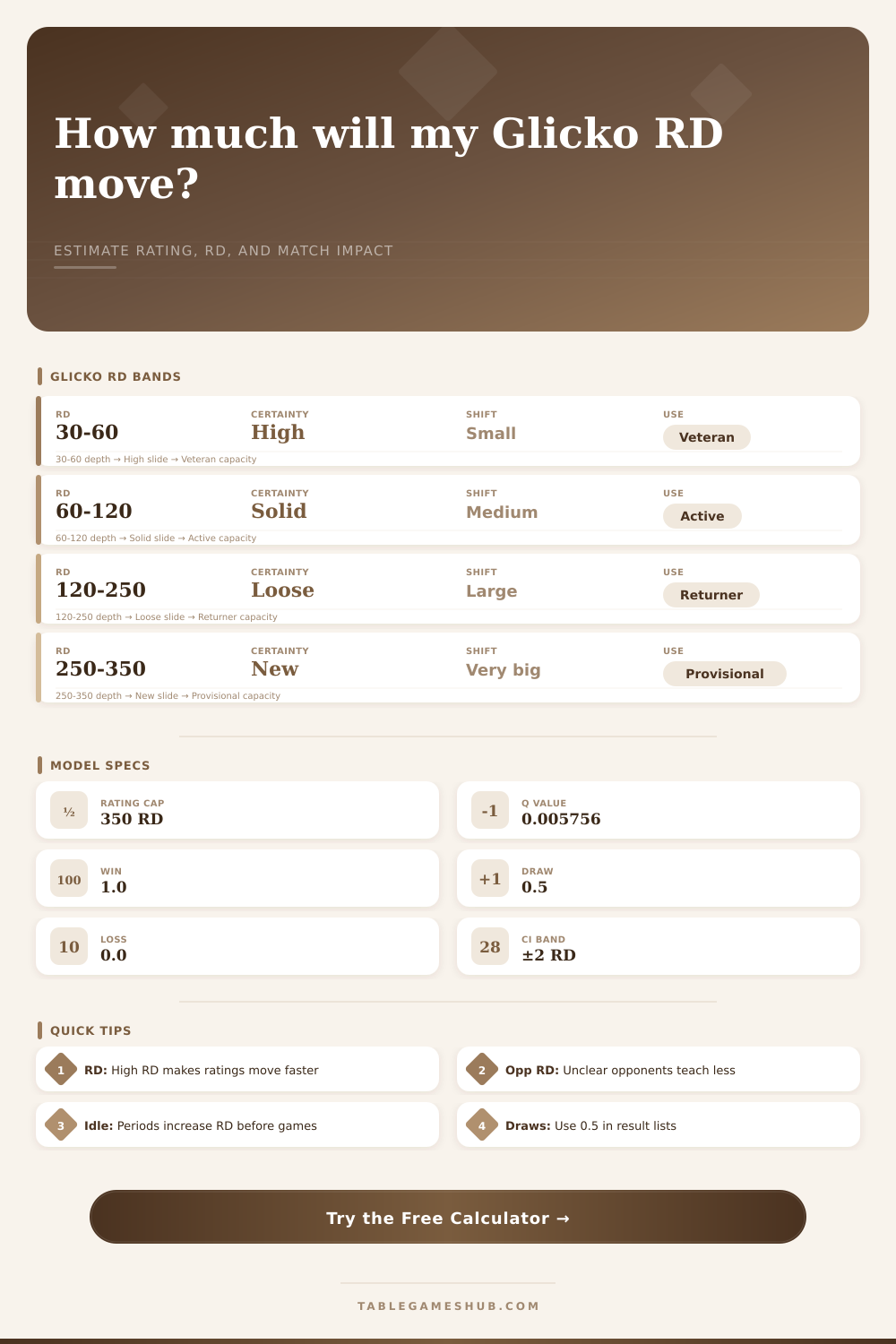
| 120 to 250 RD | Returning ladder player, short event sample, or new table-game pool. | Large shifts are normal because the system is still learning. | Do not overread small rating gaps between players in this band. |
| 250 to 350 RD | Provisional account, long inactivity, or imported rating. | Very large movement can happen after only a few results. | The interval mainly says the rating is a starting estimate, not a settled strength. |
| Input token | Score value | Use case | Calculator treatment |
|---|---|---|---|
| 1, W, win | 1.0 | Player won the rated game. | Actual score is one full point against expected score. |
| 0.5, D, draw | 0.5 | Chess draw, shared table-game result, or tied ladder point. | Actual score is half a point against expected score. |
| 0, L, loss | 0.0 | Player lost the rated game. | Actual score is zero against expected score. |
| Mixed list | One per game | Example: W, D, L or 1, 0.5, 0. | The nth result is paired with the nth opponent rating and RD. |
| Setting | Typical value | Formula role | When to use |
|---|---|---|---|
| Original Glicko c | 34.6 | Pre-game RD = min(sqrt(old RD squared + c squared times periods), 350). | Use when a league has selected a direct RD drift constant. |
| Conservative c | 15 to 25 | Raises uncertainty more slowly between rating periods. | Useful for stable club ladders with frequent player overlap. |
| Fast c | 45 to 70 | Raises uncertainty quickly for inactive players. | Useful for seasonal pools where skill changes faster. |
| Glicko-2 volatility proxy | 0.06 | Pre-game phi = sqrt(phi squared + volatility squared times periods), then converts to RD. | Use for a quick RD-growth approximation when volatility is tracked but not re-estimated. |
| Quantity | Calculator formula | Why it matters | Honest limitation |
|---|---|---|---|
| g(RD opponent) | 1 / sqrt(1 + 3q squared times RD squared / pi squared) | Downweights games against uncertain opponents. | Uses original Glicko scale for the rating-period update. |
| Expected score | 1 / (1 + 10 raised to -g(RD) times rating gap / 400) | Turns each rating gap and opponent RD into a predicted score. | It predicts the listed game result only, not table position tiebreakers. |
| Updated rating | Old rating + q / (1/RD squared + 1/d squared) times score surprise sum. | Moves rating toward results that beat or miss expectation. | It is a period update; all listed games are treated as simultaneous. |
| Updated RD | sqrt(1 / (1/RD squared + 1/d squared)) | Reduces uncertainty after informative games. | The Glicko-2 volatility iteration is not performed in this simplified calculator. |
You’ve been there: you play an opponent who’s worse than you. You lose points in your rating. Online chess is rigged! Right? Wrong. The problem was, you didn’t factor in the uncertainty.
There’s actualy two numbers behind your rating. One is your skill, and the other is how sure the system is about that skill. That’s where “rating deviation” comes into play. Players tend to focus on their points while forgetting that there’s always a margin of error. Use this calculator to plug in your recent results, it’ll do all the math.
What Is Rating Deviation?
Deviation from your rating is a metric for how sure they are about your rating. If you’re new to playing or just returning after a long hiatus, then there’s a lot of doubt about what your rating actualy should be. Perhaps your rating show up as being 1500. Maybe you’re really more like a 1400 player who stumbles along, or perhaps you’re a rock-solid 1600 player. The system doesn’t know, so it leaves your deviation high to reflect this lack of knowledge.
Why does this matter? Because when the system has a ton of uncertainty about where you fall on the bell curve, your rating will bounce all over the place. If you have a good weekend, it could jump by fifty points. How come? Because the system didn’t think you were worth very much before and now it’s calibrating you upwards. That’s volatility as a feature rather than a bug, and it enables the system to get you calibrated fast.
That doubt grows when you’re inactive. For each week you sit out, the system reasons that maybe your level has slipped a bit. It therefore adds a little more wiggle room into your profile. Don’t overlook tool’s inactivity settings. Your deviation will rise if you expect to take time off. Then, when you come back and defeat three players, your rating rockets. Those three wins would of advanced your rating far less if you’d been active. That variance is in line with what the system thought of your pre-existing rank.
The other massive factor is opponent certainty. It learns A LOT from beating a player with a low deviation and it learns practically nothing from beating a player with a high deviation. Why? Because do you know whether you beat a master or an uncalibrated novice? It counts each game based off the opponent’s deviation as well to account for this. Expect your own deviation to drop VERY slowly when playing against new accounts. You’re gaining information, but it’s noisy information. But there’s a limit to how far up it will guess. Typically max is somewhere in the three-hundred-fifty-point range. At that point, the system gives up its wild guesses and sits stationary until it has something new to chew on.
That’s what causes the initial huge swings for these provisional accounts; they begin with most uncertainty possible and burn through it with each move. By contrast, veterans tend to cling to bottom of the deviation scale. Because the system know where they’re strong, their ratings stick there and shift gradually.
Never forget that the number without the confidence interval isn’t as helpful than you think it is. An 1800 with a plus/minus of two-hundred is much different than an 1800 with a plus/minus of fifty. One player might well be solidly in the 1800 range while the other might be anywhere between sixteen hundred and two thousand. Comparing them in isolation doesn’t help because they are not really comparable. Go to the page’s reference table which explains how various deviation ranges correspond to certainty of the player. That will tell you if a difference in rating is actualy meaningful or not.
So much of this comes down to knowing what you’re really measuring. It’s not just wins/losses. It’s wins/losses with a degree of confidence associated with them. To stabilize your ranking, play consistently against known opponents. For rapid rise, ride the high deviation periods… But know that the correction will arrive sooner or later. The system must reach balance.
Your task is to provide it with proper information so that it can identify your true ranking on the ladder. Don’t chase points. Manage your uncertainty.