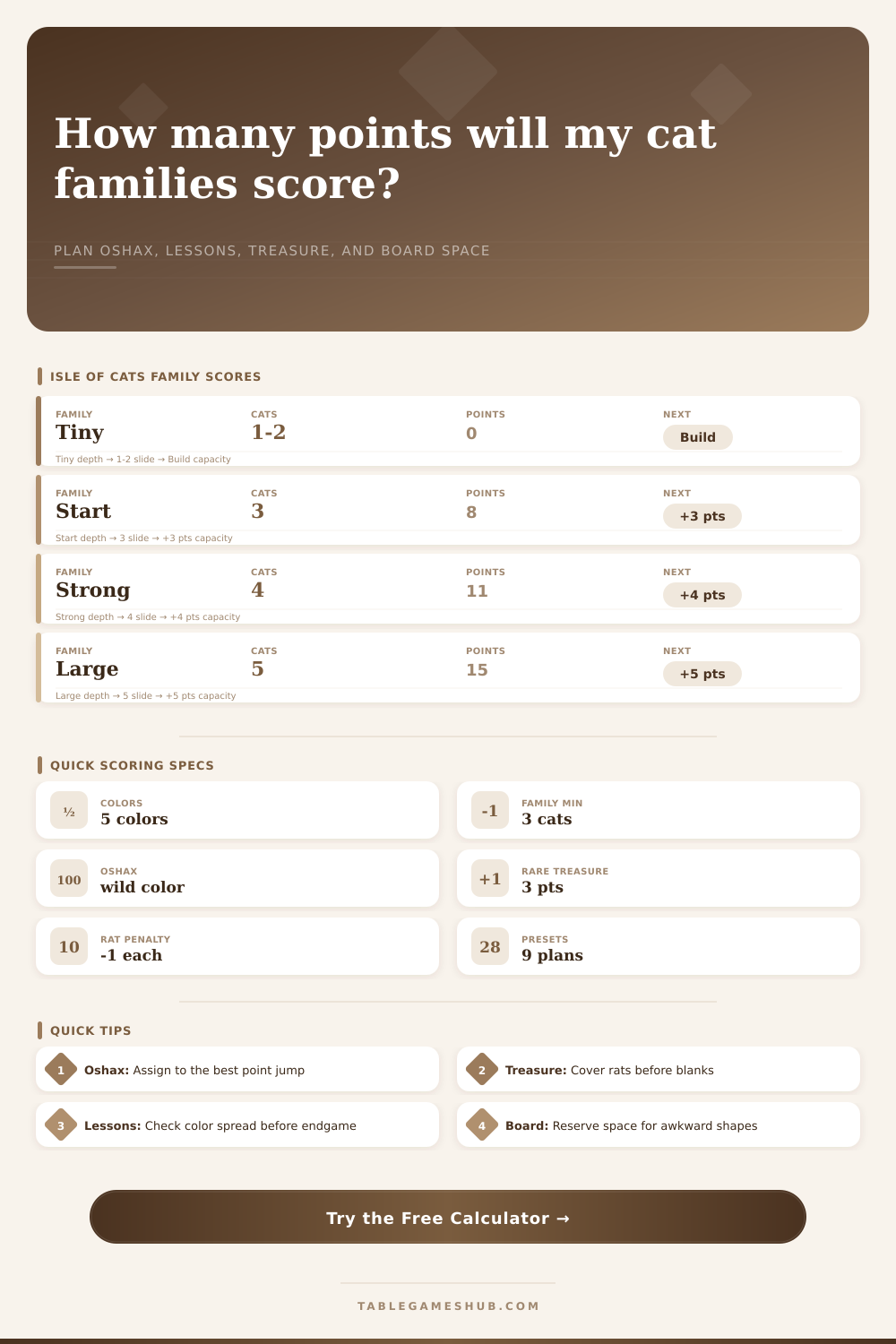
Isle of Cats Family Scoring Calculator
Assign Oshax, compare connected color families, estimate lesson-style bonuses, and check treasure coverage against rat, room, and board-space pressure.
| Connected cats in one color | Family points | Marginal jump | Oshax planning note |
|---|---|---|---|
| 1 or 2 cats | 0 points | Needs the third cat | A two-cat pair is often the best Oshax bridge. |
| 3 cats | 8 points | Plus 8 from a pair | Creates a scoring family immediately. |
| 4 cats | 11 points | Plus 3 from size three | Useful when a four-plus lesson is live. |
| 5 cats | 15 points | Plus 4 from size four | Strong anchor before late-game shapes clog the boat. |
| 6 or more cats | 20 plus 5 per extra cat | Plus 5 per added cat | Largest-family lessons can justify extra space here. |
| Board pressure | Treasure role | Calculator effect | Planning use |
|---|---|---|---|
| Visible rats | Common treasure can cover awkward single holes | Each uncovered rat is a negative point | Clear rats before chasing cosmetic empty spaces. |
| Small rooms open | Treasure patches gaps after cats set the main shape | Room gaps increase pressure score | Save narrow treasures for final room closure. |
| Rare treasure draw | Rare treasure is direct scoring and shape utility | Adds 3 points per rare treasure in package | Useful when family points are already stable. |
| Tight remaining spaces | Treasure may be safer than a hard-to-fit cat | Raises board pressure warning | Avoid planning more cat tiles than the boat can hold. |
| Lesson pressure | What it rewards | Best Oshax use | Risk to watch |
|---|---|---|---|
| Family score only | Pure connected-family points | Highest immediate scoring jump | Ignoring a live lesson card. |
| Every scoring family | More colors reaching three cats | Complete a two-cat color first | Too many small shapes compete for space. |
| Families of four or more | Medium groups becoming reliable | Push a size-three family to four | Leaving another color at two cats. |
| All five colors scoring | Broad color coverage | Fix the weakest missing color | Board shape may be too scattered. |
| Largest visible family | One dominant connected color | Stack onto the biggest family | Overbuilding past the boat shape. |
| Preset | Family shape | Treasure package | Use when |
|---|---|---|---|
| Early Pair Rescue | Several pairs, no big family yet | Balanced boat | You need to identify the first color worth completing. |
| Oshax Bridge Choice | Two colors sit just below scoring | Open room plan | One Oshax must choose between a new family and a larger one. |
| Rat Cleanup Treasure Turn | Families exist but rats remain visible | Rat pocket cleanup | Treasure placement may outscore another awkward cat. |
| Five-Color Lesson Spread | All colors are close to scoring | Lesson grid shape | A lesson rewards broad color coverage. |
| Final Day Compression | High cat count, few boat spaces | Endgame squeeze | You need to reject shapes before baskets are wasted. |
As the game continues, the available board space decreases, creating awkward spaces where difficult decisions must be made. Do I take this one tile? Or do I risk taking something worse while scoring less?
That’s the essence of Isle of Cats: the connection between score and shape. That’s what the calculator does, it help you turn your gut feeling into a plan. Generally speaking, most people understand that they’d like to have their cats all together. And Oshax can be used as a sort of wildcard. But how those two things interact when the board become cramped is lost on many.
How to Win at Isle of Cats
On the face of it, math seem straight forward. Four cats = eleven. Three cats = eight. But then you look at next cat and wonder if he/she/it will even fit. That’s when the leap doesn’t seem like such a big deal.
The thing with the trade offs is where math gets hairy. There are 5 colors you need to account for. Each Oshax can either anchor a mass of cats or bridge a space between two group. And here is the rub: how many points is that? The answer isn’t simply “how many cats?” Connectivity matters. If I take two sets of two blue cat, and don’t connect them by an Oshax, I’m still getting nothing. People gets tripped up because they’re counting heads rather than examining layout of the board.
The colors has an entirely different value when they’re on lesson cards. For example, if one of the lessons gives the most points for the biggest family, then suddenly the purple five is where it’s at. If another lesson awards for color spread, then two stray reds are preferable to the purple cluster.
Once you input your own lesson pressures into the tool, it does all the math for you. You won’t have to second guess the math anymore. Just know what lesson is running and go from there. It sounds small, but it makes a big difference. One card can turn your plan from making a tall build to making a wide one.
But there’s more than flavor text to value on the boat. There’s also a pressure valve. Rats are a liability that draw points straight from the board. Fill up enough holes with cats and they’ll start drawing points from the rats until you don’t have enough left to keep covering them all. Covering a rat hole with a common treasure helps protect your point count. Filling a gap no cat shape can reach? That’s a rare treasure for three points.
The calculator also accounts for the pressure on the board. It lets you know when things has gotten out of control. High pressure tells you that you’re getting close to a point where you chase one more cat only to find yourself stuck without enough left over to cover all the rats. Your beautiful family of six may look great at the end, but it comes at a cost that wipes out what you gained.
Winning the game is all about the Oshax assignment. Assigning your Oshax isn’t something that should of been done based off aesthetic appeal. Instead, you assign it to generate the maximum point swing. Most times this results in taking a pair of cats and making them a family of 3. That’s an eight-point swing. Adding another cat to a five-cat family increase your total by five. Unless there’s some sort of lesson driving you toward the largest family, the pair rescue is almost always correct.
The tool has presets that will allow you to simulate those scenarios without having to move any pieces around on the table. Try the Oshax Bridge preset for example. This will show you what happens to the score if you go for the smaller family vs the larger family. It is amazing how clearly you can see the trade-off.
There is a limited amount of space available on a board. Each tile you put down takes up some space that could come in handy at a later time. There are fewer and fewer shapes you’re allowed to take over time. You can’t simply plot out an ideal board. You must also account for the actual spaces available.
That’s what the treasure package settings do with the calculator. They model various endgame scenarios, from tight squeezes to wide-open rooms. It compels you to think about both the cats themselves and their shape. After all, a family of cats is only as good as its fit.
This game is all about constraints. It is a game of constraint where you score points by solving a puzzle. Follow the numbers; let them be your guide. But remember, your eyes must see the board. Check your assumptions with the tool. Run the numbers when you feel like you’ve got a solid lead in hand. Test out your Oshax moves when you’re not so sure. The data tells you whether you are chasing vanity or seeking value.
Every space matters. And when you put down the last tile, you should know that you earned every point. The board doesn’t care what you intended; it only cares what fits. Be sure your plan fits.