Food Chain Magnate Salary Calculator
Estimate salary pressure before you hire, train, discount, or chase a milestone in Food Chain Magnate.
Enter the payroll shape you expect at the end of the round. The calculator treats milestones and role mix as modifiers, then compares salary pressure against revenue and reserve cash.
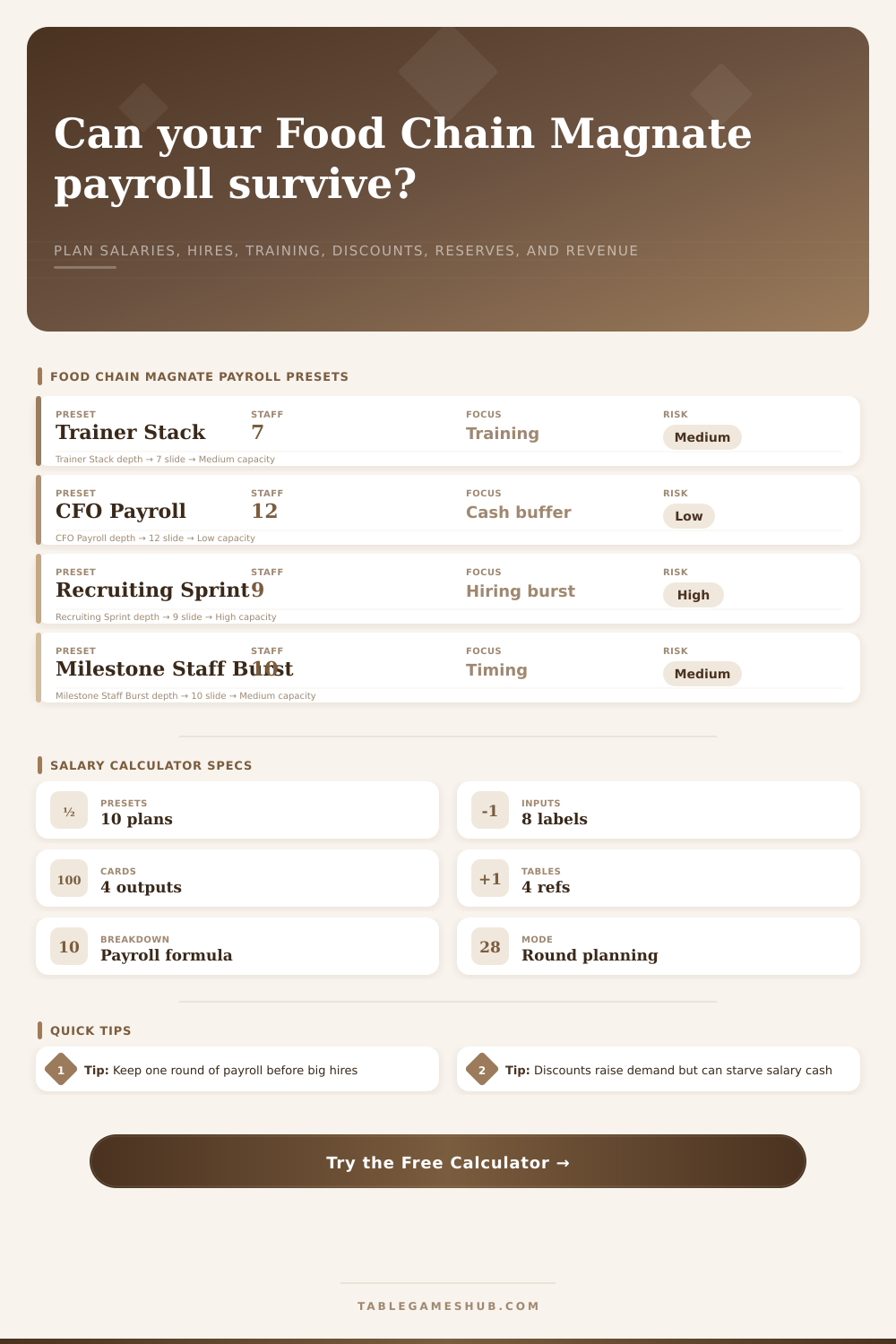
1Payroll presets
2Salary inputs
Trainer Stack keeps the company solvent if sales land near target and the training engine pays off within five rounds.
3Reference tables
Preset Reads
| Preset | Best Use | Warning |
|---|---|---|
| Trainer Stack | Build future role quality | Slow payback |
| CFO Payroll | Protect cash before salary shock | May under-expand |
| Recruiting Sprint | Grab staff before rivals | Payroll spike |
| Waitress Cash Cushion | Pad income for salaries | Needs customers |
Salary Pressure
| Payroll / Cash | Read | Action |
|---|---|---|
| Under 35% | Light | Hire or train |
| 35% to 55% | Playable | Watch demand |
| 55% to 75% | Tense | Keep reserve |
| Over 75% | Danger | Delay hires |
Training Chain Effects
| Chain | Payroll Effect | Upside |
|---|---|---|
| None | No extra drag | Lean operation |
| One lane | +4% pressure | Better next hire |
| Two lanes | +8% pressure | Fast staff quality |
| Full engine | +12% pressure | Late-game scaling |
Discount Signals
| Discount | Revenue Impact | Payroll Note |
|---|---|---|
| $0 to $4 | Mostly stable | Safe if reserve exists |
| $5 to $10 | Demand push | Track margin |
| $11 to $18 | High churn | Needs volume |
| $19+ | Cash squeeze | Payroll can bite |
4Spec grid
5Two salary tips
Food Chain Magnate lets you control your cash flow with the calculator. Plug in your expected revenues and staff counts and determine if you can afford that hire. Is the new trainer going to make you broke by the end of round twelve? It’s modeling the balance of expansion now versus surviving longer term.
If you pick one of the presets, say CFO Payroll or Trainer Stack, you’re picking a risk profile. A trainer stack buys future quality at the price of today’s liquidity. The CFO payroll maximizes your cash reserves but might leave you short on trained staff.
Plan Your Money Before Hiring Staff
Sales are the thing players think of as “active” so they concentrate on revenues. They neglect to realize their payroll is static. Training chains and salary per role influences your baseline costs. More managers mean higher costs (different than just base staff) but open bonus opportunities in future. Underfunding early due to ignoring this distinction leads to a cash scramble as the bills land.
The reference table on the page lays this out clearly by categorizing pressure levels from light to danger. Don’t let a tense situation scare you away from the hire. Let it remind you to verify your reserve cash. Two to three rounds of payroll is a tense situation that’s actualy an opportunity if you have enough buffer. You’ll be able to outmove people playing it too safe.
Here is the secret. How big of a buffer do you need before hitting key milestones?
The other bait is discounts. Discounts create demand, but erode your margin. Lowering prices shrinks your margin just as your labor costs is rising. Your cash runway calculation includes this. Drop prices $10 and hire 6 employees. The tool identifies a potentially dangerous level of pressure.
A lot of players think: “More demand = More profit.” That’s not true. It equals more volume. You need those volumes to be greater then your reserve plus your wage bills. Think of the number of rounds before repayment as your due date. With six rounds, a high-salary strategy make sense. Two rounds? Not so much. That’s what the late-game wide preset is for.
This strategy means you are already set up well and just need to stay in place. Lean founder modes apply during the early game when potential is high but cash is tight.
And there are different types of stresses involved in training chains. More staff, later. Every lane you add increase the pressure on the next round you are doing. The tool determines the percentage of pressure based off the number of lanes being trained. One lane is manageable. Train an entire engine and you could see payroll demands increases 12%+ on that alone. That’s substantial and needs to be planned for.
Turning it on isn’t good enough to assume it will get covered by sales. These are great for finding breaking points… Test out your assumptions. Put in “5 new waiters” and see if you have the cash left over after pay to cover them. If you don’t meet your reserve target, reduce until you do.
You’re trying to make the most efficient spend on salaries, not spend the least amount possible on furnitures. Managing salary is not as much an accounting question as it is a time question. It’s a balancing act between current demands vs. It is about potential capacity. Each employee is a wager that your future self will be able to afford them.
Dominant players gets their timeframes correct. Casual players do not. Have at least one payroll in reserve before making significant moves. That way, you’re always ahead of the game. When you treat each wage dollar as heavy currency, the engine runs smoothly.