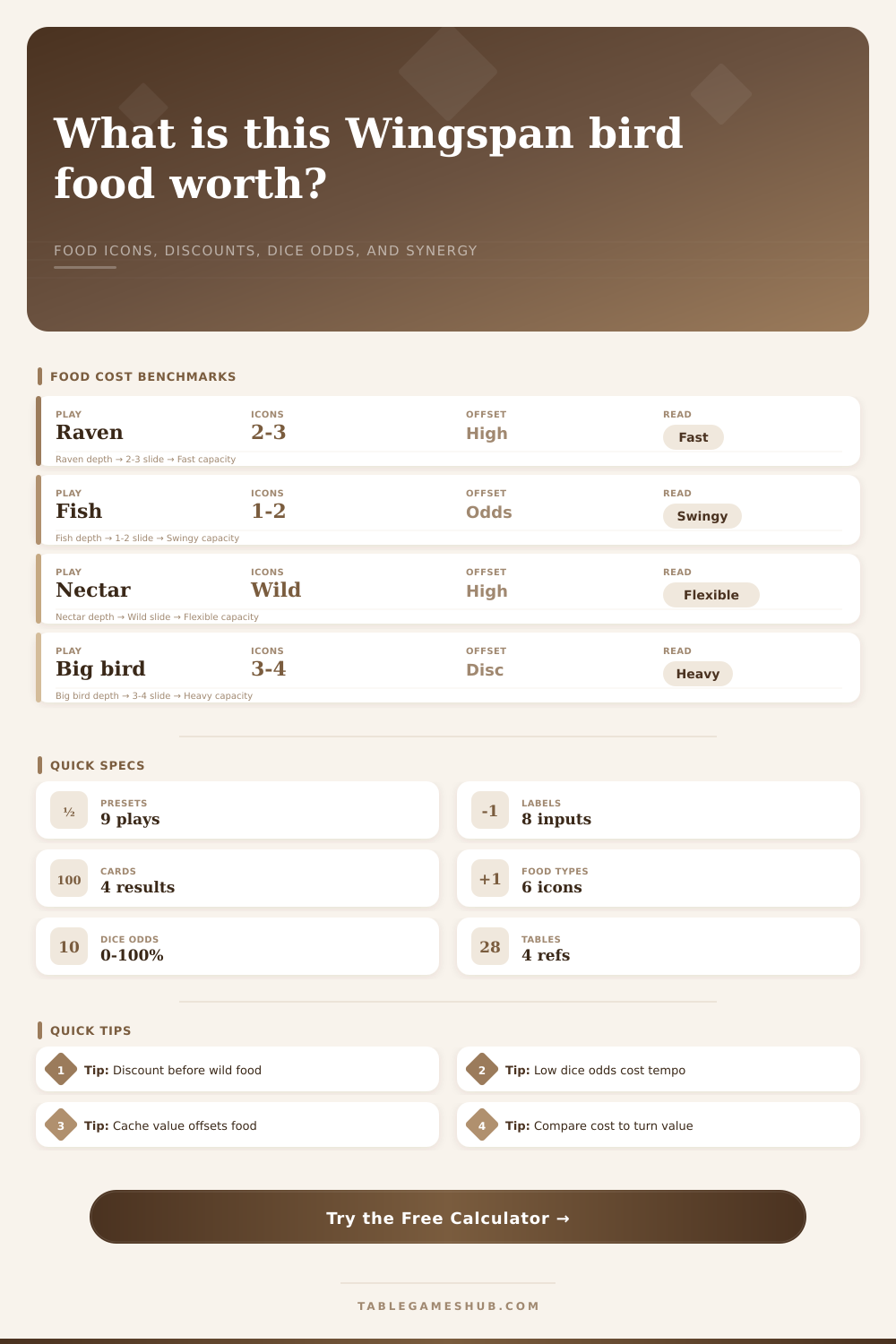
Wingspan Food Cost Calculator
Compare a bird play's required food, wild substitutions, food discounts, cached food value, habitat tempo, feeder dice odds, and bonus synergy in one quick estimate.
Enter food icons as counts, such as seed:2, fish:1, rodent:1. Supported icons are seed, fish, fruit, rodent, invert, and nectar.
Food cost result
| Icon | Common source | Trade pressure | Calculator use |
|---|---|---|---|
| Seed | Forest action | Low to medium | Stable baseline food |
| Fish | Feeder die or power | Medium to high | Dice-sensitive food |
| Fruit | Forest action | Medium | Engine or bonus food |
| Rodent | Feeder die or predator | High | Predator tempo food |
| Invert | Forest action | Medium | Flexible bird food |
| Nectar | Wildcard food | Low | Wild substitution first |
| Habitat source | Icons per turn | Best fit | Risk note |
|---|---|---|---|
| Forest food action | 2.20 | Raw food | Least tempo loss |
| Wetland card draw setup | 1.15 | Fish engines | Needs card payoff |
| Grassland egg trade setup | 1.00 | Raven loops | Eggs are not free |
| Bird power food engine | 1.55 | Repeat powers | Depends on timing |
| Bonus or tray timing | 1.80 | One-turn setup | Dice can miss |
| Preset | Food pattern | Offset idea | Typical read |
|---|---|---|---|
| Raven Food Swap | seed:1, rodent:1 | Wild food plus egg trade | Fast if eggs spare |
| Rodent Predator Play | rodent:2 | Predator cache value | Dice dependent |
| Wetland Fish Engine | fish:2, invert:1 | Wetland synergy | Good with draw |
| Nectar Wildcard | nectar:2, fruit:1 | Wild icons first | Very flexible |
| Big Bird Discount | seed:2, fish:1, rodent:1 | Discounted heavy bird | Needs payoff |
| Net food cost | Food turns | Verdict | What to check |
|---|---|---|---|
| 0 or less | 0.0-0.4 | Slam dunk | Confirm nest and card slot |
| 0.1 to 2.0 | 0.5-0.9 | Lean yes | Bonus and habitat timing |
| 2.1 to 4.5 | 1.0-1.6 | Close call | Compare alternate turn |
| Over 4.5 | 1.7 plus | Expensive | Delay or find discount |
The food requirement tell you to look at a bird card in Wingspan. You know how many points it’s worth, and you can feel that engine power is there. But you also realize that buying this bird might cost you the entire next round. Playing an expensive bird might cost you turns while your opponent quietly scores egg and advances their goal tracker. And that’s when the game is won and lost.
Rarely does it come down to playing the best cards first, it almost always comes down to who can calculate the true cost of these plays most accurately. To do so, the calculator (above) transforms the abstractions of food icons into something more concrete: a tangible tempo metric. Rather than merely tallying up how many seed there are, it compares your needs with your available board state, taking into account discounts and wild substitutions.
Calculating Food Costs in Wingspan
Why? Because raw numbers of icon deceive you. You may think two fish is cheap, only to find yourself watching the feeder die while all three turns shows insects. Your tool calculates those probabilities from the dice and presents them as the real likelihood of success or failure. It makes you face the reality of the gap between what you’d like to play and what the board is willing to offer.
Food isn’t like money in Monopoly; it’s not something most players think about playing with as a fixed pile. Instead, Wingspan food change over time. What costs nothing today may cost two dice-rolls tomorrow. It also changes based off your situation. That seed which was free today because you just flipped the forest habitat could cost zero or two depending on whether you still have rerolls. The calculator’s input for habitat source reflect this difference by varying its expectation of how many action it’ll produce. Did you use a draw from your wetlands card stack to generate some fish? It will expect fewer actions than someone who has a dedicated predator engine going.
Why does this matter? Because tempo loss add up fast. Losing one turn to fetch food doesn’t seem like much, but losing two turns while your opponent completes another high-value objective can swing the game. Beyond that, there’s the other wrinkle of wild food. Wildcard and nectar icons are both super-useful in their own ways, but like all resources, they’re finite.
The calculator encourages you to use printed discounts first, allowing you to save your important wildfood tokens for more challenging plays down the line. It sounds like a minor tactical decision, but it can be pretty powerful. Running out of nectar early and having to pay for a bird halfway through feels wasteful, while being stuck at the end game with a predator that requires multiple substitutions could of been avoided if you’d saved some of that nectar. In general, saving wildfood for times where you’ll realy need it will serve you better.
The tool makes it easy to see what you’re trading off, such as overspending on your most flexible resources. It also shows how much you’d still “owe” once they’re used for something else. The last variable that makes an otherwise expensive play work is bonus synergy. If a bird seems expensive on its own, but then I get a habitat row from playing it and/or finish off a bonus card, that drastically lowers the effective cost. By entering this additional value into the calculator, we’re comparing apples-to-apples when considering whether to make a high-synergy, expensive play versus a lower-impact, cheaper one. That is, we’re taking a complete perspective rather than falling victim to the trap of optimizing turn-by-turn efficiency at the expense of board momentum over time.
Food cost control is half intuition, but it’s also half knowing how to read the table. It’s about predicting the roll of the dice, covering our wild cards, and understanding what happens when you use a coupon to turn an all-or-nothing wager into a sure thing. And those choices come from the calculator, which helps take out the emotions involved in craving a specific bird, letting you know whether or not that’s the right call based off cold hard numbers.
Once you see the numbers, there is less luck involved and more math. You no longer have to ask yourself whether to take the shot. Now, you just need to know when the odds is in your favor.