Manhattan Project Calculator
Total your current bomb score, loaded bonuses, plutonium test value, uranium and plutonium deficits, building engine strength, espionage reach, aircraft posture, damage drag, and race-to-target status.
Pick a board-state preset, then replace the bomb card values with the exact cards in your hand or tableau.
Bomb 1
Bomb 2
Bomb 3
Bomb 4
For plutonium bombs, the calculator uses tested VP only when the global plutonium test box is set to yes. Uranium bombs use the first VP field.
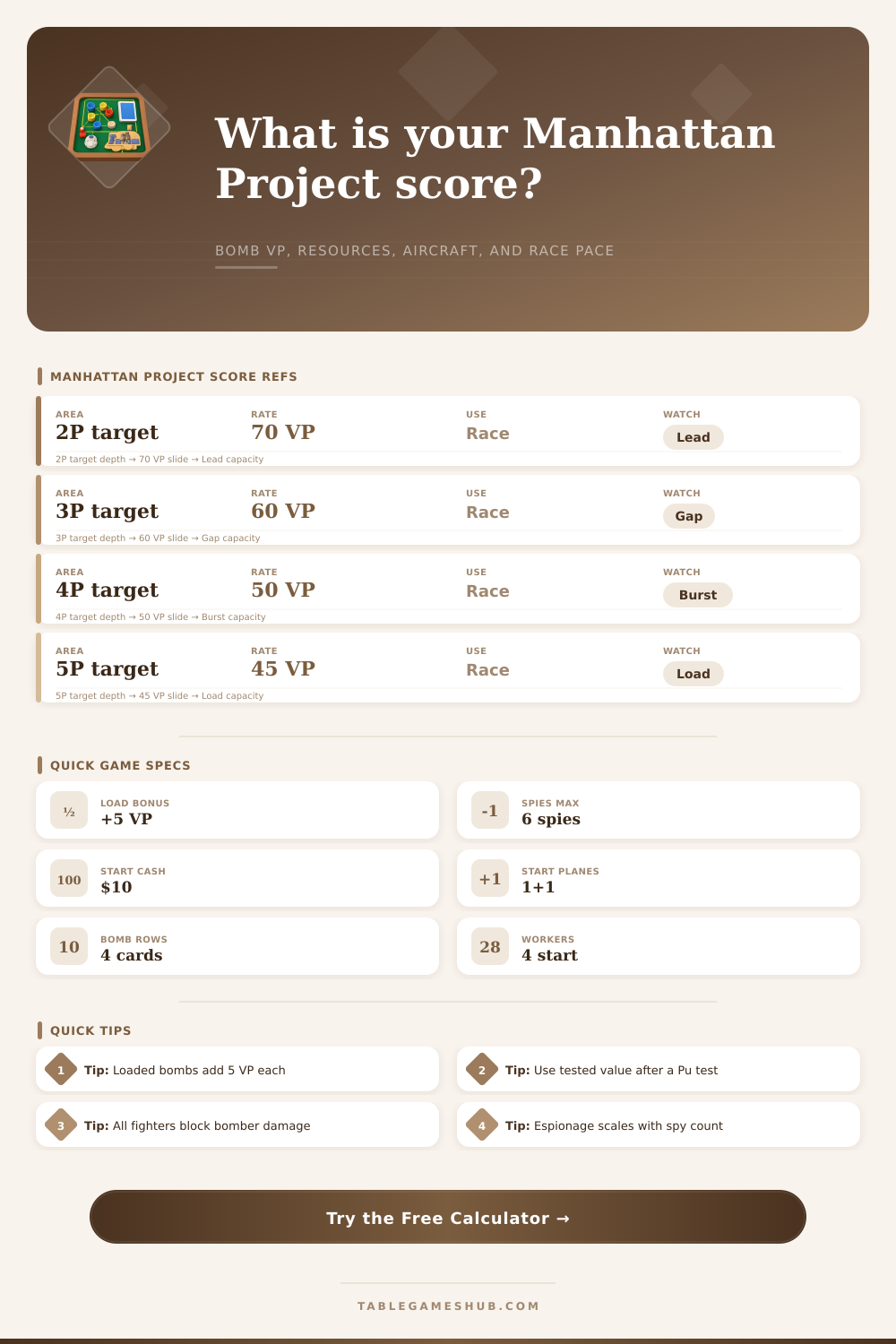
| Players | Target VP | Calculator Use | Finish Watch |
|---|---|---|---|
| 2 players | 70 VP | Longer scoring arc | Big bombs and tested plutonium matter more |
| 3 players | 60 VP | Middle target | A loaded high-value bomb can create sudden pressure |
| 4 players | 50 VP | Short race | One loaded bomb often changes the leader |
| 5 players | 45 VP | Fastest target | Watch every opponent with an unbuilt design |
| Item | How It Scores | Input to Check | Common Miss |
|---|---|---|---|
| Uranium bomb | Printed VP when built | U or untested VP field | Forgetting the load bonus |
| Plutonium bomb | Untested or tested VP | Both VP fields plus test status | Using tested value before a Pu test |
| Loaded bomb | +5 VP per loaded card | Loaded checkbox, bomber stock, load money | Counting a load without a bomber |
| Test marker | Counter VP after test | Manual test marker VP field | Omitting the marker from current score |
| System | Main Inputs | Calculator Output | Planning Use |
|---|---|---|---|
| Buildings | Built, active, mines, material sites | Engine health percent | Shows whether damage is slowing the next burst |
| Espionage | Spies and planned opponent buildings | Spy reach and capped uses | Tests if borrowed production can cover deficits |
| Air strikes | Fighters, bombers, opponent fighters, target damage | Damage feasibility | Checks if aircraft can hit buildings this action |
| Workers | Workers, scientists, engineers, contractors | Labor pool and specialist balance | Flags if designs or reactors lack specialists |
Bomb score: Enter card VP exactly as printed. The calculator adds +5 only when the loaded box is checked, so it can separate built VP from load timing.
Plutonium route: Use the test marker field for test VP, then flip the global test selector so every built plutonium bomb uses its tested score.
Aircraft pressure: If the opponent still has fighters, your fighter count is the first limiter. Bombers only become damage after the screen is gone.
Race logic: A next-burst score that reaches the target is marked as finish-ready, but the leader field warns if another player can cross first.
The meat of the game is how you juggle building your own industry while at the same time trying to rush ahead of your competitors to get most VP points first. Do you enrich some uranium this turn? Or plutonium? When do you take a risk and build more valuable test device? Or play it safe to get smaller gains now? How do you sabotage your opponent without stalling out yourself? It’s a fine line between aggression and efficiency: every dollar spent and worker hired has to earns their keep, and it’s a tightrope act of timing and planning.
The core of all that math is your own bomb cards. Every card comes with two possible values, one for being tested and one for not being tested yet. While uranium bombs gives solid, consistent points, plutonium bombs are initialy weak but soar in value when they get a global test marker. Once you know what kind of cards you have, and how much each is worth based off the print, the above tool will do math for you.
How to Win the Game
All you need to do is check boxes to say if a bomb has been built and if it’s been loaded onto an airplane. That loaded on bonus is crucial. Adding five points to every loaded bomb can easily mean difference between getting out in front and falling behind enough to let someone else cross the finish line first. They’re easy to overlook when you’re under pressure, so keeping track of them explicitly prevents some very painful miscalculations.
Your engine runs on materials. To make those bombs, you’re going to need yellowcake, uranium cubes, and plutonium cubes. Use the calculator to compare materials your plans need with what is already in your stockpile. You might have a bunch of reactors churning along, but no mines supplying their fuel. Your factories will grind to a halt. That’s where players often fall short: they’ll build all these fancy facilities and forget about lowly mines that stock the assembly line. Without enough cubes, your fancy buildings is just sitting there. This costs you turns and lets your opponents catch up or even surpass you.
Psychological warfare is layer of espionage. Spies will let you steal other players’ buildings and produce from them as if it were your own, all while not having to pay them the full price. The espionage mechanic scales with number of spies you have, up to a maximum of 6 spies per player in a standard game. Having access to your opponent’s infrastructure allow you to fill gaps in your supply lines (when you’re short on scientists) or just take over their stuff entirely.
Their power becomes your power, but only if you know which buildings to target with spies and check if those buildings is already occupied, blockaded, or damaged. Sending out your spies blindly into useless buildings isnt productive; you’ll waste actions and give away part of your hand too soon.
Enter air power, which throws things into direct conflict. Bombers enables you to take out enemy infrastructure; fighters protect your own buildings against enemy bombers. This results in a rock-paper-scissors interaction that changes long-term strategy. When buildings are damaged, they can’t be brought back online till fixed (which requires time as well as money). Your bomber count, along with your opponent’s defenses, go into the calculator to estimate if an attack is worth launching. If not, for example, if target has more fighters than you do bombers, then it will never launch. Knowing this saves you from wasting resources on useless attacks that only help your competition.
It all comes back to worker allocation. There are three types: engineers for construction, scientists for design and research, and general workers for simple tasks like operating stuff. If you misallocate them, then you’ll grind to a halt. If you have loads of cash but no one who know how to use it, what good does that do? To see where you stand on this front, the tool keeps track of your workforce and shows you when you’re about to be able to build a reactor or when you’re simply shuffling around yellowcake. It’s got a neat view of what you want to do versus what you can get done.
It’s all about consolidating when needed and pushing when necessary. In general, being well rounded works better than specializing early on. Build up enough scoring power to crush the final few minutes and enough production that you can survive the mid-game scramble. Depending on how many players are racing, their target scores will differ (lesser players = more points). So in lower player counts, haste makes waste. More than anything, be patient.
Keep an eye on your estimated burst and your opponent’s score. If you’re in contention, burn everything. If you’re way out of the running, slow down and sabotage. You should of want to be building bombs…you want to be building them at the right time so your opponents have no chance of stopping you. That’s where the difference between the greats and everyone else shows.