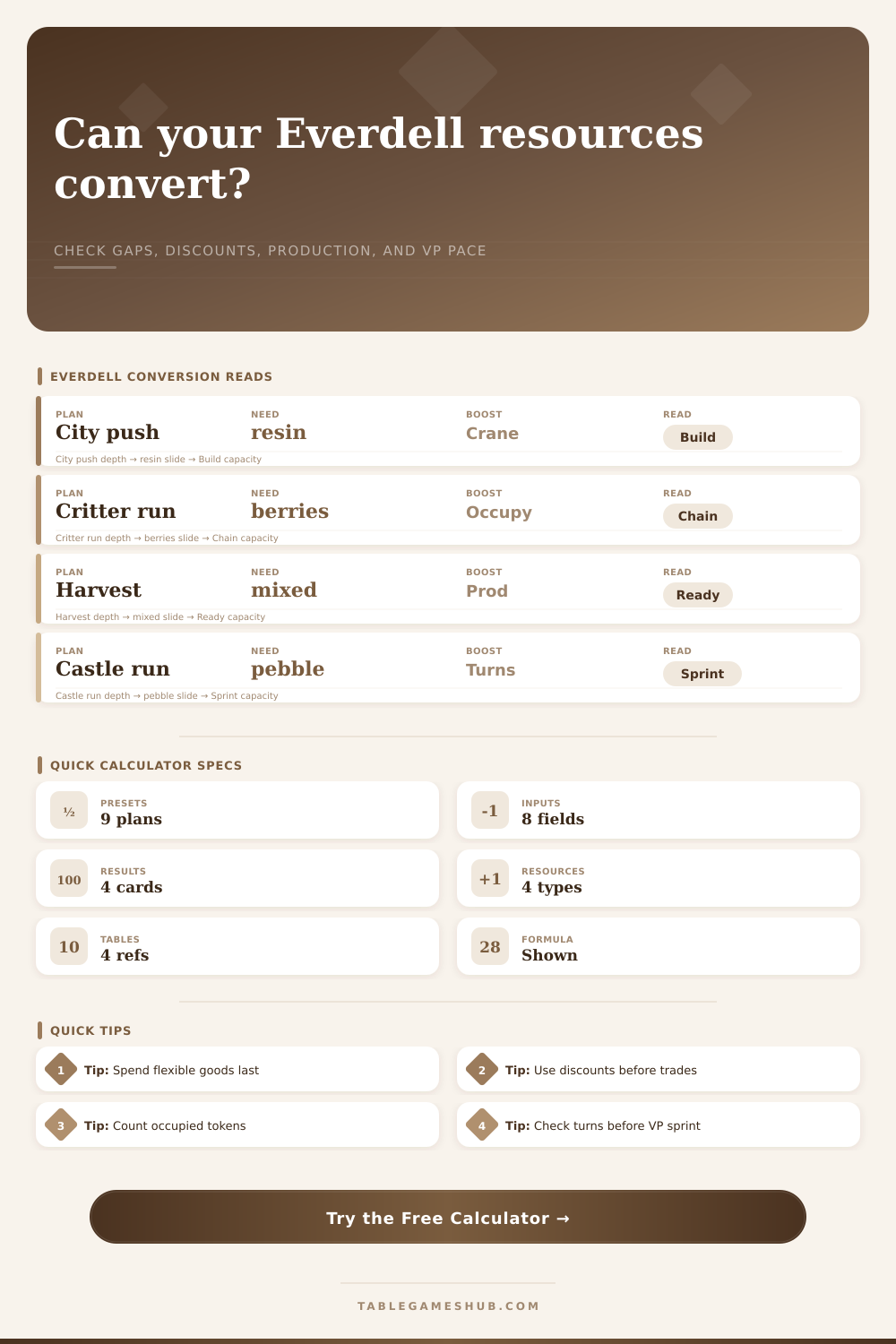
Everdell Resource Conversion Calculator
Compare twig, resin, pebble, and berry stock against a target card, then model discounts, production triggers, occupied tokens, point value, and turns remaining.
Use this for the board game Everdell when deciding whether a card or city push can convert from available resources into points and tempo before the season or game ends.
Conversion results
| Resource | Calculator weight | Common pressure | Conversion note |
|---|---|---|---|
| Twig | 1.0 | Early construction | Flexible for cheap buildings, but surplus twigs are weaker when resin or pebbles are missing. |
| Resin | 1.3 | Mid construction | High demand for city pieces; missing resin often blocks otherwise ready construction turns. |
| Pebble | 1.6 | Heavy builds | Highest modeled resource weight because many point-heavy constructions are pebble constrained. |
| Berry | 1.2 | Critter chains | Strong when the plan needs critters, occupied tokens, or linked city timing. |
| Aid | Best target | Modeled effect | When it matters |
|---|---|---|---|
| Crane | Construction | Reduces weighted build cost by up to three resource value. | Best when a single construction is short on resin or pebbles. |
| Innkeeper | Critter | Reduces berry need by up to three berry value. | Best for a berry-heavy critter that completes a chain. |
| Production | Mixed | Adds resource value before gap and readiness are calculated. | Best before Prepare for Season or copied production effects. |
| Exchange | Flexible | Converts surplus at partial value toward missing resources. | Best when one resource type is overstocked and another is short. |
| Plan mix | Resource focus | Token impact | Calculator read |
|---|---|---|---|
| Construction focus | Twigs, resin, pebbles | Low direct help | Discounts matter more than occupied tokens unless the build unlocks a critter. |
| Critter focus | Berries | High help | Occupied tokens and berry discounts can flip a short hand into a ready chain. |
| Mixed city turn | All resources | Medium help | Balanced plans score well when no single missing resource controls the turn. |
| Point sprint card | Pebbles or berries | Variable help | Late turns reward high printed points even when efficiency is only moderate. |
| Preset | Main bottleneck | Result card to watch | Decision signal |
|---|---|---|---|
| Twig-to-Resin City Push | Resin gap | Resource Gap | Convert only if surplus twigs plus production cover the resin shortage. |
| Berry Critter Chain | Berries | Conversion Score | Occupied tokens can make the critter chain ready without extra gathering. |
| Crane Discount Build | Construction cost | VP Pace | A discount build is strong when points per turn beats the hand alternative. |
| Castle Point Sprint | Pebble timing | Turn Read | High point value can justify a narrow gap if enough turns remain to finish. |
| Final Turn Conversion | Any missing good | Resource Gap | Final turns need a clean gap or a specific aid already in place. |
In Everdell, there’s a particular variety of panic that settles over your soul once you’re all twigged up for construction, but you’re a resin away from a complete row in your city of critter. The game could close out or someone else will swipe it up as you sit staring at the board thinking “if I just wait…” The distance between you and what you want feel like a gulf. It’s resource anxiety pure and simple.
A lot of people simply guess, hoping to shuffle some excess goods around so the math works out. But there’s a more effective way to address that stress without breaking into a sweat right down your sleeves. The Everdell Resource Conversion Calculator eliminates the guesswork for all those tight turns.
How to Use the Everdell Resource Calculator
Essentialy, it lets you input how many berries, pebbles, twigs, and resin you has on hand and compares that with the precise price of any given card, taking into account discounts and production triggers. Once you plug in your starting resources and what aid you’d like to use (the top calculator is above), it do the math for you so you don’t have to fumble around with mental conversions and coefficients on the fly.
Simply put in how much of each resource you currently hold, e.g., “I’ve got two resin and three twigs”, and then the cost of the card you’re hoping to play. Then it’ll tell you: can I afford to cash this in now? Or do I need to wait a turn to collect additional resources?
This works best when you understand which resources tend to be “trickier” to juggle… I.e. This is why one resource might have more value than another. Pebbles are rare and count for a lot in calculations, so they prevents you from building those high point buildings later on. On the other hand, twigs is easy to come by but aren’t valuable on their own. The reference table that comes with tool reflects this and spells out the values.
A single twig is less penalizing than a single pebble because you’ll never run out of twigs late in the match. Resin hovers somewhere in between, needed for mid-match expansion, but frequently held back by players who lack use for it presently.
The calculator will ask what aids you have, such as the Innkeeper or the Crane, because discounts reframe the whole equation. Those aren’t minor boosts; they’re basic adjustments that can transform a bad turn into a huge point-grab. For instance, if you have a Crane, your buildings gets built way cheaper, and all of a sudden you may be able to fit an expensive building you weren’t considering. If you forget about that discount when doing the math in your head, then you’re probably going to think you need more resources than necessary. The calculator takes that into account.
It adjusts the goal cost first. Then, it tells you if it matches your available stock with a yes or no answer: Is this viable for me today?
The other thing to think about is timing, and this is where turns remaining input really comes in handy. Spending resources now may not matter much in Spring (you have lots of time to recover), but can be fatal in Winter (the game could end the next round). The tool takes all this into account as part of a VP Pace metric, so you know whether the VP/turn from holding on to resources vs. Spending now will make up for the gap. Sometimes it’s best to spend now, while holding back on the big spend until later, but only if your timeline allow for it.
There’s also an added wrinkle with occupied tokens. These critter are played into specific critter chains. This reduces the berry cost for future plays, allowing you to reuse or replace those tokens on the board. The calculator accounts for this by treating them like a discount, lowering the weighted gap and increasing your conversion score. This is particulary valuable if you’re running a mixed strategy, building out one structure just to get to a cheap critter play.
Then trust that read: Is it telling you to sprint for points? Build? Hold? That’s the beauty of it. It tells you what makes sense given how fast time is running out compared to how fast you are using up your resources. You should of trusted the math. You don’t have to understand any math to win… Just learn to recognize when the odds are in your favor.
If there’s a common scenario you’d like to see modeled out, use the presets. Or if the situation is unique, plug in your own numbers. The point either way: Stop worrying about the math and get back to playing the game. It’s a small shift, but it makes all the difference between controlling the board and scrambling for resources.