Kingdomino Crown Scoring Calculator
Total Kingdomino terrain scores from squares, crowns, connected regions, board completion, center castle, and optional variant points.
Enter each terrain as total squares, total crowns, and the number of separated connected regions. For exact official scoring, split a terrain into the regions you know; this calculator estimates crown fragmentation when only terrain totals are available.
👑Scoring Presets
▣Board Inputs
🗺Terrain Squares, Crowns, and Regions
| Terrain | Squares | Crowns | Regions | Estimated Points |
|---|
⚙Component and Scoring Specs
📋Terrain Reference
| Terrain | Common scoring profile | Best input cue | Watch item |
|---|---|---|---|
| Fields | Large areas with modest crown count | One region with 1 to 3 crowns | Easy to split around the castle |
| Forests | Strong mid-board cluster scoring | Count every connected tree group | Two forest blobs reduce crown reach |
| Water | Long rivers can be wide but crown-light | Use regions for broken channels | Crowns on isolated ends score poorly |
| Grasslands | Often filler unless crowned animals appear | Score zero when crowns are zero | Uncrowned squares still occupy grid space |
| Swamps | Compact patches can score efficiently | Use one region for a single marsh block | Small splits waste crowns |
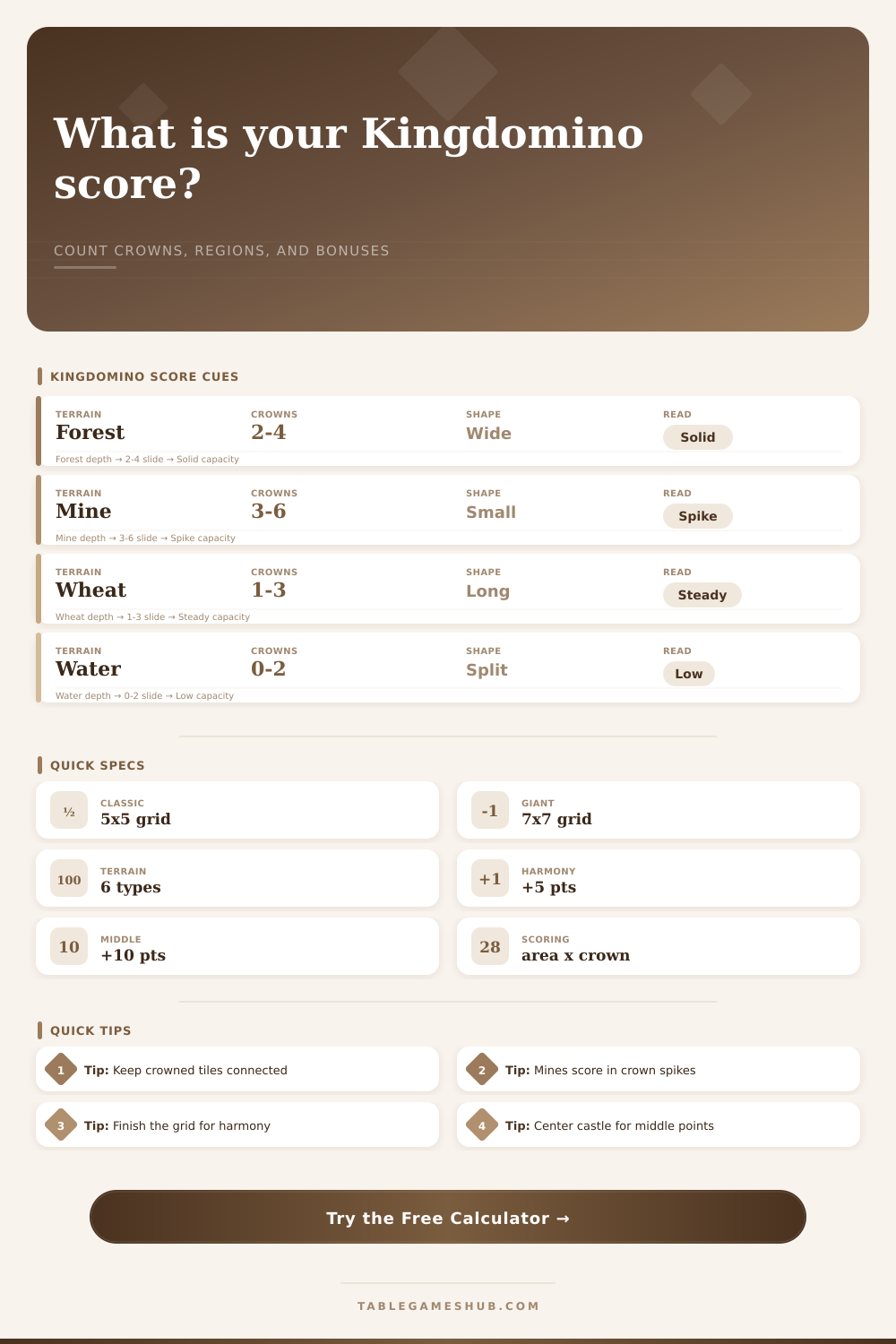
| Mines | Small terrain with high crown spikes | Enter high crowns even with few squares | Best when the mine tiles touch |
🧮Bonus Reference
| Bonus | Points | Input switch | When to include |
|---|---|---|---|
| Harmony | +5 | Harmony checked | Only when the selected grid has no incomplete spaces |
| Middle kingdom | +10 | Middle checked | Castle starts in the center square of the kingdom |
| Variant bonus | Custom | Variant bonus input | House rules, Queendomino extras, duel achievements |
| Incomplete grid | No penalty | Incomplete spaces | Used here to block harmony and show fill rate |
🗂Preset Reference
| Preset | Board | Scoring shape | Useful comparison |
|---|---|---|---|
| Forest Crown Cluster | 5x5 | One large crowned forest | Tests one-region multiplication |
| Mine Crown Spike | 5x5 | Small mine, many crowns | Shows crown density over area |
| 5x5 Harmony Finish | 5x5 | Complete grid with bonus | Checks final total swing |
| 7x7 Giant Board | 7x7 | Wide regions and more open space | Compares giant-board scaling |
📐Score Math Reference
| Input pattern | Formula used | Result cue | Manual check |
|---|---|---|---|
| One connected region | Squares x crowns | Official match | Count touching same terrain tiles |
| Multiple regions | Largest-share estimate | Lower than full aggregate | Split exact regions if known |
| No crowns | Score becomes zero | Area is filler only | Verify crown icons on tiles |
| Complete board | Terrain + bonuses | Harmony may apply | Check selected board size |
💡Scoring Tips
In Kingdomino, you lay your last domino, and you realize that math gets tricky. There are twenty-five squares containing water, mines, forests, and fields. When you finally count how many connected region you’ve got, those shapes don’t seem so hot. Hand-calculating turns can suck the joy right from the draft-and-build experience. This is especially true when you check whether that split-up forest cluster scored higher or lower different than some lumpy mine region. Knowing what you’re looking for on the next turn are less important then having an easy way to tally up your terrain scores.
It’s a multiplication, not an addition game. You aren’t just counting crowns or squaring off land; you is measuring how well those two elements intersect within connected groups. You’re looking at the overlap between those two factor in clusters, and that’s where the scoring comes from.
Why Kingdomino Scoring Is Hard
There are eight squares of wheat spread across three islands. Those three islands will get scored separately. So if you have three pieces of land that look like this: then the calculator will understand that these three regions is fragmented and therefore will score each one individually. (This is why most people overestimate their score, they don’t realize how much less connected there terrain is.)
In Kingdomino, volume versus density is key, think of mines as the classic low-volume/high-density card. A mine with three crowns on a single square score nine points. That’s enough to win hands-down over four squares of forest each holding two crowns. These kinds of patterns is spelled out in the reference table. It illustrates how mines spike; how water trails tend to drag scores down through isolation.
By entering your numbers, you’re doing an audit: did that high-risk mine play pay off? How does it compare to safer, broader field builds?
There’s a toggle switch for the two types of boards (giant vs. Classic). Changing this alters the stakes completely: a 7×7 grid provides more room for error but also require greater efficiency. Tiebreakers sometimes break up good games with bonuses. If all of your squares is filled then you get 5 points (harmony bonus). If your castle happens to be near the center of your kingdom, then you get another 10 points (middle kingdom bonus).
Easy enough right? But those mean you have to think ahead about where you want to draft from. There’s no shortage of players who don’t fill out their grid and end up getting boned because of it at the last second. One open space in the corner is all it takes. The calculator calls these out specifically. You either complete the grid or accept a slight dip in your terrain score, now that’s a concrete decision based off math instead of some vague goal.
Oh, and it takes into account any custom bonuses and variant rules too! Often house rules include things such as special achievement cards or tower height variations that give arbitrary point values. Instead of ignoring this you can add in your own custom variable. You should of added it sooner if you could. This way the score always shows exactly what happened at your table, not just what the base rule book say. This helps avoid post-game arguments like, “Well, that counts as an extra X points, doesn’t it?
So yeah, it’s ultimately all about spatial accounting in Kingdomino. You’re investing in a collection of land and the cash flows through connecting regions. The return flow from multiplying crowns. And then, the most skilled player ceases to consider tiles separately. They begin to perceive their own board as an arrangement of equations to solve. Counting becomes automatic and is left to a trusted calculator. This allows you to concentrate on what matters: the draft strategy that defines the board.
Who won? The numbers show you that answer. How did they do it? That teaches you how to win the next round. Maintain a castle near its center. Connect your regions. The score will follow accordingally.