Direct Encounter Calculator
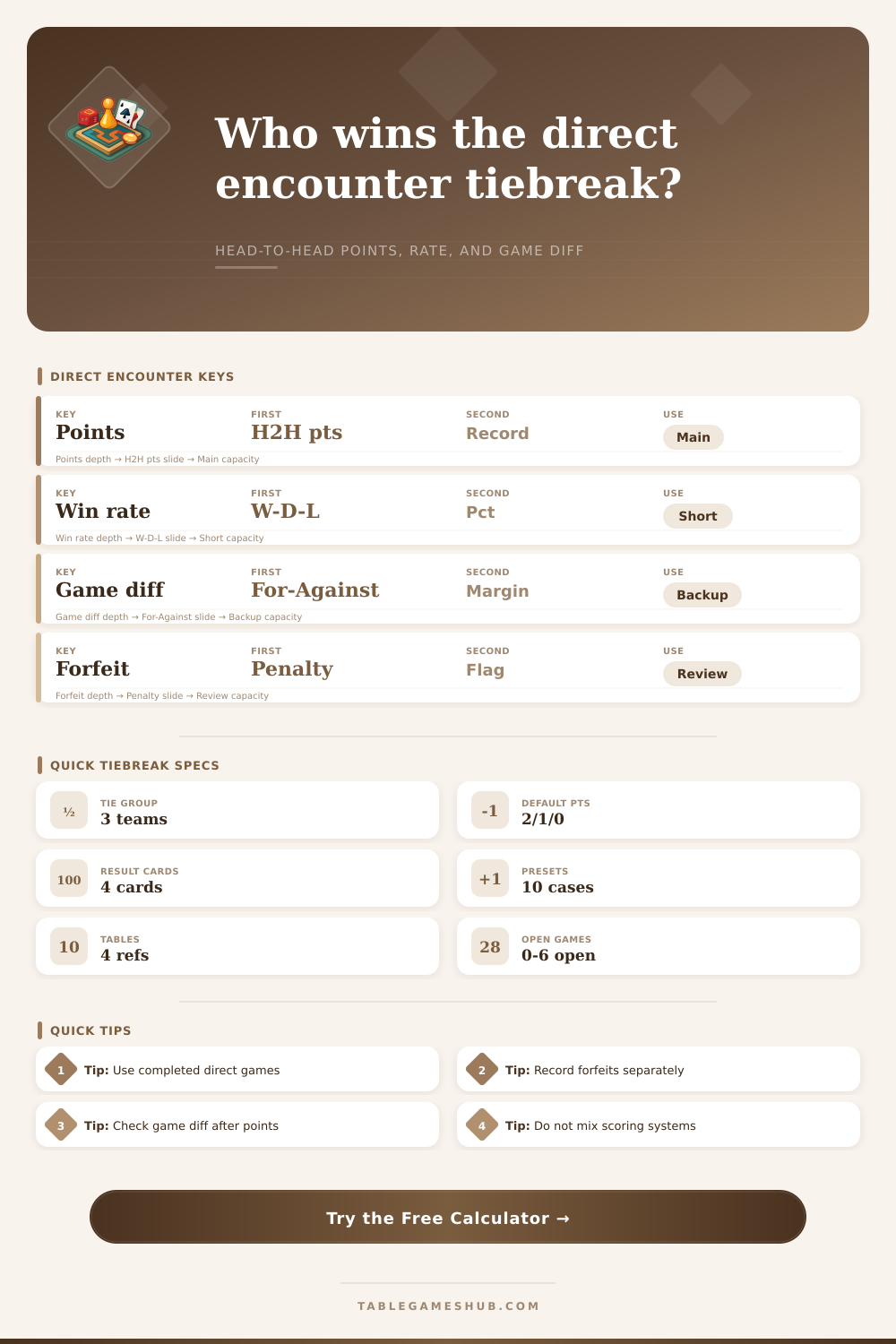
Resolve a tied group with head-to-head match points, weighted win rate, game-point differential, open encounters, forfeits, and mini-table priority.
| Tiebreak key | Formula | Best use | Watch point |
|---|---|---|---|
| Direct points | W x win + D x draw + L x loss | Most league mini-tables | Use the same point system for every tied player. |
| Head-to-head rate | (W + 0.5D) / completed | Unequal completed encounters | Unplayed handling must be written in the event rules. |
| Game differential | Game points for - game points against | Secondary split after direct points | Only compare from the same direct match set. |
| Forfeit review | Penalty and flag outside played record | Disputed or awarded results | Confirm whether rules rank forfeits last. |
| System | Win | Draw | Loss | Typical table-game use |
|---|---|---|---|---|
| 2 / 1 / 0 | 2 | 1 | 0 | Chess clubs, bridge teams, compact board-game leagues. |
| 3 / 1 / 0 | 3 | 1 | 0 | Football-style standings, long round robins, goal-diff formats. |
| 1 / 0.5 / 0 | 1 | 0.5 | 0 | Match win percentage, chess score sheets, small pods. |
| 5 / 2 / 0 | 5 | 2 | 0 | Team events where a win needs stronger separation. |
| 1 / 0 / 0 | 1 | 0 | 0 | No-draw formats, elimination seeding, best-of matches. |
| Handling | Calculation effect | Good for | Risk |
|---|---|---|---|
| Ignore open matches | Use only completed direct encounters | Clear completed mini-table comparisons | Can reward a lighter direct schedule. |
| Average open matches | Add current points-per-game pace | Unequal schedules with no fault assigned | Average can hide matchup strength. |
| Zero for open matches | Count them as no points in denominator | Missed reporting or late results | Harsh when games are genuinely pending. |
| Record only | Use W-D-L rate and skip game points | Events without reliable game-score details | Loses a strong secondary comparator. |
| Scenario | Direct points | Game diff | Priority read |
|---|---|---|---|
| Clean sweep in a 3-player tie | 4 on 2 / 1 / 0 | Usually positive | Direct points usually settle the tie. |
| Three-way cycle | Equal points | Compare diff next | Use only games among tied players. |
| One forfeit in mini-table | Penalty flag | May include awarded margin | Check whether event rules rank forfeits last. |
| Unequal completed matches | Use rate or average | Coverage matters | Never mix completed and projected rows silently. |
Remove every match against players outside the tied group before entering wins, draws, losses, game points, and forfeits.
Use direct points, win rate, game differential, and forfeit review in the same order for every tied player or team.
And so that’s where we end up with an unruly last round in the league. Three player is tied for match points and all three are holding their breaths as they wait for someone to untangle the knot. A call goes into tournament director. He opens the rule book. It’s fat. And it doesn’t say much about what happens when there’s a tie.
Look closely at the direct encounter calculator and make a clear math decision different than a he said-she said one. Because that’s what this does: it zeroes in on how you did against certain opponents; not who had most total wins across everyone. So head-to-head sounds easy enough, until it isn’t.
How to Solve Ties in Games
The first issue is that you need to construct the mini-table propery. First thing’s first: eliminate all results from people not in contention. Then you only look at matches between the contender. Immediately this can get contaminated if organizers don’t remember to throw out results from outside field. Next you input wins, draws, losses of just those games into tool.
The kind of point system you choose (three points per win like in football, or two points per win) will determine how much risk is rewarded and which player might come out on top. In case of a point tie, game differential are usually used as a backup tiebreaker. This calculates the gap between how many points you gave up in a game and how many you scored. If Team A beat Team B 2-1 and Team C beat Team D 10-0, their final score would both be 2-1, but that doesn’t tell the full story. So the lower your difference the better, unless a lower number mean more points were given up than gained.
That’s where the reference table comes into play. You’ll notice it tells you exactly where to draw the line, where the points come into play vs. Just looking at the spread in raw scores. Generally, leagues will want to use points first since it shows a higher degree of decision making rather than efficiency (of how much was scored). As a second filter, it helps prevent lopsided blowouts from dominating the standings. These blowouts often has little to do with who actually played well, unlike closer, more competitive matches.
Sometimes players don’t show up for their games; sometimes games aren’t completed. In those cases, forfeit flags and unplayed game are key. Averaging them in creates an estimation error. Ignoring them gives an unfair advantage to a player who have fewer head-to-head games. Letting you choose what to do about these gaps makes sure that the sporting merit isn’t lost by administrative decisions. Know your rules before you start: if you have forfeits in your league, does your system heavily penalize them? Flagging them separately as such will prevent them from appearing as normal losses in your win-rate calculation. It’s a small difference but helps preserve fairness when conduct issues pop up in the middle of the tournament.
When the tie group’s schedule isn’t evenly split across all player, then win rate comes into play. For example, let’s say there was a scheduling mishap and one player has competed in two straight-up matches while another has participated in three. In that case, comparing total points wouldn’t be fair. The win-rate percentage help even out the playing field as it shows how many times someone won compared to the number of games they’ve actualy finished. You’re not competing based off volume anymore but intensity of performance. Once you select the right mode, the calculator will adjust for that automatically. It does all the work behind the scenes so you don’t have to do any divisions by hand at crunch time.
The face-to-face nature puts someone accountable to the people they are working with. You can’t cower behind victories over a team that got rolled by everyone but you when your competitors all beat them and rolled each other. It is a pure test of who was better in front of whom. Once they are isolated like this most arguments dissapears as the math proves conclusively who smoked who.
Get everyone on the same page about how tiebreaks work before the first round begins or you’ll be arguing rules instead of playing games for longer than you want. Breaking ties isn’t discovering a secret champion; rather, it’s using a pre-established logic to its conclusion. The mechanism doesn’t matter as much as having everyone see how it was done.
You should of seen it coming. In a case where three guys tie, the guy with the superior record versus his peer should get the head-to-head advantage of a better seed. That’s just fair. He won it fair and square on his own merits.