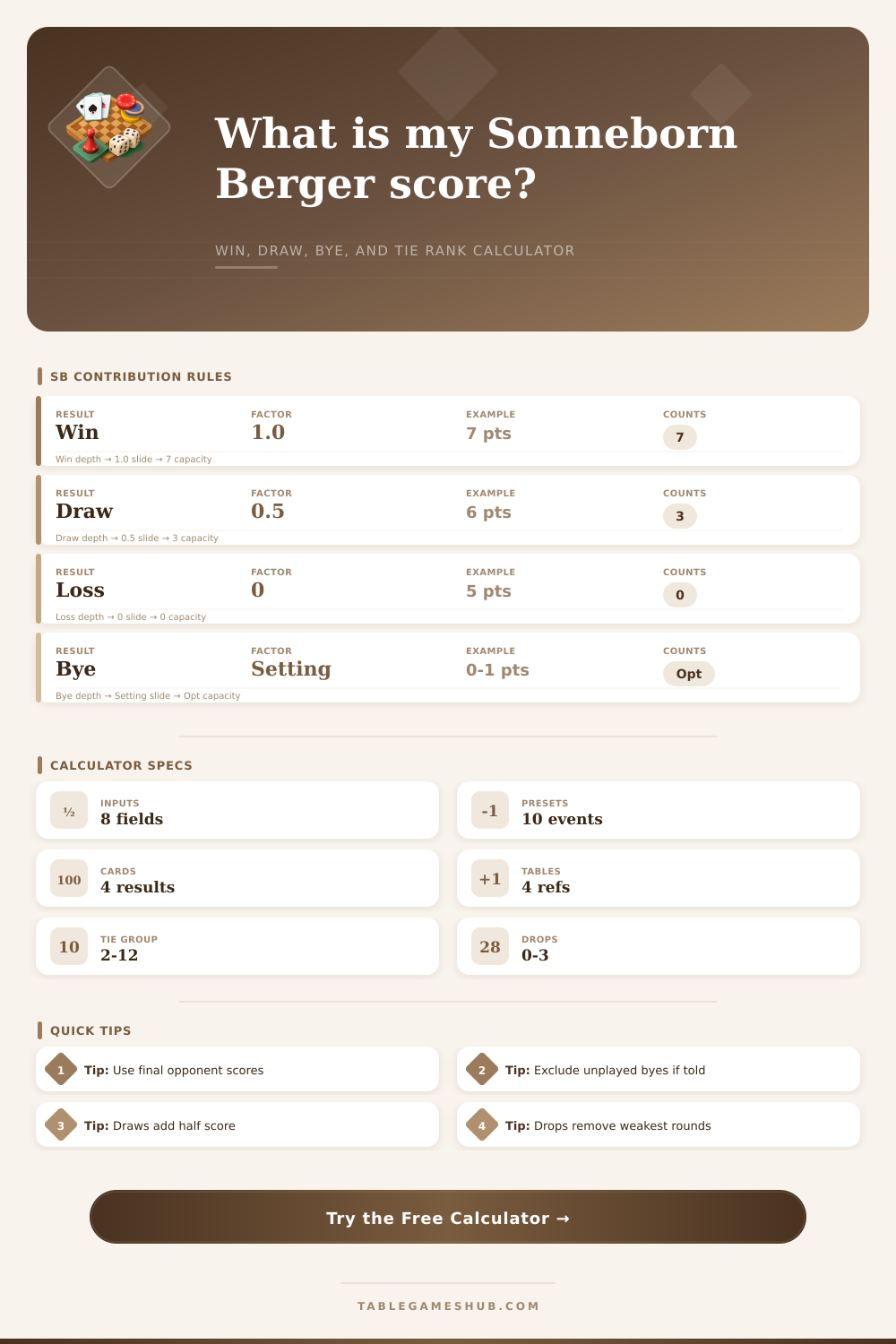
Sonneborn Berger Tiebreak Calculator
Compute SB score from final opponent points, result sequence, byes, forfeits, scoring system, dropped rounds, and tie group size.
| Result type | SB factor | Contribution example | Typical use |
|---|---|---|---|
| Win over opponent on 6.5 | 1.0 | 6.5 SB | Main strength reward |
| Draw with opponent on 6.5 | 0.5 | 3.25 SB | Shared strength reward |
| Loss to opponent on 6.5 | 0.0 | 0 SB | No direct SB gain |
| Unplayed bye or forfeit | Rule based | 0, average, or manual | Organizer policy |
| Event format | Common rounds | SB behavior | Data quality check |
|---|---|---|---|
| Swiss system | 5, 7, 9, or 11 | Rewards wins over high finishers | Use final scores after all rounds |
| Round robin | Players minus one | Very stable because everyone plays shared field | Check all opponent totals are final |
| Team board event | Match schedule | May use board points or match points | Match the published scoring unit |
| Playoff pool | 2 to 5 mini rounds | Can be sensitive to one draw | Confirm forfeits before ranking |
| Bye policy | Contribution input | When it appears | Calculator option |
|---|---|---|---|
| Exclude unplayed round | No SB contribution | Most conservative listings | Exclude unplayed byes |
| Zero contribution | Opponent score set to 0 | Events that keep round count visible | Count as zero |
| Average opponent score | Mean of played opponents | Some Swiss tiebreak variants | Use average |
| Manual assigned score | Organizer published score | Forfeit pairings or appeals | Use manual score |
| Tiebreak method | Uses your results | Uses opponent scores | Best comparison point |
|---|---|---|---|
| Sonneborn-Berger | Yes, by W/D/L factor | Yes, final scores | Who scored against stronger finishers |
| Buchholz | No result weighting | Yes, all opponents | Overall schedule strength |
| Median Buchholz | No result weighting | Yes, with high and low removed | Schedule strength with outliers reduced |
| Direct encounter | Head-to-head only | No broad field score | Tied players who played each other |
When we talk about tension in a chess tournament, usually that tension isn’t found in the games of the final round. That tension comes after two players has finished with same score and the tournament organizers must break the deadlock with a calculator. One of the most common methods of breaking a deadlock like this is something called the Sonneborn Berger tiebreak.
While it’s one of the least understood measures of competitive chess, it’s also one of the most elegant. Because it values wins over stronger opponents higher than wins over weaker opponent, it rewards players with a strong schedule.
What Is Sonneborn Berger Tiebreak?
The calculator above will take care of math for you. What it does is remove all the math so you can pay attention to what those numbers realy say about your final standing. Sonneborn Berger builds value based off a weighted result. A win counts more if you defeat someone who finished first in the event. You get half of their total added to yours if you drew and they placed second. A loss doesn’t count toward anything, something many novices forget. Losing to a grandmaster? That’s nice. It doesn’t earn you any points.
You are realy measuring the final standings of those you played against rather than just who you played. Knowing that is the key. The result is an interesting set of strategic considerations in Swiss system event. For example, players tend to be reluctant to take an easy win against someone rated below them early in the event for fear of dragging down their tiebreak value at the end. On the other hand, pursuing strong player too eagerly can lead to defeat rather than a draw. If the stronger player also goes on to perform well, you’ll still gain points from your draw.
The tool comes with reference tables spelling out the contribution rules and showing what each possible outcome (win/draw/loss) translates into numerically. No need to try to memorise the coefficients, just know that a draw equals half the opponent’s score, and use this knowledge when deciding if you really wanted to work hard enough for your stalemate.
The math alone isn’t everything; context is everything too. Forfeits and byes throw a wrench into things, especially when different tournament have varying rules for handling them. Depending on the tournament rules, they may exclude unplayed rounds entirely, award an average opponent score, or assign a zero for the bye or forfeit. Your simulator lets you set which options match each tournament’s rulebook. Having this flexibility is essential, as even differing interpretations of how byes factor into the standings can reverse the order in the tiebreaker for two player who finished in a tie.
Never trust your own math without looking at the official standings sheet; organizers will override conventional math formulas based on their own judgment.
There’s also something about tiebreaks psychologically that not many people talk about. The fact that you know what your Sonneborn Berger score is empowers you: You have some leverage in negotiating with other players for certain pairings in the late rounds or even just appealing to get a better pairing overall. Say you’re tied with someone else, but you realize your tiebreak is stronger than theirs. Then you can play slightly more conservatively since you know that drawing them will earn you a stronger place then losing would. Or say you have a weaker tiebreak; then you has to be willing to take more chances to ensure victory. It becomes less about raw skill and more about carefully managing risk.
The drop function on the calculator also mimics reality. In events, they often has to drop the worst-performing round or two so that everyone has roughly the same score. This is because having one bad competitor will drag down an otherwise strong schedule.
In the end, tiebreaks aren’t meant as retribution for defeating weaker opponents. Tiebreaks are designed to distinguish quality among equals. They take two players who ended up tied in score and say that only one of them beat the field’s best. That’s what Sonneborn Berger does. Mathematically. And it takes a complex tie and makes it a sensible ranking by who beat whom during the tournament. When you go in there, you expect to win games. But when you come out, you know that where you finished depends on who you beat along the way. You should of known that sooner.