Win Loss Draw Rating Calculator
Estimate an Elo-style rating update from wins, losses, draws, average opponent rating, current rating, K factor, draw value, and the selected rating system profile.
| Step | Formula | Meaning | Calculator field |
|---|---|---|---|
| Game count | G = wins + losses + draws | Total games in the rating period. | Wins, losses, draws |
| Actual score | S = wins + draws x draw value | Points earned before rating comparison. | Wins and draw value |
| Expected rate | E = 1 / (1 + 10 ^ ((opp - rating) / 400)) | Single-game expectation against average opponent. | Current and opponent rating |
| Rating change | Change = K x (S - G x E) | Rating movement from score above or below expectation. | K factor and results |
| Profile | Default use | Difference cap | Reading |
|---|---|---|---|
| Standard Elo | Board-game ladders and club nights | None | Best for custom community ratings. |
| Chess club | Chess events with draws | 400 points | Matches a common quick estimate style. |
| Go club | Go leagues with a simpler ladder | 600 points | Allows wider strength gaps before cap. |
| Tabletop tournament | Swiss or league board-game events | 500 points | Good for mixed player pools. |
| Online arena | Fast online match pools | 350 points | More compressed expectation for large gaps. |
| K factor | Best fit | Rating movement | Use when |
|---|---|---|---|
| 8 to 16 | Stable expert ladder | Small changes | Players have many prior rated games. |
| 18 to 28 | Normal club rating | Moderate changes | Most established tabletop or chess events. |
| 30 to 44 | Developing rating pool | Large changes | Newer ratings still need to settle. |
| 45 to 64 | Provisional or fast arena | Very large changes | Short events or intentionally reactive ladders. |
| Pattern | Actual signal | Expected score check | Rating note |
|---|---|---|---|
| More wins than losses | Positive actual score | Compare against opponent strength | Only rises if score beats expectation. |
| Draw-heavy set | Score clusters near draw value | Strong favorite may still lose points | Draws are not neutral unless expectation is 0.5. |
| Losses to stronger players | Low actual score | May be close to expected | Rating loss can be small with low expectation. |
| Upset run | Score exceeds forecast | Large positive score edge | Higher K magnifies the gain. |
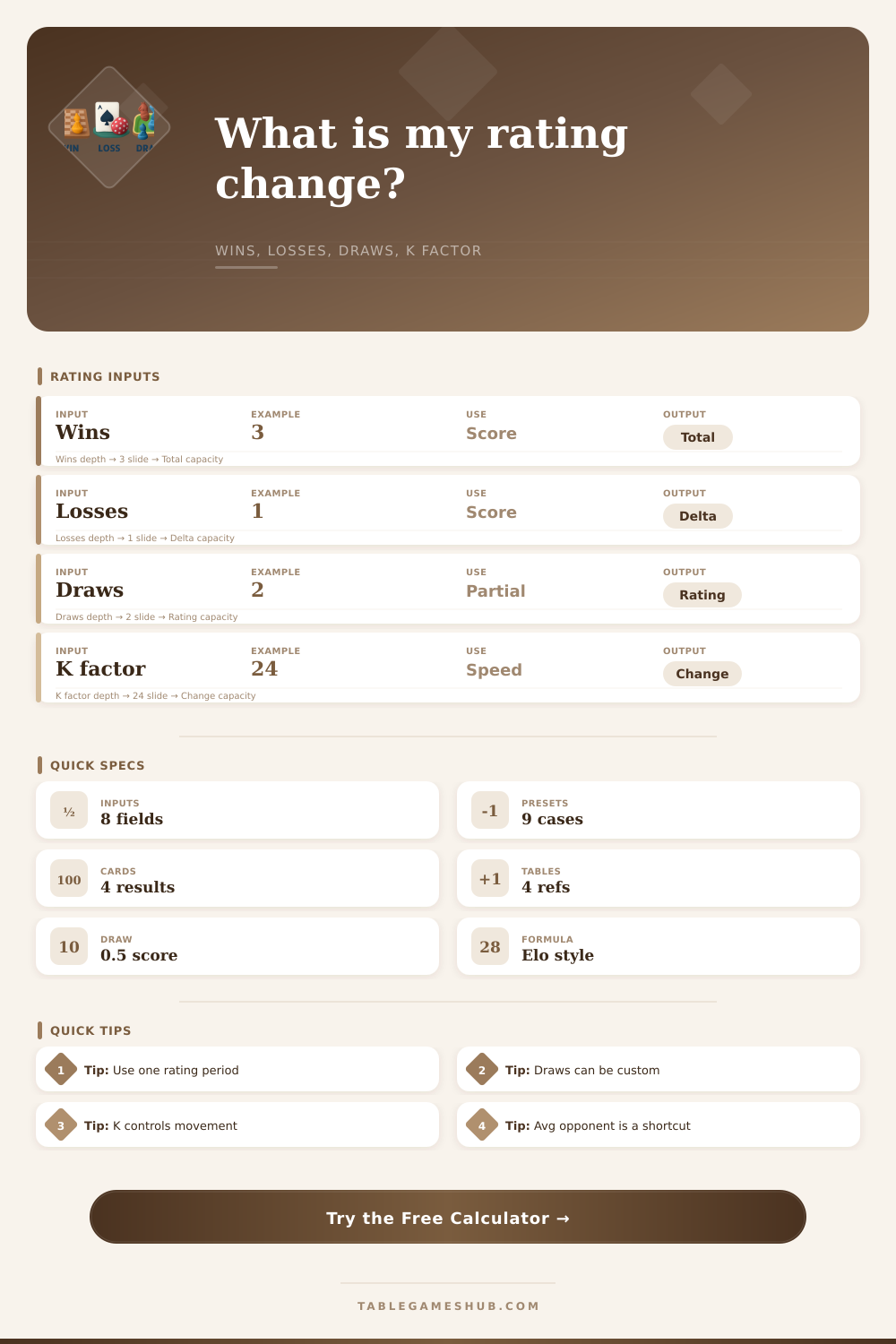
For example, you play a few rounds in a casual board game night with your friends, winning three rounds, losing one round, and drawing two rounds. Based off your gut feelings, you think you did pretty well. Your skill level have gone up. But based on the raw numbers alone, you may end up having absolutely no idea where you really are.
And that’s because ratings aren’t concerned with your feelings. Ratings is concerned with expectations. If there’s a discrepancy between what should of happened and what actualy did happen, that will make a difference.
How Rating Calculators Work
That’s why this win loss draw rating calculator tries to close the gap between math and our intuition. It looks at the messy reality of mixed results and makes a precise guess at what your new standing would be if you played an average field.
It’s an Elo system (or at least one very similar). And the concept is simple enough… On paper, if not always in real life: You’re given a starting rating. Opponents also has a rating. Based on those ratings, the math say you’ll perform as predicted. Did you beat somebody a lot better? You’ll be rewarded bigly, because you blew past expectations. You lose to somebody much lower-rated? You’ll take a severe lashing.
The beauty is that the calculator handles the complicated math of comparing your results against what was expected. This means you won’t need to sit down and crunch probabilities after each match, just enter in who you played, and whether you won/lost/drew.
There’s one other input that many folks don’t quite get, and that’s the K factor. Consider this your sensitivity dial. By having a higher K factor, the system can establishes your level faster; when you lose a lot of games or win a bunch, your rating will swing like a pendulum. That’s great if you’re new to the system since your real strength hasn’t been fully determined.
Conversely, by having a lower K factor, your rating stay relatively static. Veterans who’ve played thousands of rated match typically stay on a lower K because they’ve already proven their rating is fairly reflective of their actual skill. You can use the tool to set your own K slider to match your situation. New to the scene? Crank it up. Been playing forever? Turn it down.
Your K determines the weighting of each individual game into the final score. That’s where draws come in. Depending on the game, it’s something else. In chess, a draw is worth half a point. Some tabletop tournaments is less and include tiebreakers which weight it further. You can adjust a custom value for draw into the calculator.
Why? Because half a point instead of full points makes a world of difference when it comes to your final score. And if your results are rife with ties then getting this one right will make all the difference between an honest update vs. Rating profile. Take reference tables bundled with the tool that detail how different profiles handles those edge cases. From the more typical club play to the more compressed rating differences in online arena modes.
So you get back a performance rating and a new rating. Your new rating is where you ended up from that particular event. Your performance rating show how strong your results were compared to the rest of the field, regardless of where you started. So if your performance rating is significantly better than your new rating then that means you started out on the lower side and moved yourself up through hard work. If they’re similar then you played right in line with expectations.
So this difference allows you to distinguish between skill improvement versus just plain old good luck. People’s first instinct is to look at their winning percentage. If that’s all there is to it then you could be fifty-fifty against your opponents but still gain points because they’re good. You might even go undefeated and lose points if everyone you played was way beneath you. So it doesn’t reward vanity metrics. It rewards beating expectations.
And when you put in your opponent’s average rating, that’s what you’re telling the system: What difficulty setting did you play? Averaging a couple of easy wins with one hard loss will skew the result. Be honest here. Average out those individual games separately. That’s best. But for a quick estimate, average away.
So in conclusion: a rating is merely a snapshot of how strong you’re playing at a particular time. It’s going to ebb and flow. Sometimes you’ll play up a weight class; sometimes you’ll stumble. Your aim should be to track that trend rather than chasing a perfect number.
When you know how a win/loss/draw translates into a rating change, you cease to guess if you’re improving. You know.