Azul Queen's Garden Calculator
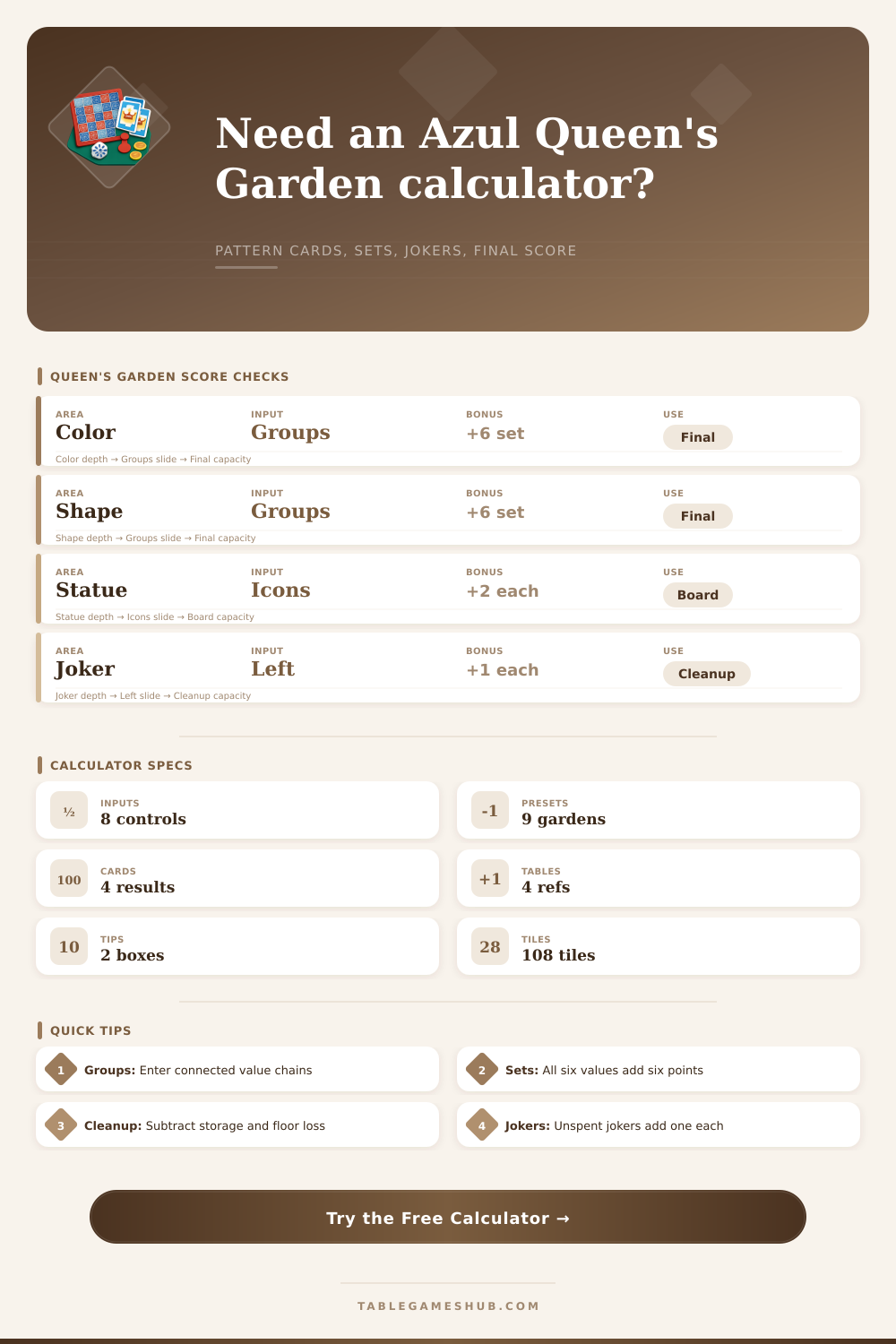
Total a Queen's Garden board with pattern card pressure, connected color runs, connected shape runs, completed six-tile sets, statue and fountain surrounds, floor penalties, joker reserve, and final score.
1Named Queen's Garden Presets
2Pattern Cards, Garden Tiles, and Cleanup Inputs
| Scoring line | Entered data | Formula | Points |
|---|
3Queen's Garden Spec Grid
4Queen's Garden Reference Tables
| Tile value | Common symbol shorthand | Placement cost reminder | Final score role |
|---|---|---|---|
| 1 | Tree or small planting | Lowest payment pressure | Adds 1 to each connected color or shape group |
| 2 | Bird or low ornament | Moderate payment pressure | Adds 2 to the group sum |
| 3 | Butterfly or mid planting | Needs matching support | Adds 3 and often bridges partial sets |
| 4 | Flower cluster | Costs four matching value | Adds 4 to color and shape chains |
| 5 | Pavilion feature | High payment pressure | Adds 5 and anchors heavy groups |
| 6 | Large flower or showpiece | Most expensive tile | Adds 6 and completes the highest set value |
| Group state | Example entry | Score formula | Use it when |
|---|---|---|---|
| Small connected color group | 1+3+4 | 1 + 3 + 4 = 8 | Same color tiles touch through the garden |
| Complete connected color set | 1+2+3+4+5+6 | 21 + 6 set bonus | All six values of one color connect |
| Partial connected shape group | 2+4+6 | 2 + 4 + 6 = 12 | Same symbol appears across several colors |
| Complete connected shape set | 1+2+3+4+5+6 | 21 + 6 set bonus | All six colors of one symbol connect |
| Evaluation focus | Calculator estimate | Best matching input | Score impact |
|---|---|---|---|
| Royal Arbor | Rewards healthy color groups | Connected color chains | About 10 percent of color score |
| Butterfly Walk | Rewards symbol spread | Connected shape chains | About 10 percent of shape score |
| Bird Bath | Rewards ornaments near lines | Statues and fountains | Two points per surrounded icon |
| Queen's Pavilion | Rewards full set pressure | Completed set counts | Three points per complete set |
| Cleanup item | Entry format | Calculator treatment | Practical note |
|---|---|---|---|
| Floor penalties | First P in P/J | Subtracts from the score | Use total loss from floor and storage cleanup |
| Unspent joker tiles | Second J in P/J | Adds one point per joker | Keep only true leftover jokers here |
| Surrounded statues | Statue input | Adds two point audit value each | Also reminds you why jokers appeared |
| Negative floor floorcap | Any penalty | Final score cannot drop below zero | The displayed total uses a zero floor |
5Scoring Tips
Double-audit dense tiles: a high-value tile can score once in a color group and again in a shape group when both connected sets are valid.
Record cleanup separately: keep floor and storage penalties in the first cleanup number, then enter only unspent joker tiles after the slash.
Drawing risk, drafting tiles, playing them out, and then settling up at the end is what makes Azul so exciting. Jokers is spent when you place them but don’t come back in. Storage overflow and floor penalties subtract points from your final score. Your board points determines if you’ll win or lose. Use our calculator to see grand total. There’s no need to count tiles or crack open rule books again. A complex board becomes a straightforward number.
The scoring mechanism has two dimensions: Shape Group and Color Group. Each tile are part of both a shape group and a color group. If there’s a purple butterfly, it contribute toward butterflies as well as purple chains. Many people gets stuck on color because they’re easy to see. They fail to notice shape groups. To give you the big picture, the calculator lets you enter connected groups for both dimension separately. For each dimension, you enters in connected groups. It makes sure you know that a tile can contributes to your score TWICE if it matches into 2 sequences.
How the Calculator Helps You Score in Azul
The input is clear but the data entry is not perfect. Simple addition chains to describe your connected runs. Enter all those purple tiles valued 1-6 together. They’re just one group. The tool adds standard bonus for filling out that set. It lets you focus on the game while it do the math. How do they become groups? Tables of examples on the page explains. This is in case you haven’t quite got the hang off what’s considered connected yet.
The game gets won and lost in cleanup phases. Penalties builds up silently through the game when you lay on floor tiles. They feel minor in the moment but add up significantly by the end, but it adds up. The game takes those away from you early. It asks for the penalty score right at the start so you can see how total effect will play out.
The game keeps track of your remaining jokers as well. You gets one point for each joker left over. This doesn’t sound like much. Until you consider that hanging onto jokers may be more valuable than using them to make a big move with no bonus. That’s a nuance. You could of used some jokers to get a premium tile. Then if it doesn’t help form a set…or continue a row…you’ve paid dearly without gaining anything.
More strategy comes from the pattern cards Additional points can be earned by placing tiles according to specific patterns on active cards. The tool calculates how many additional points you get based off which pattern is currently played. Does your board match any of the spread out symbols? Do you have color group? Are there other modifier goals? It’ll check that too. A live estimate will tell you how closely your board meet those goals. No need to remember each card’s modifier. Enter what you see and let it do math.
You’ll notice that there is also fountains and statues. These are immovable fixtures on the board and require thought when placing tiles around them. They’re often missed until its too late. There’s a field for surrounded icons in the calculator which will add the value of those icons into your total. It encourages you to think about space constraints early on in the game. Ignore statues now and you might block your own placements with higher penalties and lower scores later.
Instead, it’s less about crunching numbers and more about validating your strategy. It tell you why you’re getting points and where you should be looking to get more. For example, you might find that your shape groups contributed half of your bonus points, even though you thought you were playing for color dominance. That knowledge altered my approach to the next round. I began viewing the tile as an asset that needed to earn me points for both shape and color.
It’s a chaotic affair, and that’s the point: tiles topple over; stacks go bust; jokers are squandered on risky plays. To get good, you must accept the chaos and understand how big it is. Understanding cause-and-effect turns guesswork into calculation. You can tell at any moment what you’ve got… And why.