Splendor Duel Privilege Calculator
Audit a Splendor Duel position with privilege scrolls, gem tokens, pearls, gold, crowns, card points by color, royal cards, replenishment risk, and progress toward each instant win condition.
1Privilege Position Presets
Load a named duel state, then tune the scroll count, token purse, card color points, crowns, royal status, target card, board refill risk, and opponent pressure.
2Scrolls, Tokens, Crowns, and Win Tracks
3Duel Spec Grid
4Privilege and Token Reference Tables
| Scroll position | Token meaning | Calculator tempo | Best use |
|---|---|---|---|
| Zero scrolls | No pre-action correction | Negative if refill is hot | Take only if the board keeps a safe route. |
| One scroll | One precise token before action | Small positive | Patch one color or pearl gap. |
| Two scrolls | Strong token steering | High tempo | Prepare a point card while denying the shared board. |
| Three scrolls | Maximum privilege bank | Cap bonus | Spend one before a refill that would otherwise help the opponent. |
| Resource lane | Entered field | Scoring effect | Risk note |
|---|---|---|---|
| Five gem colors | W/B/G/R/K | Counts direct payment toward the target card | Short colors can be covered by gold or scrolls. |
| Pearl tokens | P in the purse | Counts only for pearl-cost cards | Pearl shortage raises buy delay sharply. |
| Gold tokens | Gold in the purse | Wild cover after regular tokens | Gold does not replace a missing pearl in this model. |
| Privilege scrolls | Scroll input | Adds pre-action reach after payment gap | Spending scrolls may expose the next refill. |
| Crown band | Royal status | Progress signal | Calculator call |
|---|---|---|---|
| 0 to 2 crowns | No royal draft yet | Early crown setup | Value crowns only if the target card is affordable. |
| 3 to 5 crowns | First royal should be claimed | Middle royal tempo | Unclaimed royal value is shown as lost tempo. |
| 6 to 9 crowns | Second royal should be claimed | Win threat building | Every crown card threatens the 10-crown finish. |
| 10 crowns | Crown win reached | Immediate finish | Calculator reports crown lane as complete. |
| Win condition | Threshold | Inputs used | Warning band |
|---|---|---|---|
| Total prestige | 20 points | Card color points plus royal status | 16 or more points enters finish watch. |
| Single color prestige | 10 points | Highest W/B/G/R/K point lane | 7 or more in one color is a color-race threat. |
| Crown victory | 10 crowns | Crowns owned plus target-card crowns | 8 or more crowns is a tactical emergency. |
| Opponent refill pressure | Board state | Risk selector and privilege tempo | Hot, danger, and lethal states reduce tempo. |
5Two Splendor Duel Privilege Tips
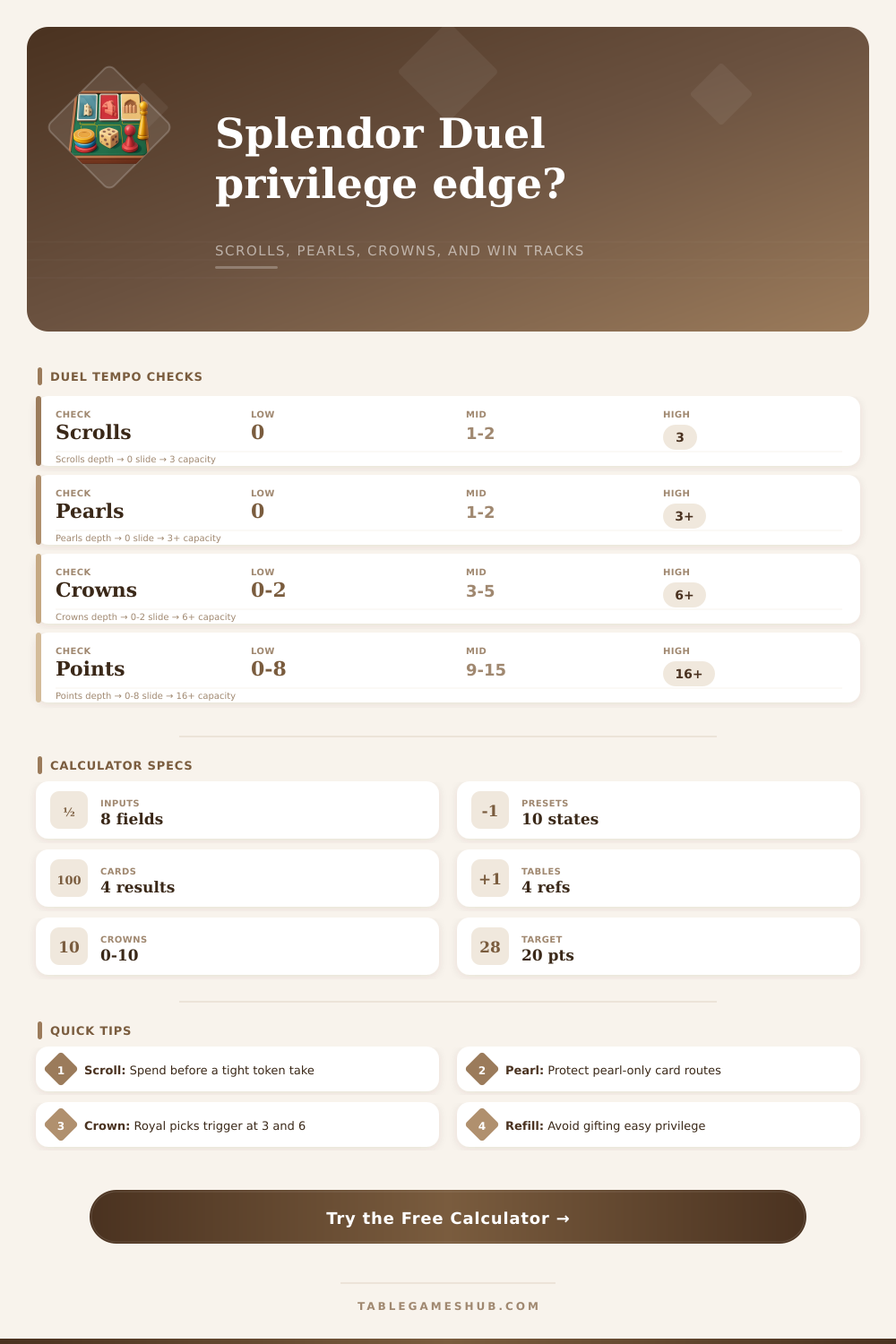
Spend scrolls where they change the buy: a privilege token is strongest when it converts a one-token gap into an immediate card, especially for pearl cards or crown cards that trigger royal picks.
Score refill risk before taking tokens: if your action refills the board into a pearl, crown, or same-color point route for the opponent, treat the tempo score as a warning, not a bonus.
Splendor Duel’s ability to make you pause before using a privilege scroll is often why you do it. You crave that instant gratification, but are concern that the board refill might aid your adversary. Why does this matter? Resource management is deceptively thin in this game. You know which cards you can buy, but you don’t know timing or the effects of each card, except for their cost.
Enter: the calculator. Plug in your number of crowns and tokens in your purse, and let it crunch numbers for you. No more guesswork over if taking that extra turn of reach is worth risking an unstable board state.
Why You Should Use the Calculator Tool
This brings us to the most versatile tool of them all: privilege scrolls. Use them to fill a gap in your gem count or gain a pearl before your main action. This flexibility comes at a price, though. Each scroll held represents a lost timing opportunity and each scroll spent alters terrain on the following round. Looking through those multiple lenses allows you to audit that decision. A scroll isn’t just telling you how much you can get away with spending, but also whether it will establish a winning condition or give your opponent a direct line to victory.
Take pearl tokens for example. Unlike the five basic gem colors, they’re their own color and can’t be replaced with normal reserves/gold. Because a shortage of pearls often creates a bottleneck, it may not seem like much until it halts you dead in your tracks. When you input how many pearls you have, the system will check if you has enough to secure a pearl-rich route. If you come up short, the calculator will very probablly identify this as a risky situation; those tokens on the board scream “grab me” to your opponent. It is a tiny detail, sure, yet it controls entire mid-game flow.
And then there are the royal cards and crowns. Once you hit three or six crowns, you get an instant choice from the royal deck. This adds points and changes balance of power. This is where the table on the page helps. It lays out how these thresholds interact with your current prestige lead. So while one person might be in a different tactical universe with seven crowns and their opponent having two, it’s a totally diffrent situation if you both has four. The tool maps out that pressure. It tells you when it’s safe to go for a royal card and when it puts you at risk for a counter-attack on those same color point tracks.
Winning isn’t just about reaching twenty points anymore; you can also win by getting 10 crowns in total or 10 prestige points on one color of gems. That’s what makes each choice so complicatedly. What appears advantageous for your overall score could actualy hurt your chances of winning because it enables your opponent to close out one of the colors before you do. The computer calculates your progress across all three lanes and shows you a percentage of how likely it is that you will be able to close the game out. It requires you to consider your opponent as much as yourself.
Too many people think only about what they’re doing next without considering what happens on the board when they do it. For example: what happens when you buy something? You put back onto the board a set of cards and gems which your opponent can use to get a good card easly. You’ve just paid your opponent money to advance ahead of schedule. That’s why the risk selector in the tool considers how hot the refill is, helping you judge whether the refill lets you go all out. It also considers if the refill is so dangerous that you’ll need to slow down or deny resources even if it hurts your tempo.
There are also presets which you can use to test out some scenarios before committing to creating them from scratch. Load up a Pearl Vault Pinch to learn about what happens when pearl tokens become rare and your buy reach goes down. Try out a Royal Crown Rush to get a feel for the pressure of having to win on crowns. By playing around with states, you’ll internalize the thresholds. Eventually, you won’t need to bring this tool out at each turn. You’ll just instinctively know when you should spend a scroll and when you shouldn’t.
You could of kept it in reserve as an insurance policy. So, in conclusion, Splendor Duel is a game about building your hand out carefully but also keeping an eye on how you can prevent your opponent from easily doing the same thing. The calculator makes it clear where these paths exist. It strips away the noise and highlights the real leverage points in your situation. Is it chasing points? Color dominance? Crown chases? Great play always has later effects of what your current resources will do. Refill risk becomes something to keep an eye on, because here, sometimes the best move isn’t one at all, just the one that doesn’t seem like a move.