Earth Abundance Calculator
Total an Earth-style tableau score with plant card points, growth tokens, sprouts, soil and water reserves, compost cards, canopy coverage, event points, ecosystem bonuses, and a final abundance rating.
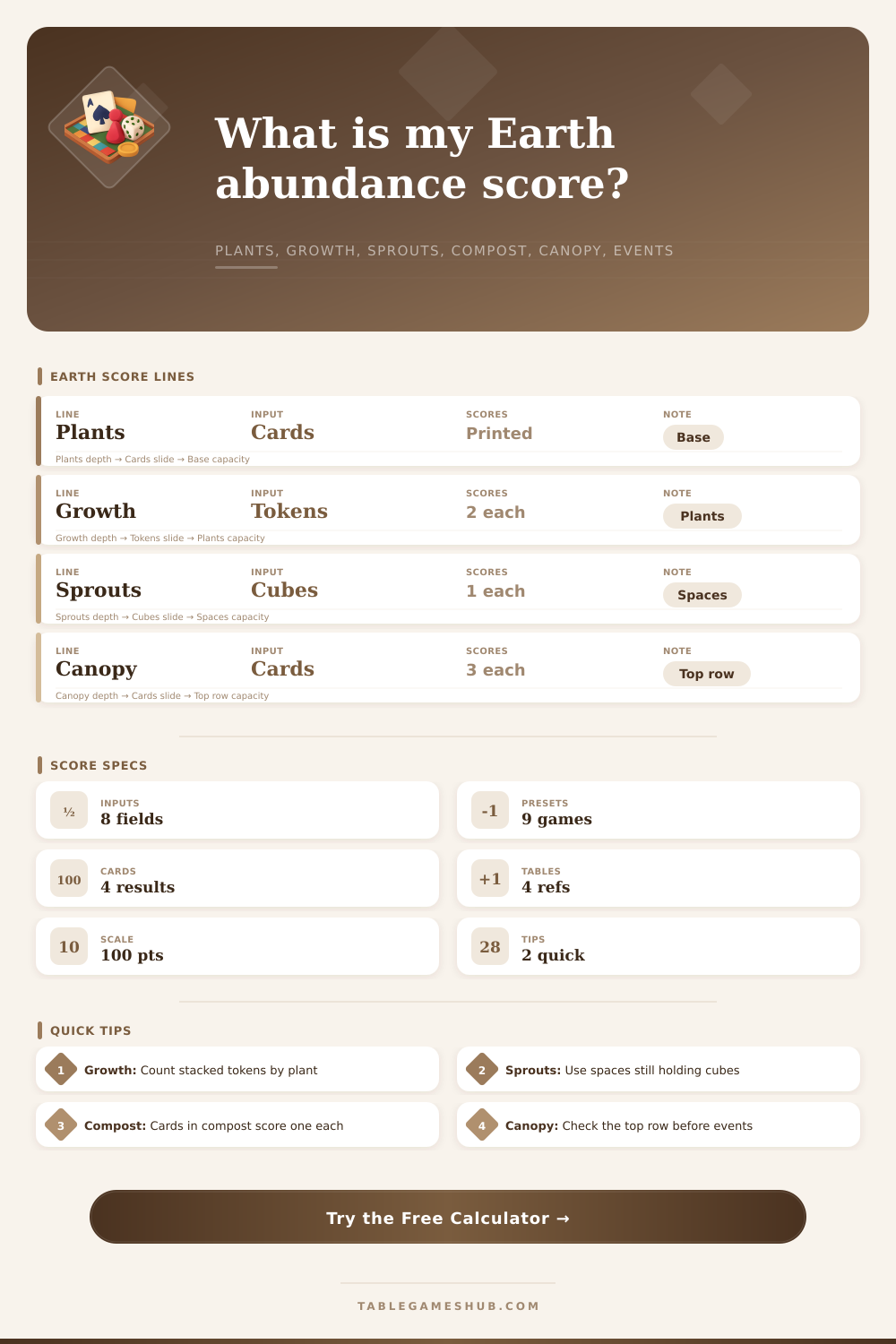
| Score line | What to count | Calculator value | Audit cue |
|---|---|---|---|
| Plant card base | Printed plant and terrain points | Entered directly | Separate printed points from events. |
| Growth | Growth tokens on plants | 2 points each | Stacks matter, empty spaces do not. |
| Sprouts | Sprout cubes still present | 1 point each | Only remaining sprouts score. |
| Compost | Cards in compost pile | 1 point each | Do not count cards still in hand. |
| Ecosystem focus | Full bonus trigger | Partial trigger | Best signal |
|---|---|---|---|
| Balanced habitat | Plants, tokens, cycle, canopy all active | Three active systems | No single line carries the score. |
| Canopy crown | 8 or more canopy cards | 5 to 7 canopy cards | Top row is the visible engine. |
| Sprout bloom | 32 or more sprouts | 18 to 31 sprouts | Sprouts outpace growth tokens. |
| Compost loop | 24 or more compost cards | 12 to 23 compost cards | Recycling fuels the final score. |
| Archetype | Common lead line | Support line | Calculator watch item |
|---|---|---|---|
| Verdant canopy | Canopy cards | Plant printed points | Check canopy count before events. |
| Sprout meadow | Sprouts | Water reserve | High sprouts need final space check. |
| Compost cycle | Compost cards | Soil reserve | Compost can hide missed points. |
| Event orchard | Event card points | Plant card base | Resolved events should be final values. |
| Audit pass | Count first | Then verify | Why it matters |
|---|---|---|---|
| Plant tableau | Printed card points | Canopy row cards | Base points and canopy are easy to mix. |
| Token sweep | Growth and sprouts | Occupied plant spaces | Only tokens still on cards score. |
| Resource sweep | Soil and water | Balance bonus | Harmony score uses the lower reserve. |
| Final sweep | Compost and events | Ecosystem focus | These lines often decide the rank. |
It’s not as simple as counting up points on cards. Earth-style games adds levels of ecology onto simple arithmetic. In this game, you’re working with a constructed ecosystem. Every piece, from every token to every plant and resource, has value to a living system that add up in an odd way. The calculator do the math for you. It understands the multipliers of growth tokens. It understands the bonuses associated with canopy coverage. So you can understand what happened with your tableau.
Base plant cards are foundation to all scores. These numbers printed on them is like the structure itself: how strong your forest or garden will be. Unlike changing (and random) aspects of other components; such as wild events, or your neighbor’s moves; these numbers never shift. But there’s also the trap of falling into thinking that getting lots of high-plant-points are enough. That’s where mechanics of support come in, and why some newbies don’t take them into account.
How to Score Points in the Game
A token of growth stacked on top of one of these cards act as a multiplier of sorts. That’s why when the rulebook says a growth token is “worth” twice its face value, it acts as a multiplier for that plant vitality. If you pile enough of these tokens up on one card, a low-cost plant become a point machine. It transforms from sapling to giant oak. It’s less about what you planted, than how much has grown.
With sprouts, there is another strategy: they take up space and don’t last long. When it’s time to score, each cube that remains as a sprout counts toward your point total. And this adds an edge of competition early in the game. On the one hand, you want to populate the board with these young thing so you get some cheap points early. On the other hand, you must turn them into larger plants before running out of room. If you let your board fill up with unresolved sprouts, you limit your scoring potential.
It’s a tool that tells you if you went all-in on fast expansion at the start, but never had something stable enough later in the game. It shows the balance between numbers and maturity among your living resource. Water and soil, though often viewed only as an expense associated with doing something, have real value in-game; and there’s no reward for hoarding them at the end of the day. A harmony score will balance your supply reserves, favoring efficient use rather than just stockpiling.
The amounts don’t have to be exactly equal, but large differences in what you’ve collected show you’re wasting turns gathering one resource without considering the other. It’s a small bonus but it makes a difference, punishing overly specialized hoarders who neglect to keep up with very basics needed to sustain their plants health. It considers this harmony when calculating your total ecosystem rating, so having a bulging inventory won’t always equal being in a good place.
The compost cards also include a scoring element called recycling. You don’t just discard your cards into the compost pile to recieve a fresh set. Instead, each card in the compost help increase your end-game score. You should be cycling through your hand instead of holding on to lesser cards too long. Composting actively involves you in your final score. So composting is a double reward: it’s quick adaptation and it’s aggressive play.
Players who hang on to cards tend to end up with a full hand of lower-scoring plant. Frequent composters creates a second scoring track that runs parallel to their primary garden. The vertical: Canopy coverage scores adds another dimension to the score. If certain conditions is met, cards at the top of the row earn big points. That encourages the player to build upwards, to create layers in their habitat. Just having a large area isn’t sufficient; it requires depth as well.
The tool lets you play through various modes where you select what you want to focus on. Perhaps you want to maximize sprout density more than canopy height? Maybe you want to see if your current board state fits some typical ecosystem (a meadow versus a dense forest?). These are wildcards: events. The events throw the power dynamic out of whack in fun ways.
They’ll give you points right off the bat toward your total, but many depend upon other factors. For example, an event may reward you for having many sprouts (a bloom event), while punishing you for not watering any (a drought event). These wild cards hinge on connection between your inner picture and external forces. The tool crunches it all together into one rating of relative abundance. It gives you a clear picture of how well you’re doing.
It’s not about racking up points; it’s about building a growing ecosystem that makes sense together. If you’re trying to grow a healthy compost system or a rich tree canopy, each step will fine-tune your game plan for the next round. The calculator translates big-picture green ideas into actual numbers, showing exactly how your actions play out in real world. Every decision matters, and your garden shows what it’s made of, literally.