Power Grid Recharged Calculator
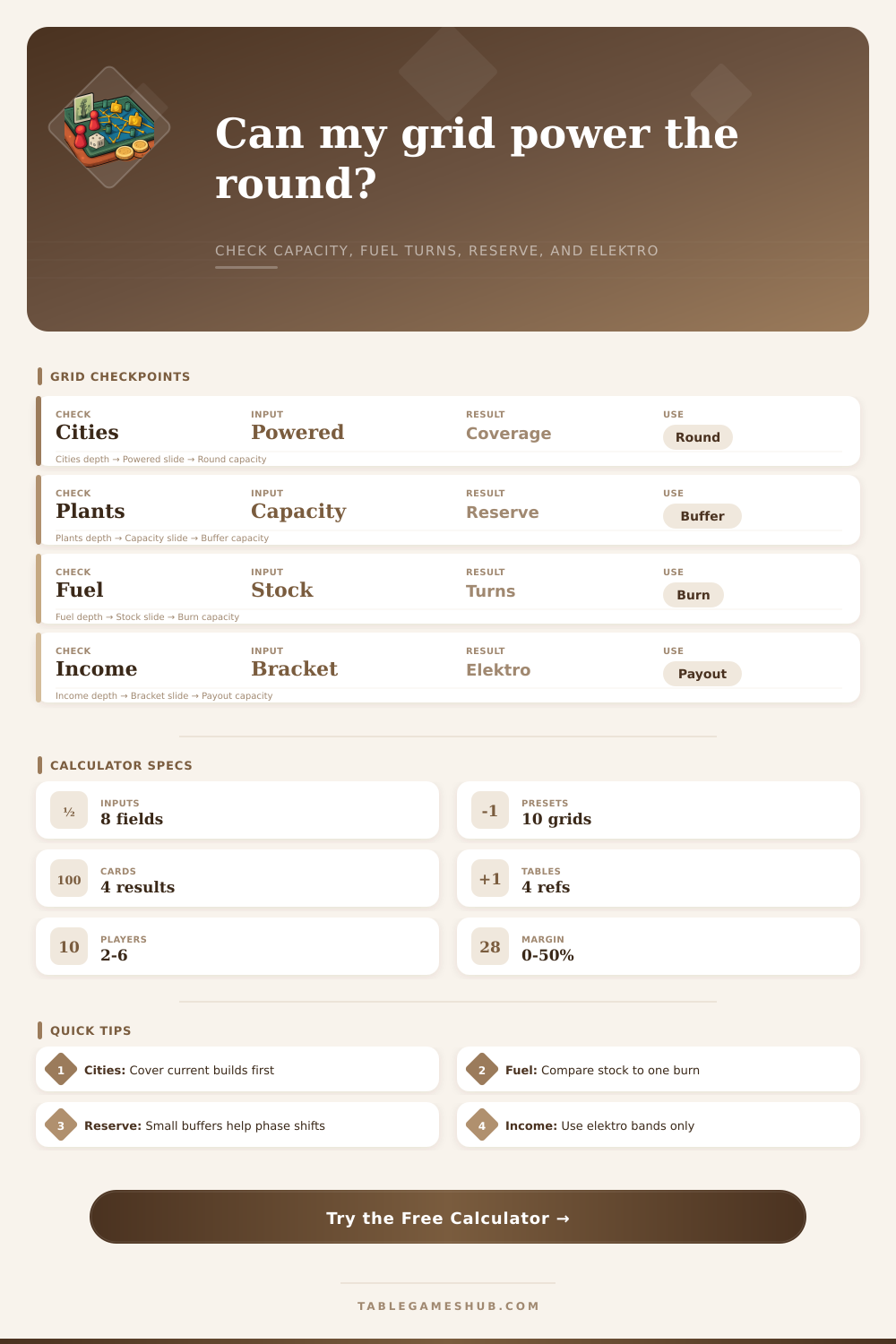
Audit a single player grid for the next bureaucracy: cities powered, plant capacity, fuel stock, resource burn, income bracket, player count, phase, and reserve margin.
Capacity covers all selected cities.
Below the selected reserve target.
Enough stock for one full burn.
Matches the middle elektro band.
| Cities Powered | Income | Band | Audit Note |
|---|---|---|---|
| 1-4 | 22-54 elektro | Low | Early grid payout |
| 5-8 | 64-90 elektro | Middle | Most midgame checks |
| 9-12 | 98-118 elektro | High | Large network payout |
| 13-20 | 124-150 elektro | Top | Endgame payout cap |
| Step / Phase | Reserve Feel | Capacity Check | Table Signal |
|---|---|---|---|
| Step 1 | 15-25% | Cities plus spare | Networks are smaller |
| Step 2 | 10-20% | Match next build | More city spaces open |
| Step 3 | 0-15% | Cover final demand | Endgame timing matters |
| Final round | 0-10% | Power maximum cities | Unused reserve is only a buffer |
| Fuel Turns | Stock State | Burn Check | Calculator Verdict |
|---|---|---|---|
| 0.0x | Empty | No full burn | Fuel short |
| 0.1-0.9x | Thin | Partial burn | Short this round |
| 1.0-1.9x | Ready | One full burn | Round covered |
| 2.0x+ | Stocked | Multiple burns | Reserve stock |
| Players | Grid Tempo | Capacity Pressure | Reserve Cue |
|---|---|---|---|
| 2 | Open | Lower | Keep a modest buffer |
| 3-4 | Balanced | Medium | Match phase target |
| 5 | Tight | High | Track next plant gap |
| 6 | Crowded | Very high | Audit coverage every round |
By this time, you’ve established a network of cities throughout the map. It’s an impressive web of wires connecting your towns to their power plant. On board, it look cool. However, when you go to grab some resources to ensure lights stay on, your hand comes up empty. That’s what happens in the classic Power Grid Recharged trap. You expanded but forgot about logistics required to support your growth.
Auditing your grid before each turn instead of after can be the difference between being a dominant player and someone who folds early. You input your starting data (number of cities, fuel stock, existing capacity), let the calculator do the work, and it spares you the brainpower needed to juggle a bunch of numbers at once. It also makes you face a blunt fact: Your theoretical capacity is different than your actual power.
How to Win at Power Grid Recharged
There’s a gap… Known as the reserve margin, between the sum of all your production and amount of cities you’re already servicing. A healthy grid always have some wiggle room. This surplus capacity lets you pick up another city when it is time to build again. This means you won’t need to make an emergency purchase of pricey plants midway through the round. If you don’t have this safety net, then one savvy competitor can snatch up a city and put you either on a pricey detour or completely out of commission.
The majority of players gets bogged down in fuel management. The temptation of purchasing whichever resource is priced the lowest can be very strong. However, without considering your burn rate compared to your current stock, you’re running on borrowed time. If your inventory only covers half a round’s consumption, you’re livig on borrowed time.
The tool helps in visualizing this through comparison between your projected use and your stockpile. This comparison tell you whether you are stocked for immediate needs or if you need to pivot your buying strategy before the market prices climb. As the game progresses, resources become scarce and serve as weapons. Fuel longevity is something that many players neglect which leaves them scrambling to purchase overpriced supplies while others sit back and watch them bleed money.
Another wrinkle is income brackets, which also need some thought. These determine how much elektro you get based off where you rank among all players in terms of cities powered. That number change dramatically every round as others are extending their own network. If you’re safe in an upper bracket now, another player may go nuts and knock you down a few notches. Fortunately, the calculator comes with a set of helpful tables of reference showing what those cutoffs look like.
Use them to see which bracket has the best return per unit risk given your state of development. Going after the big money too soon could of backfire horribly if it necessitates adding cities so quickly that you overextend your plants and fuel supply.
The size of player pool at your table also changes the pace of network expansion and resource consumption. Six people means rapid resource depletion and a hungry competition for the lowest-cost plant. Being passive simply won’t cut it; every move requires pinpoint accuracy due to short supply lines. Two people let you coast with more leisurely play, but you better scale efficienty if you want to stay economically ahead. Knowing this will help you predict the pace at which you should lock down your upcoming power source and adjust your reserve target to match.
In conclusion, Power Grid Recharged isn’t won by the player who draws the flashiest map; it’s won by the one who keeps his or her operations running reliably over time. Expand sustainably, each new city needs to be fueled and capable of supporting itself for several rounds. Monitor both your reserves and coverage, which turns uncertainty into calculated risk. Refill your fuel tank and level out your buffer, because while your competitors go dark, your grid will still hum right along.