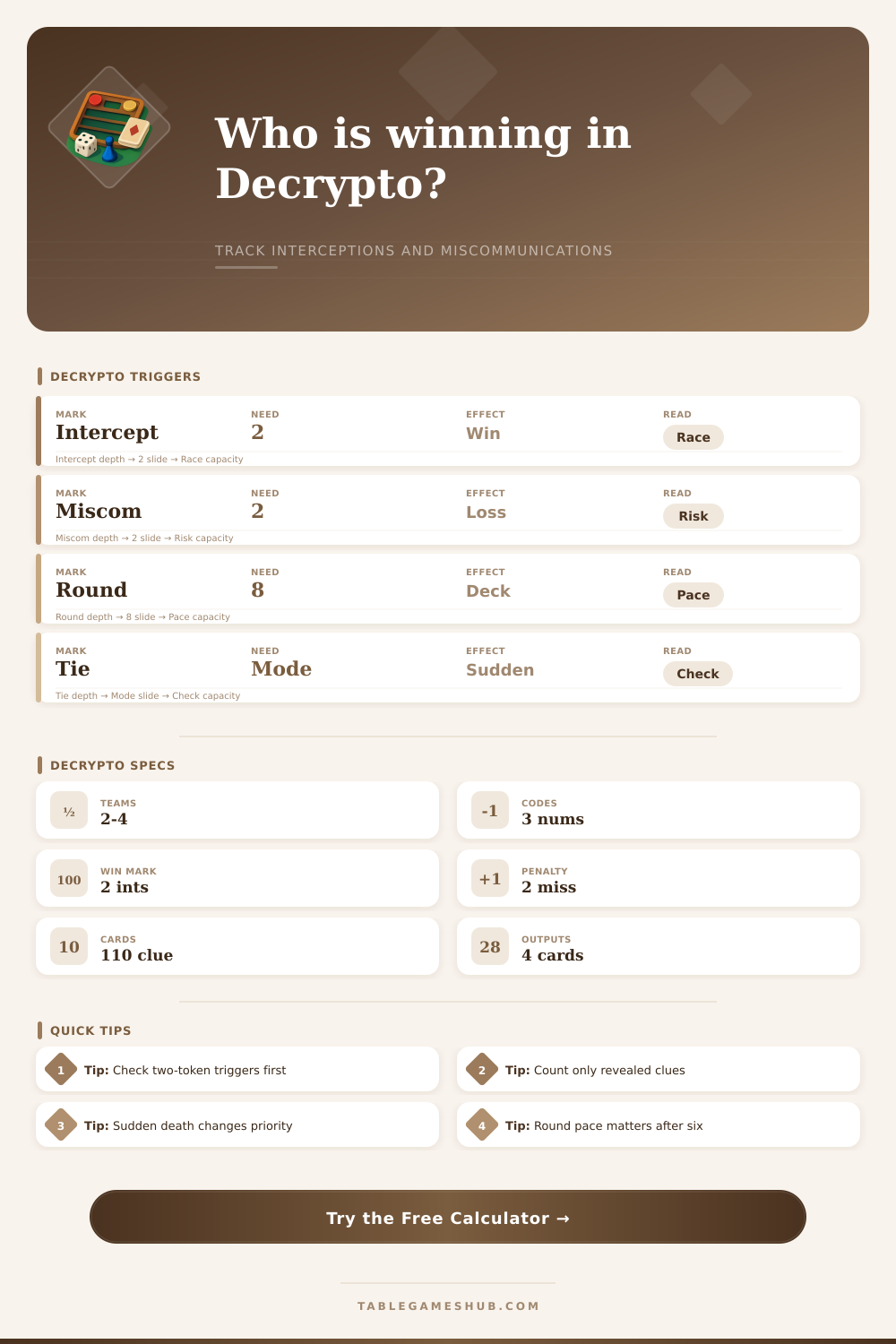
Decrypto Score Calculator
Score the current Decrypto match from interceptions, miscommunications, rounds, clue cards used, team count, sudden death state, and the active win condition.
| Trigger | Official Count | Calculator Use | Result Meaning |
|---|---|---|---|
| Interception token | First team to 2 | Positive race score | Team has cracked opposing clue patterns. |
| Miscommunication token | First team to 2 | Penalty threshold | Team has failed internal decoding too often. |
| Both happen together | Check timing | Sudden-state label | Use table ruling for simultaneous end states. |
| Variant threshold | 2 or 3 tokens | Win mode selector | Classroom and endurance modes change cushion. |
| Round Band | Typical State | Score Read | Calculator Note |
|---|---|---|---|
| Rounds 1-2 | Opening clues | Volatile | One token is useful but not decisive. |
| Rounds 3-5 | Pattern forming | Stable read | Interception edge starts to matter. |
| Rounds 6-8 | Words exposed | High pressure | Miscommunications become harder to absorb. |
| Round 9+ | Extended table | Variant pace | Deck pressure and repeated clue families matter. |
| Cards Used | Deck Share | Pressure Band | Interpretation |
|---|---|---|---|
| 0-22 cards | 0-20% | Low | Plenty of clue space remains. |
| 23-55 cards | 21-50% | Moderate | Repeated clue families are easier to spot. |
| 56-88 cards | 51-80% | High | Late-game clue discipline matters more. |
| 89+ cards | 81%+ | Extreme | Variant or event tables should audit the deck. |
| State | Next Token | Winning Check | Penalty Check |
|---|---|---|---|
| Not active | Any normal token | Compare to interception target | Compare to miscommunication target |
| Alpha sudden death | Alpha trigger | Alpha can close instantly | Alpha can also self-eliminate |
| Bravo sudden death | Bravo trigger | Bravo can close instantly | Bravo can also self-eliminate |
| Mutual sudden death | Any trigger | First resolved result decides | Use table timing before tie-breaking |
A Coded Game is a game about sending coded messages and trying to understand what’s going on while not letting anyone else know what’s realy happening. That’s how Decrypto becomes tense. There are two kind of danger tokens to watch. If any interception token land on the board, you have accurately guessed the other team’s code before completing your own. It then goes into the interception stack which is good. If you don’t complete your own code after three tries, you recieve a miscommunication penalty token and you lose. That token go into the miscommunication stack.
By default, if you have intercepted enough times, Team Bravo or Team Alpha wins. However, if there are too many miscomms, that team gets knocked out. Plug those numbers into calculator above and it’ll do all the calculations for you. Now you won’t even have to think about who is close to winning or who is closer to being eliminated.
How Decrypto Works
The stress comes from the fact that tokens used to mark progress toward victory are also the ones used to signify failure. Two marks on a pile might be your teammates’ ticket to victory, or their end. It’s all about context. To help remove the confusion, the system provide buttons that allow you to choose current game state, is it sudden death? Standard play? One of the many variant modes such as endurance rules?
Once you specify what you’re playing, the system will modify its assessment based off how far along you are in the deck. Losing an intercept early on feels like a small misstep; at round six, it change everything in no small way since there aren’t many clue cards left to throw safely. The other factor influencing all choices at the table is deck pressure. Every time a new card is revealed, there is fewer unique word associations to draw from and more families of words begin repeating themselves. This allows your opponents to more easy eliminate options based on what they know rather than straight up deduction.
To help you visualize where you are in the deck, we laid out the pressure bands on reference table on the page. As you get closer to running out of the deck, the risk with each clue grow. You have fewer clean options remaining that haven’t already been used in earlier rounds. That constraint push players to swing for the fences. This frequently results in poor communication.
When the game reach sudden death states, all of this changes your focus. Once we reach mutual sudden death, whoever places the next token win, even if it’s negative. At this point, the game shifts from trying to build an advantage to trying to survive one more turn. This state is clearly flagged by calculator so that you don’t mistake a tied board for a stable balance when in fact it is critical.
In these modes, players frequently overlook that it isn’t about having more points than someone else. It is about who blinks first in the race. Decrypto isn’t so much about crafting brilliant clues as it is assessing risk while under the gun. How likely is it that your teammate can puzzle out some obscure metaphor? How certain are you that something too straightforward won’t get called out by your opponents?
It’s not like there is ever a good play here. There is just the best play given state of the deck, number of cards left in it, and number of tokens currently in play. Keeping tabs on all this takes half your brain away at times when you need every ounce of mental power firing on all cylinders. Letting the device do the scorekeeping lets you focus on things that matter.
You have to figure out how to communicate that seven thing without anybody realizing you’re talking numbers at all. Then it gets quiet again, except you know which one of you has got the upper hand until next clue falls.