Boggle Word Count Calculator
Count a Boggle round by word length, apply duplicate word penalties, compare the net score against a target, and adjust the read for board size, player count, and scoring table version.
Adjust the word bands and scoring version to recalculate the round.
Scoring table versions
| Version | 3-4 | 5 | 6 | 7 | 8+ |
|---|---|---|---|---|---|
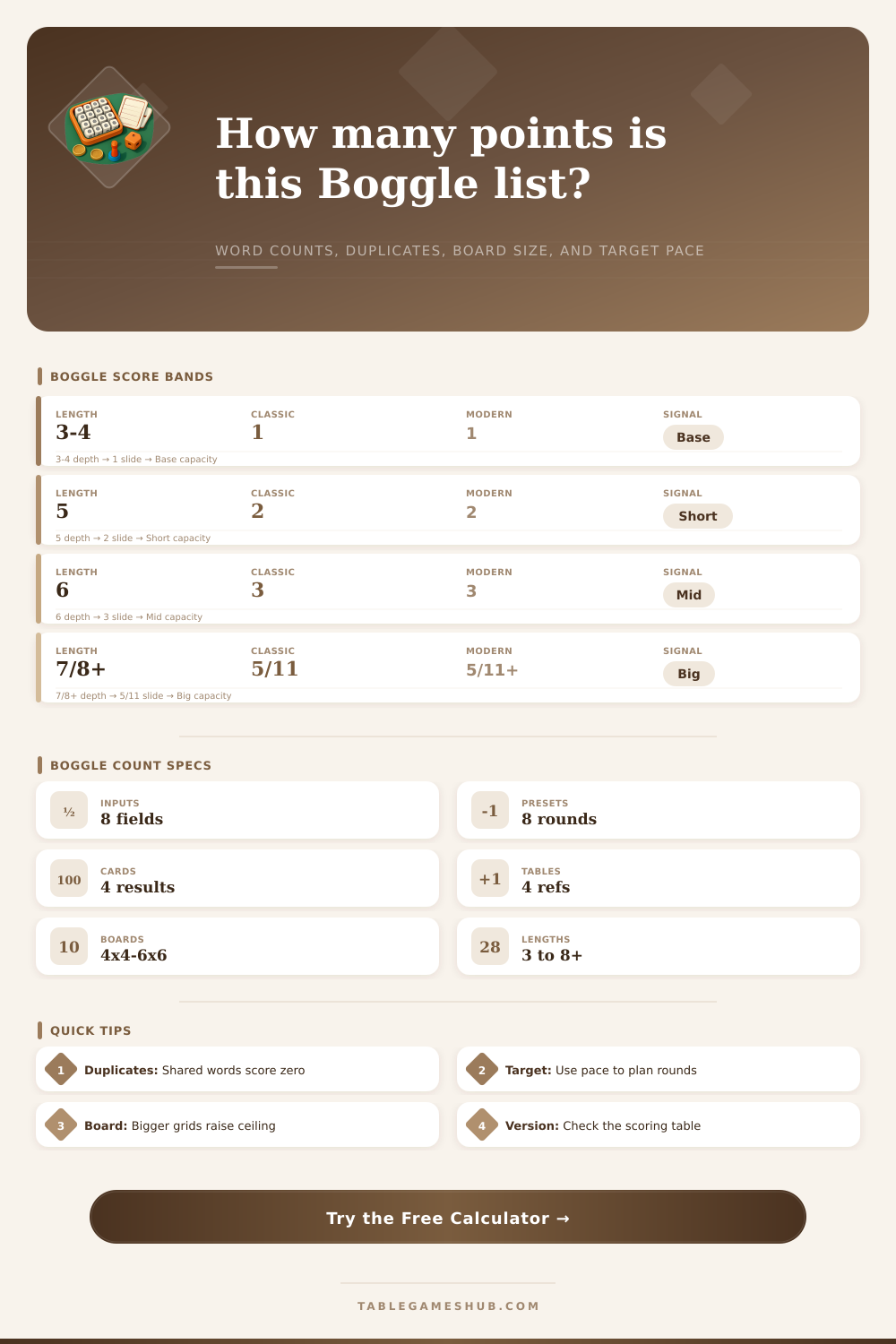
| Classic Hasbro | 1 | 2 | 3 | 5 | 11 |
| Big Boggle extended | 1 | 2 | 3 | 5 | 11 + 2 each extra |
| Club flat cap | 1 | 2 | 3 | 5 | 8 |
| Junior practice | 1 | 1 | 2 | 3 | 5 |
Board size planning
| Board | Cells | Usual time | Player range | Score feel |
|---|---|---|---|---|
| Classic 4x4 | 16 | 3 minutes | 1-6 | Compact |
| Big 5x5 | 25 | 3-4 minutes | 1-8 | Word rich |
| Super 6x6 | 36 | 4-5 minutes | 1-10 | High ceiling |
| Teaching grid | 16 | Untimed | 2-4 | Low pressure |
Word count bands
| Band | Input field | Typical role | Duplicate risk | Score leverage |
|---|---|---|---|---|
| 3-4 letters | 3/4 count | Base volume | High | Low |
| 5 letters | 5/6 count | Useful separators | Medium | Medium |
| 6 letters | 5/6 count | Strong finds | Medium | Medium high |
| 7 and 8+ | 7/8+ count | Round swings | Low | Very high |
Common setup configurations
| Setup | Players | Target | Duplicate pressure | Use case |
|---|---|---|---|---|
| Solo drill | 1 | 35 | None | Vocabulary pace |
| Family table | 4 | 45 | Medium | Classic round |
| Club table | 6 | 65 | High | Competitive list |
| Big board chase | 5 | 90 | Medium | Long word focus |
After entering how many duplicates of each word length you’re using, the calculator figures out the points, saving you from having to juggle those numbers around manually as you shift between various board size. It’s all mathematics, leaving you free to let the tool process it instead of doing mental gymnastics while playing.
As with any game, know that it’s not only about counting up more words than your opponent; it’s also a matter of quality over quantity. Finding even one eight-letter word can wipe out a pile of three-letter throwaway words, provided it was found before the timer ran out.
How to Score Points in Boggle
How word length changes how you scan the grid Players should know that it’s tempting to treat all words equally when found. However, that’s not a good strategy. Points is weighted in favor of length, meaning longer is better. They are also penalized for volume, meaning faster is worse.
Classic scoring: Three-letter words earns one point each, meaning you must find 11 of them to catch up with a solitary eight-letter word. Scanning rules vary by rule set; refer to the reference table on the page for details. You can fill out scoresheets faster by snagging short words but you’re losing time against another player who is searching for a six-letter term. It’s fast vs deep, there’s no free lunch.
But it gets trickier: A standard four-by-four grid is not very large, which limits the ways that letters can “be next to” each other. On a larger board, say, a five-by-five or six-by-six, the potential number of word connections grows rapidly. That means more longer words are feasible, which means your target score for each round should be way up.
Aim for forty points? The tool lets you set what a good score is by adjusting the board size. If you pick a board size that is too low, you probably underestimates how much more you could get from the grid.
Most families gets thrown off when they encounter duplicate words, often forgetting to check for them until the very end. At this point momentum has slowed, and the calculator prompts you to input a duplicate penalty count at the beginning in order to make you consider your collision potential. Because the word counts dissapears if they’re duplicates (like dog or cat), it’s likely that you’ll have several common words appearing on all lists in a six-person game.
The trick is to aim for longer phrasing or odd spelling that’s less prone to detection by competitors, as the stress of competition will result in higher duplication rates that can feel more differentiating between drills different than a group game.
One wrinkle: There’s some tactical element to when, too. Because rounds last only three minutes, there’s just barely time to nail down maybe thirty words if you’re working smartly. If you race through easy little words, you’ll miss the longer ones that is staring right back at you. A seven-letter word will take more mental effort, more “cognitive load”, to find than a quick little four-letter word at the edges of the board.
Do you feel confident going wide? Or do you need to clear all the low-hanging fruit before seeking out the longer chains of connected words? That’s something a novice would of want to do; experts can afford to skip over the low-hanging fruit altogether and wait for the big finds.
If you’re serious about keeping records, make sure to select the appropriate scoring version for your games. Depending on which club you play in, their extended tables may give extra weight to extreme word lengths, or they may have a maximum point for each word. In either case, this allows you to compare your scores against other players and sessions. A good score in one group may be an average score for another, depending on how they view word length.
In the end, Boggle is a game of pattern recognition under pressure, patterns that aren’t necessarily apparent to the naked eye. That’s why I said above that the calculator isn’t meant to teach you how to see these lines; only experience with varied letter combinations can do that. All it does is give you a way to measure your result.
You can use this to track your improvement over time or to check whether your strategy is working (for example, did you find more long words?). Did you avoid some duplicate scores? The math will show you.
Once the points has been added up, the room falls back into silence and, inevitably, one person will win a point here or lose them all there because they forgot to cross off a shared word. That’s what keeps this game so interesting… Unpredictable, and so ultimately satisfying when, amid the madness of the grid, your eye settles on just the right eight letters.