Double Nine Dominoes Calculator
Balance a 55-tile double-nine set by player count, starting hand size, boneyard tiles, exposed pips, highest double, draw odds, and hidden distribution estimates.
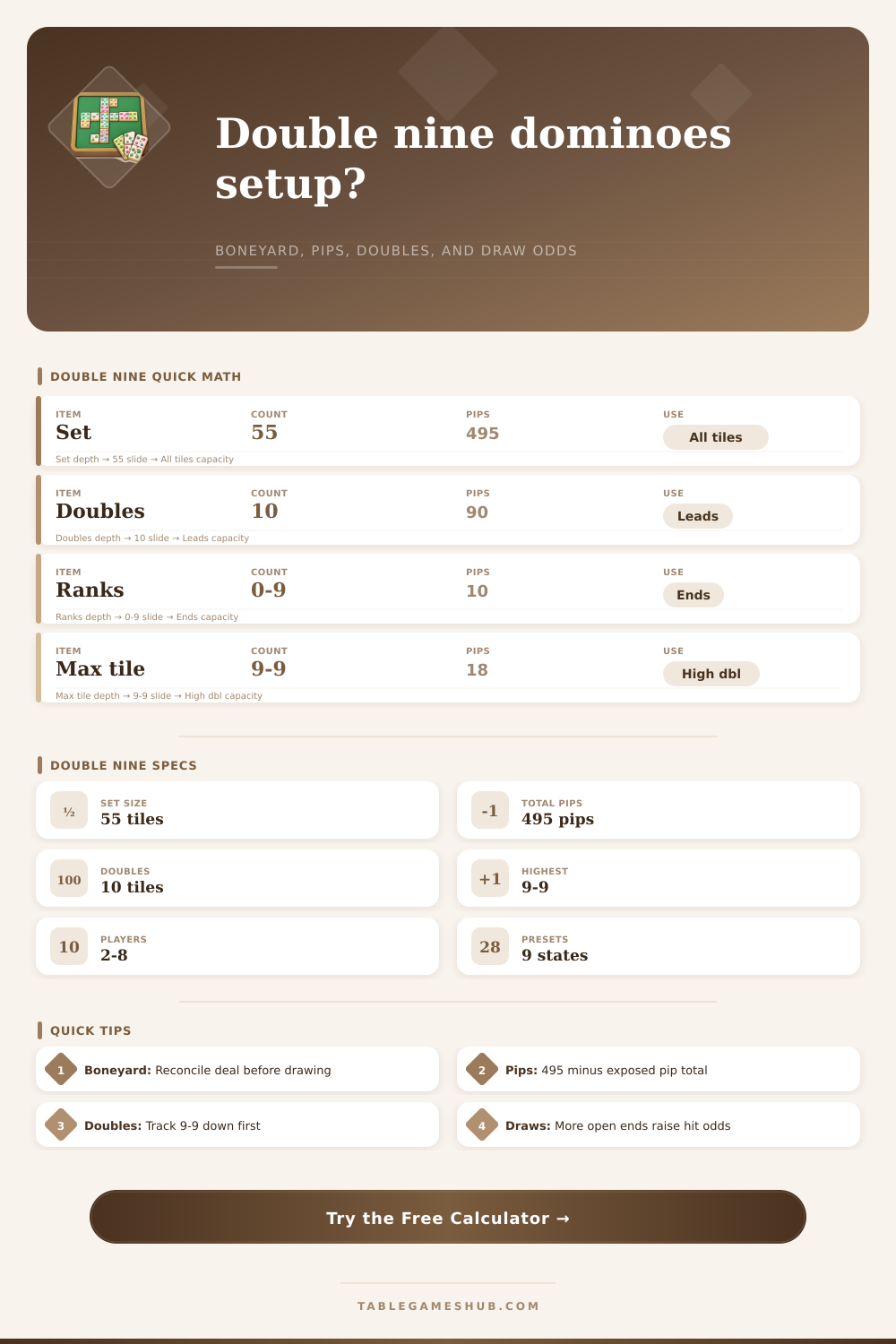
The table is balanced against a standard 55-tile double-nine set.
Current distribution estimate
| Zone | Tile estimate | Pip estimate | How it is calculated |
|---|---|---|---|
| Boneyard | 15 tiles | 135 pips | Remaining average times boneyard tiles |
Draw and open-end probability guide
| Open end model | Matching tiles in set | Single draw estimate | Boneyard reading |
|---|---|---|---|
| Two ends | 19 of 55 | 34.5% | Standard line |
Highest double tracker
| Double | Pips | Opening pressure | Table note |
|---|---|---|---|
| 9-9 | 18 | Highest | Often checked first in double-nine openers |
| 8-8 | 16 | High | Next fallback when 9-9 is known or played |
| 7-7 | 14 | Medium high | Strong but no longer the top double |
| 6-6 | 12 | Middle | Double-six value inside a double-nine set |
| 0-0 | 0 | Blank double | No pip burden but still a double branch |
Common double-nine setup references
| Scenario | Players | Starting hand | Setup boneyard |
|---|---|---|---|
| Two-player draw | 2 | 10 tiles each | 35 tiles |
| Four-player block | 4 | 10 tiles each | 15 tiles |
| Six-player chicken foot | 6 | 8 tiles each | 7 tiles |
| Eight-player Mexican Train | 8 | 6 tiles each | 7 tiles |
| Seven-hand tournament | 7 | 7 tiles each | 6 tiles |
Double nine is a chaotic pile of dominoes compared to the orderly nature of playing with a conventional set of double sixes. Instead of twenty eight tiles, now there are fifty five. Each move involve far more complex math. Suddenly, the grand total of pips shoots up to four hundred ninety-five, and your hand is likely carrying more weight than you can comfortabley hold without a plan. By the second round it’s no longer a casual game but a study in numbers as those extra ranks rapidly mount across the table.
Plug in the current state of your board and number of player, and it does all the work for you (see the calculator above). It won’t only tell you what’s left, but where those leftover pieces likely is. Enter the number of tiles remaining in the boneyard and it will match that number with traditional fifty-five tile set size. This becomes important as the game go on for a long time. You’ll convince yourself there are tons of low numbered tiles left. But four other player have been hoarding eights and nines. Distribution changes completly!
How the Calculator Helps You Play Better
That hidden truth gets exposed as the tool estimates who has what vs. It shows what is left in the draw pile. The highest double still unaccounted for is one of the more valuable tools as well. Since the nine-nine tile (18 pips) in a double-nine game typically sets the tone for opening strategy, knowing if that tile has been played yet will help you know where that tile is hiding…in someone’s hand or buried deep in the boneyard. This tool calculates the likelihood that the particular tile can be drawn.
It’s this number which tell you your level of aggression with any high-value matches you may have. Is there little chance? Maybe hold onto your cards a bit longer instead of pushing to make a connection that likely won’t come through.
Where good players divide from the rest, it’s in their understanding of pip management. On a small set, you can afford to be sloppy with heavy tiles. On these an eight or a nine costs you a point at the end of the game.
These reference tables shows how different game types affect the open ends available for matching. With a spinner design like this, there can be as many as four ways to hook things together. That approximately doubles your matching potential different than a normal block game. That design change shifts the risk of keeping big tiles. Not only do you have to count their spots, but also their spots’ chance to drop off before time runs out.
If you play Chicken Foot, Mexican Train or some other variant with different starting conditions, the tool will help because it has preset buttons. Those changes things like how many tiles to deal at the start and how many are left in the boneyard. That changes your draw odds. As the boneyard gets smaller, the law of small numbers kicks in. Each time you draw a tile, it eliminate one possibility from the pool. That means the remaining distribution becomes more predictable, less random … if you’ve paid any attention. The tool models that compression. You get a real-world estimate of your hit probability instead of just going by gut feeling.
The number of tiles on the table can be overwhelming. There is 10 different types of doubles. These include scoring hazards and branch points. Beyond a quick glance at the board it’s important to understand which tiles are exposed and which ones are still hidden. With the calculator, you can see how many player tiles are exposed vs. Hidden. That allows you to estimate if your opponents is blocking you or building longer chains. Understanding that difference guides your upcoming move.
Learning all the sets is unnecessary in order to play effective with them. But learning to have respect for the math is necessary. The math help quantify uncertainty and gives you that respect. Those hunches about what your opponent might have become a tangible probability. Knowing that you’ve got a 34% chance of completing your open ends on the tiles left matches your open ends lets you take a calculated risk versus hoping it works out. This transition from hoping it will work out to calculating how much it will work out is the difference between a winning strategy and a lucky night.
All this leads up to saying that double-nine dominoes is more about matching numbers but also a game of inference and memory. A tool for that is the calculator. Instead of frantically trying to count tiles in your head you can free yourself to concentrate on the flow of the game. It’s still you who makes the moves. But now you’re doing so with all the information you have. And fifty-five tiles could of feel like a mountain at first. Once you break it down into its parts, however, it’s really just another set waiting to be managed.