🀄 American Mahjong Score Calculator
Total the printed card hand value, joker status, concealed or exposed state, self-pick or discard settlement, house doubles, bettor side result, and table adjustments.
Choose a preset or enter the completed hand details to calculate American mahjong score.
Settlement will show printed value, adjustment, table doubles, source payment, and bettor side result.
Use your table's card and house rules as the authority when a local rule differs.
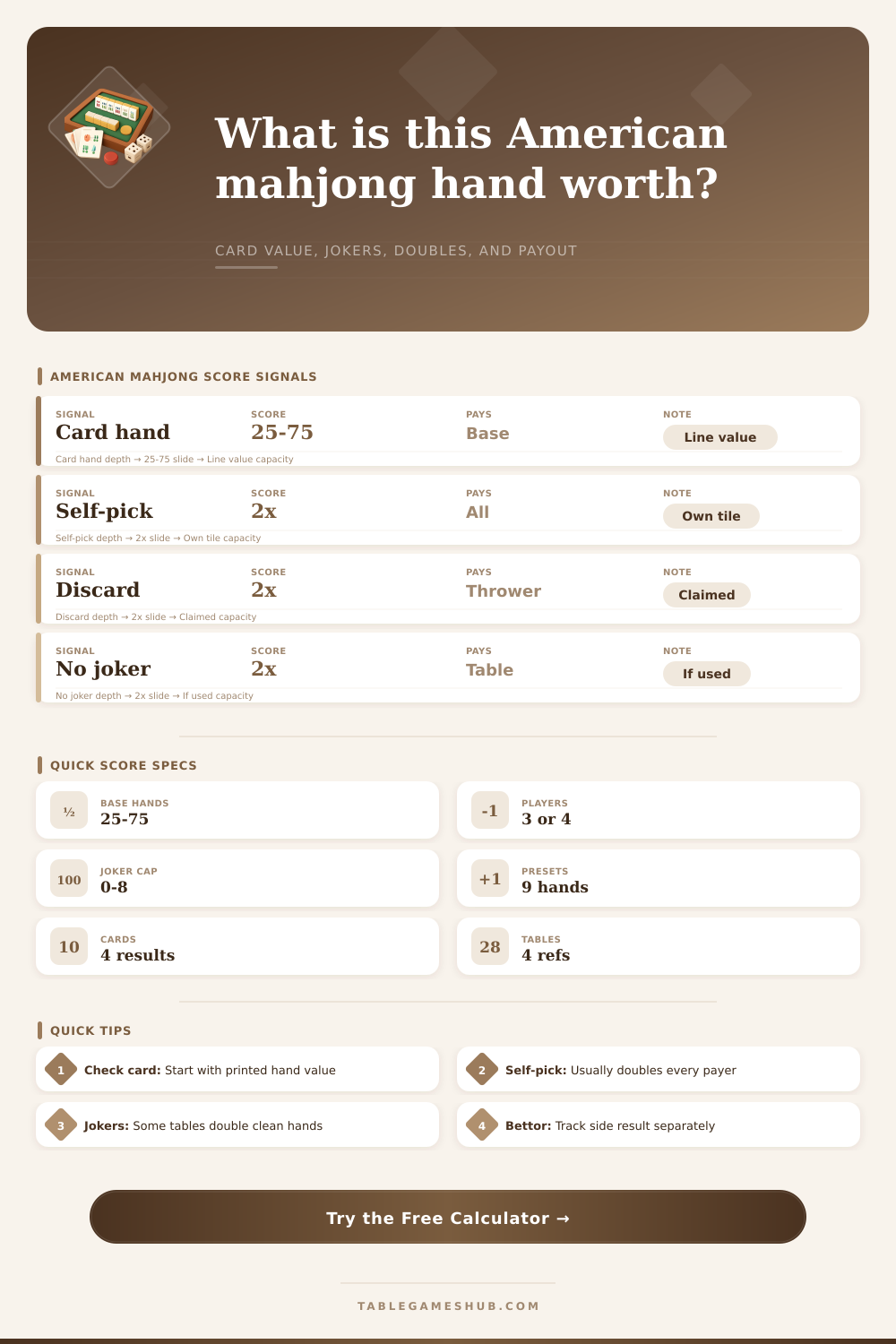
| Printed card value | Typical use | Clean-hand note | Calculator input |
|---|---|---|---|
| 25 points | Common standard hand | Often no extra hand double | 25 point standard line |
| 30 points | Moderate card hand | Clean double only by house rule | 30 point card hand |
| 35 points | Premium card line | Good concealed check | 35 point premium line |
| 40 points | High-value section | Can swing with self-pick | 40 point premium line |
| 50 points | Rare or hard pattern | Confirm joker allowance | 50 point high-value hand |
| 75 points | Top-value hand | Verify exact card wording | 75 point rare hand |
| Win source | Who pays double | Other opponents | Settlement note |
|---|---|---|---|
| Discard win | Discarder pays 2x | Each pays 1x | Used for claimed winning tile |
| Self-pick | Every opponent pays 2x | No single payer | Used for wall draw win |
| Jokerless self-pick | Every opponent pays 2x | Hand may double first | Depends on clean-hand rule |
| Last wall tile | Every opponent pays 2x | Extra double if selected | House rule only |
| Double package | Jokerless | Concealed | Wall-pick extra |
|---|---|---|---|
| Printed value only | No hand double | No hand double | No hand double |
| Clean hands | 2x if 0 jokers | No hand double | No hand double |
| Concealed hands | No hand double | 2x if declared | No hand double |
| Clean + concealed | 2x if 0 jokers | 2x if declared | No hand double |
| Table stack | 2x if 0 jokers | 2x if declared | 2x on last wall |
| Bettor option | Side result | Best for | Displayed as |
|---|---|---|---|
| No bettor | 0 | Standard scoring | Side score 0 |
| Backed winner | Positive hand score | Correct prediction | Bettor gains |
| Backed discarder | Negative double score | Wrong discard pick | Bettor pays |
| Wrong player | Negative hand score | Missed pick | Bettor loses |
Separate hand doubles from payment doubles
Apply jokerless, concealed, or wall-pick house doubles to the printed hand value first. Then apply discard or self-pick settlement to decide who pays.
Keep bettor math out of the winner total
The bettor result is a side line in this calculator. That makes it easier to compare table settlement against any local bettor agreement.
That rush of confidence hits when you have a perfect hand, a pung of honors matched by four other winds laid out on the table, face down, ready to conceal a winning play. There’s silence in the room; then somebody shouts out point value from the card, and suddenly it’s scramble time: How much do we owe? Who owes whom? It’s in this moment that the distinction between a casual game and a scored match feel painfully real.
Despite knowing the rules inside and out, it’s far too easy to forget the math, with its many moving parts, and end up confused about who owe what. A calculator completely changes the feel of the evening. This is where the central confusion lie in most tables: nearly everyone agree that doubles of anything on the base point value multiply. But very few people realize the interaction between that and what happens when someone claims a discard vs. Picking up their own hand. The tool on this page separate these two lines of thought.
Why Use a Score Calculator?
It lets you first establish which of these will be used at your table: do they allow a single double when someone has concealed cards? Do they allow a double if no jokers is played? Or do they allow both doubles to stack? Stacking doubles can easily makes a normal three-dozen point hand worth hundreds, well before considering how to settle discards, so this is important to establish first.
For example, compare the cash flows of drawing off wall vs. Picking up someone’s discard. In the former, everyone except the discarding player pays the base amount, whereas they pay double points when you pick up their discard. Depending on how many players you have around the table, this can mean an enormous difference in financial risk. A four-player game will spread it out more than a three-player one where loser must cough up a bigger portion of the pot. However, the calculator automaticly takes into account player count, eliminating the “who-owes-how-much” guessing game.
And then there’s the joker. I personally love the no-joker rule. It’s such an aggressive play, and if everyone at your table agree with your house rules, it should of work out just as well in your favor. Basically, a lot of people punish going rogue by rewarding players who stick to patterned runs, so keeping track of how many wildcards you played is essential for proper scoring. One forgotten wildcard entry and all of a sudden your grand total are incorrect, and more likely then not you’ll realize this too late to correct it, once someone starts the next round. Catch those mistakes early (on-screen) rather than during a heated chip dispute.
There is also the extra problem of side betting which most regular score cards don’t even address. If there are some bettors who wagered on the discarder or the winner of that hand, then their wager is out of pool of the main table. You don’t want to mix bet outcomes with hand scores to settle everything. It is a nightmare to keep straight at 10 o’clock at night when everybody wants to go home. Having the bettor outcome in its own separate line item will make it clear how much money was won at the table and what needs to be settled separately away from the table. That way you can just enjoy playing and not have to become everybody’s bookie.
So how does one learn to score American Mahjong? In short, it’s less math than it is maintaining consistency. There’s no need for pencil-and-paper and complicated arithmetic when it comes down to it. It doesn’t matter if you’re playing a basic twenty-five point hand or a rare seventy-five pointer. Setting up clear rules at the start and sticking to them will get you through. This might mean tracking down which variable affect each tile or just keeping things simple. Because really, you didn’t come to play a game of mental calculus, you’re here to play tiles.
Eliminate the friction around who owe what. The tension eases and the game moves more smooth. You’ll actualy be able to sit back and enjoy that hidden victory without stressing over whether you got the multiplier right. It’s worth its weight in peace of mind.