🀄 Mahjong Fu Calculator
Total riichi mahjong fu from base points, wait shape, pair value, meld types, win method, and special hand overrides.
| Fu source | Fu value | Applies when | Calculator handling |
|---|---|---|---|
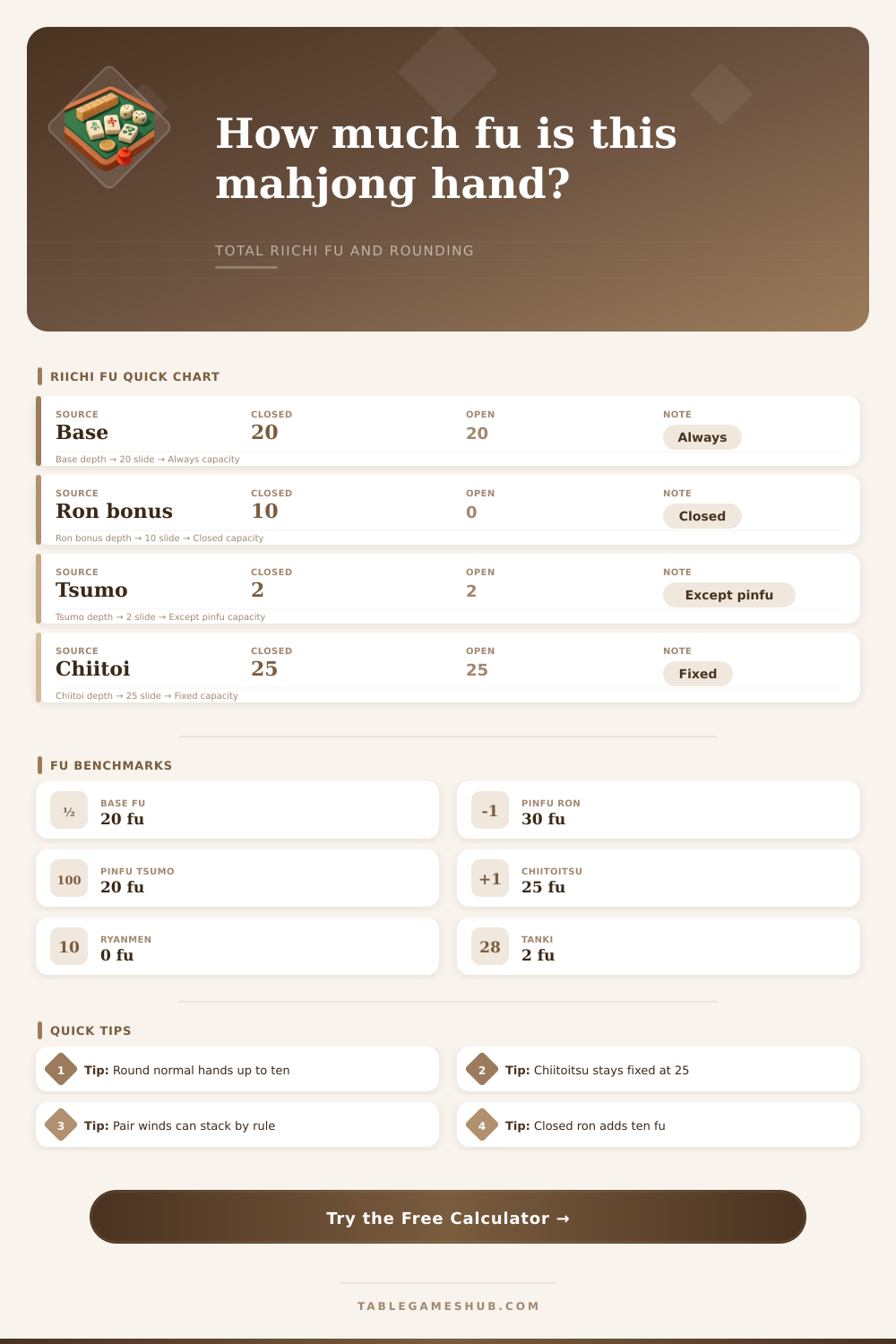
| Base fu | 20 | Every normal hand | Always included unless chiitoitsu fixed mode is active |
| Closed ron bonus | 10 | Closed hand wins by discard | Added from hand state and winning method |
| Tsumo bonus | 2 | Self draw on standard hands | Suppressed for pinfu tsumo special case |
| Normal rounding | Next 10 | Most riichi hands | Raw subtotal rounds upward after all standard sources |
| Triplet or quad | Simple tiles | Terminal or honor | Scoring note |
|---|---|---|---|
| Open triplet | 2 fu | 4 fu | Called pon or open set |
| Closed triplet | 4 fu | 8 fu | Concealed set scores double open triplet |
| Open quad | 8 fu | 16 fu | Called kan, lower than concealed kan |
| Closed quad | 16 fu | 32 fu | Largest standard set fu source |
| Wait or pair | Fu | Example | Calculator choice |
|---|---|---|---|
| Ryanmen wait | 0 fu | Two-sided 3-4 waits on 2 or 5 | Ryanmen two-sided wait |
| Kanchan or penchan | 2 fu | Middle wait or edge wait | Kanchan closed or penchan edge |
| Tanki wait | 2 fu | Single tile completes the pair | Tanki pair wait |
| Dragon or value wind pair | 2 fu | White dragon or seat wind pair | Pair value selector |
| Special result | Official fu | Raw idea | Use in calculator |
|---|---|---|---|
| Closed pinfu ron | 30 fu | 20 base plus closed ron ten | Pinfu override with closed ron |
| Pinfu tsumo | 20 fu | No wait, pair, or tsumo fu | Pinfu override with tsumo |
| Chiitoitsu | 25 fu | Seven pairs fixed score | Chiitoitsu override ignores normal sources |
| Open all-sequence ron | 30 fu | Common minimum after rounding | Standard mode with low raw subtotal |
Count structure before yaku
Fu is about hand shape: winning method, waits, pairs, triplets, and quads. Yaku decide whether the hand can score.
Separate fixed hands from rounded hands
Chiitoitsu is fixed at twenty-five fu, while most standard hands round the raw subtotal up to the next ten.
Use this calculator to total riichi mahjong fu from hand state, win method, waits, value pairs, triplets, quads, and special hand overrides.
It’s perfect on paper; you’re sitting at the mahjong table with a hand that has all the makings of a winner. The shapes is clean, the yakus are lined up, and now your opponent discards the winning tile. And then it happens: someone from across the table asks how much is this really going to be worth?
It is not just about whether you win, but about how much you take home when the scoring tiles are flipped over. That’s where the riichi mahjong fu system kicks in, transitioning away from a dry mathematical exercise and becoming key tool to evaluate hands. While a calculator (like the one above) can do the math for you, knowing what goes into those inputs changes the game entirely.
What is Fu and Why It Matters
Fu, Most novices does this wrong. Since yaku is what determines if you get any points, it becomes their main focus. After they get a hand with honro/minkan they think the point value will take care of itself. This is where most players miss it. Fu is the multiplier and in tight games, a mere step up in rank can be the difference between being in contention and being out.
Each tile you discard should be viewed not only as a possible wait but also as a structure piece that either add to or subtract from your overall total. For example, each regular hand start with 20 fu in the base. This means it’s worth that amount just for having a good shape in the first place. Then value continues to increase based on how hard it is to form the hand.
For instance, if you closed your hand and won on a ron, you’ll get another 10 fu because it takes some skill to hold your cards without anyone noticing until your opponent feed them to you. In other words, it’s a reward for being sneaky and a punishment for being too transparent. When you choose how you want to win, the site will calculate it for you; this is built into the tool. However, understanding where the bonus comes from can also guide your decision about when to open your hand versus keep it closed to go after a particular yaku.
The type of wait is also significant. An open, two sided wait (ryanmen) have zero fu, which is probably most efficient and most likely to be a winner anyway. That’s just the natural state of an unbroken hand. If you’re holding a penchan or kanchan tile and waiting to play it as the next one, then those edge or internal waits cost two fu. Two sounds insignificant, but they show you have inefficient hand structure. You’re accepting the chance you won’t win… Even though you’ll get points from playing it… Because it may never come around.
The tradeoff is between value and speed. The same hold true for quads and triplets. Announced sets (open) are low-cost because you told the other players you had them at the table. Closed triplets cost more because you kept them secret from the other players, so they don’t know what your strategy is. Terminals and honors double that cost because these tiles are more difficult for your opponents to safely discard.
Stack two closed terminal triplets in a hand and the fu starts going up fast, placing you into increasing payment brackets. The reference table on this page shows how much faster concealed sets outpace open ones in point value. Finally, there are special cases that throw out the rulebook completely.
The chiitoitsu hand (seven pairs) scores a flat 25 points and gets no consideration in fu whatsoever, a flat rate for an entirely different style of structure. In contrast, hands containing only concealed sets actualy increase fu through closed triplet bonuses; pinfu hands, which count strictly based on the efficiency of their sequences, has virtually none of those add-ons considered. They’re limited to a certain low point total, rewarding simply for being so simple.
That’s a major strategic choice: do I go for pinfu, or do I build towards fu? Each card discarded is a piece of data. Close triplets if you’re after points. Opening sets and hoping for ryanmen waits if you are on the clock, or trying to secure a win first. Those numbers come from the calculator, but whether they’re worth the risk comes down to you.
Fu is how you translate what is hidden in your hand into something valuable for others to see. It’s the game of imperfect information; when you master it, it becomes a game of calculated strategy. You should of learned that sooner.