🀄 Mahjong Fan Calculator
Total Chinese-style fan from patterns, flowers, valued winds, hand state, win method, limit cap, and table payment multiplier.
Choose a preset or enter the hand details to calculate fan.
Payment units = table multiplier x 2^(capped fan).
| Pattern set | Fan | Open adjustment | Best use |
|---|---|---|---|
| All Chows / Ping Hu | 1 | Needs clean shape | Low base hand |
| Mixed Triple Chow | 3 | Usually unchanged | Three suit sequence |
| All Pungs | 3 | Usually unchanged | Triplet build |
| Half Flush | 3 | -1 when open | One suit plus honors |
| Full Flush | 6 | -2 when open | Pure one suit |
| Seven Pairs | 4 | Must be concealed | Pair hand |
| Three Dragon Pungs | 8 | Limit pressure | Dragon heavy |
| Thirteen Orphans | 13 | Must be concealed | Limit hand |
| Bonus source | Fan each | Maximum | Notes |
|---|---|---|---|
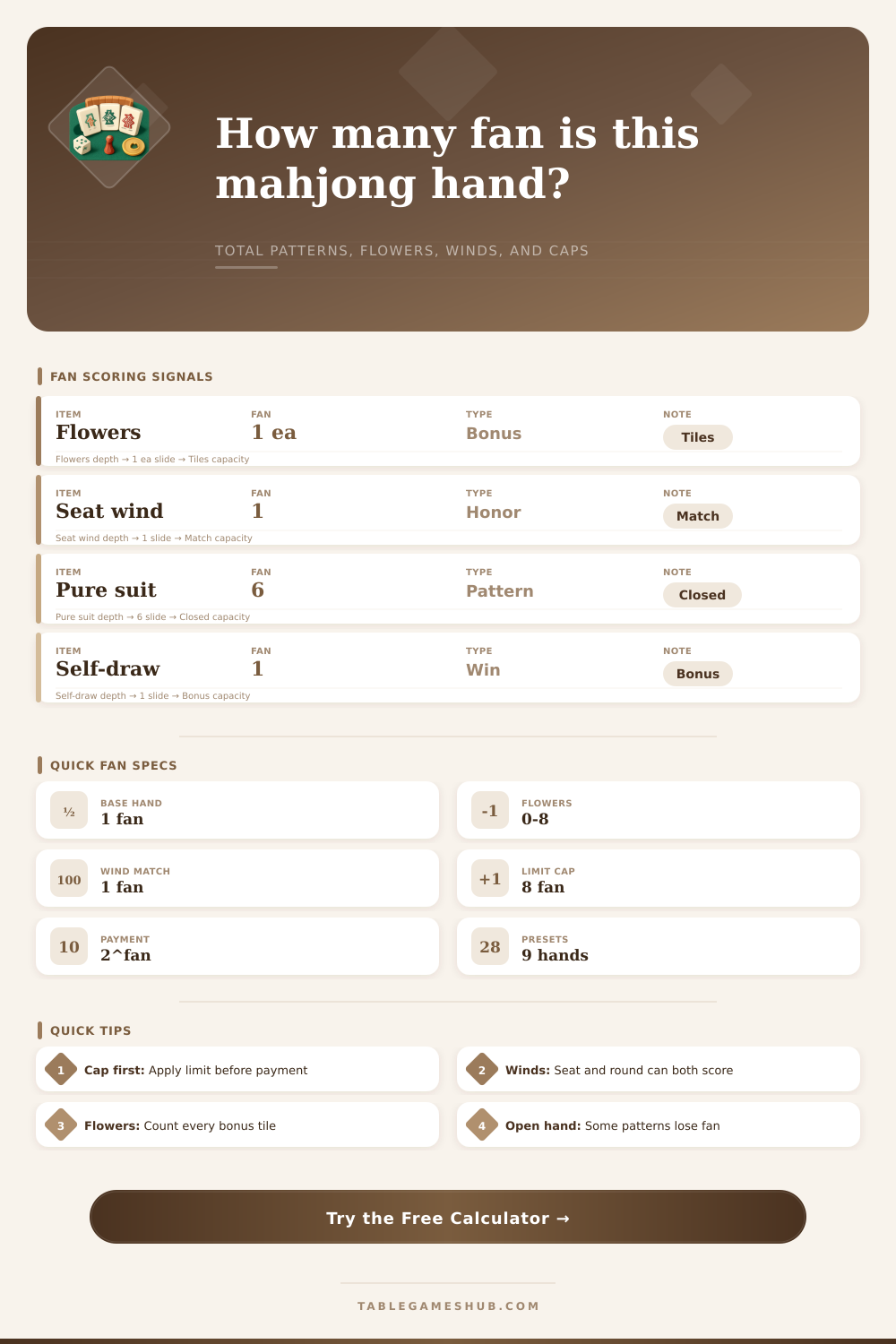
| Flower or season | 1 | 8 | Each bonus tile counted |
| Seat wind set | 1 | 1 | Pung or kong match |
| Round wind set | 1 | 1 | Can stack with seat |
| Fully concealed | 1 | 1 | No exposed melds |
| Self-draw | 1 | 1 | Won from the wall |
| Last or replacement tile | 1 | 1 | Special win timing |
| Capped fan | Payment units | Score band | Table note |
|---|---|---|---|
| 1 | 2x | Base | Small hand |
| 2 | 4x | Built | Bonus online |
| 4 | 16x | Strong | Common small cap |
| 6 | 64x | Major | Pattern heavy |
| 8 | 256x | Limit | Common limit cap |
| 13 | 8192x | Grand | Rare limit model |
| Preset | Pattern focus | Likely fan | Check first |
|---|---|---|---|
| East Wind Opener | Seat wind | 3-5 | Wind matches |
| Flower Gate | Bonus tiles | 5-8 | Flower count |
| Pure Bamboo | Full flush | 6-10 | Open penalty |
| Dragon Wall | Dragon pungs | 8+ | Limit cap |
Apply the cap after counting every source
Total base fan, pattern fan, flowers, winds, state, and win method first. Only then trim the total to the table limit.
Treat open reductions as pattern adjustments
When a table reduces flush-style or concealed-only patterns, subtract that adjustment from the pattern before adding universal bonuses.
Ron gets declared, and suddenly all player are holding their breath. You count out fan points, but who knows if they did it right? The rest of the table hold its breath as the winner counts out wind matches, concealed bonuses and flower tiles, trying to avoid an arithmetic error that could lead to arguments. The score must be calculated correctly. Otherwise, you get ripped off at the table, break up flow of game, and risk a fight about which limit hand is worth three points or four.
With this mahjong fan calculator, you can avoids all that friction. It’ll do the math for you and let you play instead of arguing with each other.
How the Calculator Helps You Score Correctly
Fan, or point values, are assigned by the system based off various parts of your winning hand. Your base value (generally low) increases according to patterns such as Full Flush or All Chows. As you make those selections, the calculator do the math for you. It’s easy enough to see from reference table on the page just what each element adds to the whole.
To really understand how scoring works beyond just adding things up, you need to look closer. For example, a Full Flush score high points because it severely limits your selection of tiles and complicates completing the hand. On the other hand, having lots of open melds can be flexible but not very valuable. This is why open reductions exist in the scoring rules.
This ecosystem also features dragon and wind tiles which play an interesting part in this game. Because matching your seat wind or the current round wind earns extra points, getting them right ties your win/loss directly to the state of the game different than the general combination of tiles. Players can easily ignore such small bonuses thinking that big picture patterns will do all the heavy lifting. They won’t. A few extra points from matching winds here and there can be the difference that puts a hand over the line. This change can alter multiplier payout. The tool handles these subtleties without fail so you never leave money on the table through forgetfulness.
It may sound like nothing, but when you’re down and scrambling to get back in green, every little bit counts. Things get really tricky when win methods are combined with concealed hands and limit caps. Completely concealing your hand and winning through self-draw is greatly admired. It shows off great risk taking and tile managing abilities. This also increase the number of fans, which is a very good thing!
But there’s an exponential payout system for mah jong. Past a certain number of fans, payouts skyrocket, but they are limited by whatever the table agree upon. And that cap is applied to the score BEFORE multiplying the results, so they never become too extreme. Therefore, not only should you know what’s in your hand, but you need to know the limit of the table you’re playing at. For example, if the limit is eight fans, trying to push for more isn’t worth the effort.
You should of known this earlier. A common mistake among beginning Mahjong players is that they attempt too many high-fan hands too soon in the game. After the wall begins to dry up, they stick with advanced patterns such as Thirteen Orphans or Seven Pairs instead of taking more secure, lower value victories. That’s a tactical misstep.
The calculator tells you what a hand might be worth; it doesn’t tell you if it’s prudent to go for it. You need to weigh the likelihood of completing a hand, the chance another player will win it before you do, and how much the hand may pay out. A small win of two fans today can mean your opponent misses an eight-fan limit hand tomorrow.
But all of this ultimately comes back to one thing: consistency. Whether you’re playing for fun on a Saturday night with friends or in a competitive tournament, consistent scoring makes everything fair. It allows the game to flow and the tool lets you confirm those scores in seconds. Once you don’t have to think about math anymore, guess what? Your gameplay actualy gets better. You can make better decisions. You know someone else has got your back handling the details while you focus on your strategy instead. Having confidence in how you’re going to settle up is just as helpful as organizing your set of tiles so you can keep your head clear. That’s why the table stays light and focused on strategy instead of settlement.
You want to recieve your winnings without any issues.