Dice Combination Probability Calculator
Calculate ordered sequences, unordered dice hands, exact face sets, target matches, wild faces, reroll attempts, combinations, and permutations for tabletop dice pools.
| Combo Type | Core Logic | Ordered Basis | Unordered Basis |
|---|---|---|---|
| Exact listed faces | Match each listed face, with wild faces filling deficits. | sides raised to dice count | multiset buckets plus permutations |
| Target matches | Binomial probability using target faces plus wild faces. | success positions among dice | matching count buckets |
| Pair and full house | Occupancy patterns count repeated faces and wild substitutions. | multinomial sequence count | face-count partitions |
| Straight or coverage | Required faces must be represented, or wilds must fill missing faces. | covered target symbols | distinct face coverage |
| Scenario | Dice | Goal | One-Roll Chance |
|---|---|---|---|
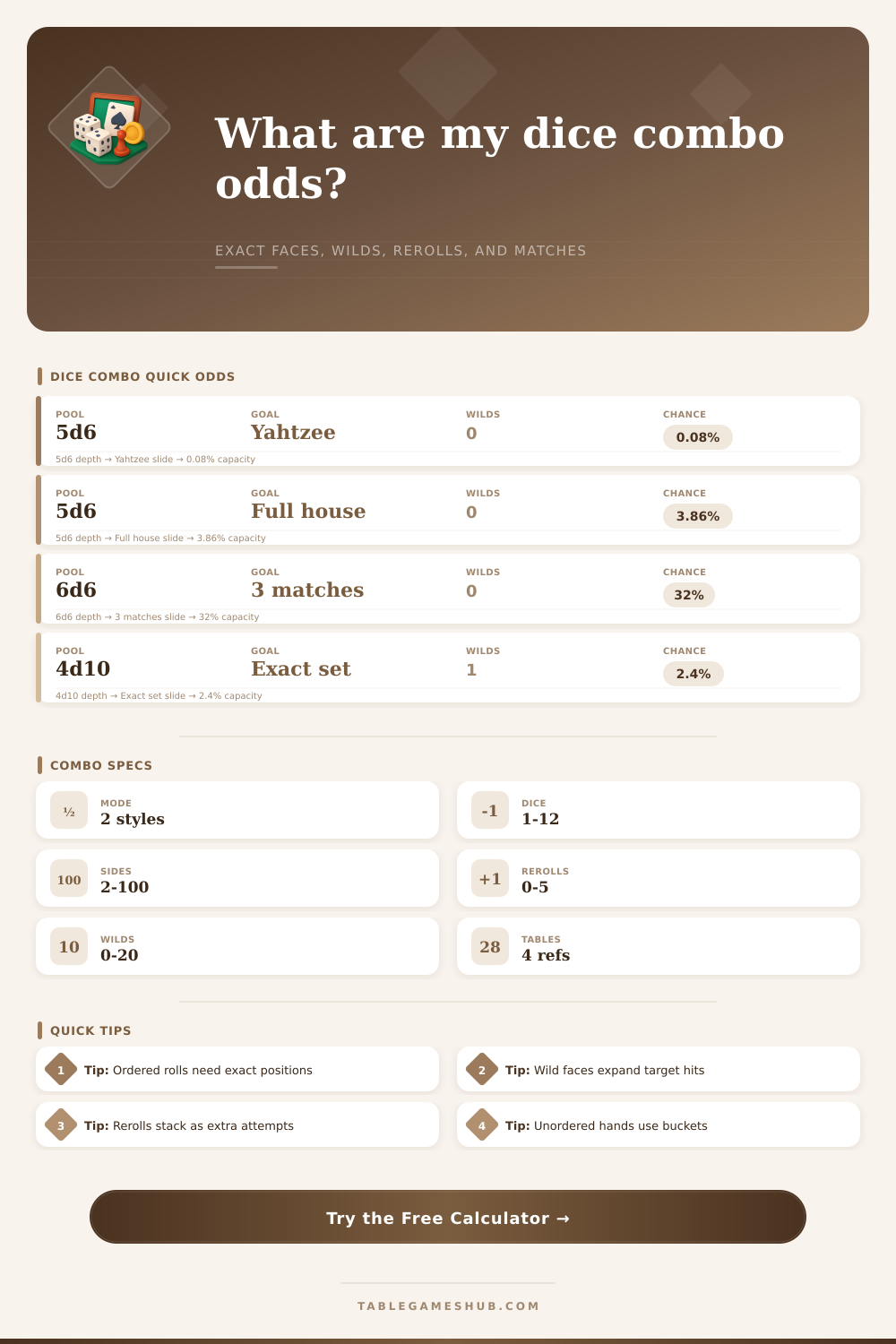
| Yahtzee exact five of a kind | 5d6 | all dice same | 0.0772% |
| Full house on five dice | 5d6 | 3 plus 2 pattern | 3.858% |
| Any pair in four dice | 4d6 | at least one pair | 72.22% |
| Specific ordered d20 pair | 2d20 | 20 then 20 | 0.25% |
| Adjustment | What Changes | Best For | Math Impact |
|---|---|---|---|
| One wild face | Adds one successful side to target checks. | symbol dice and joker faces | raises per-die hit rate |
| Multiple wild faces | Wilds can fill multiple missing target symbols. | custom dice sets | expands favorable counts |
| One reroll attempt | Runs the full pool chance twice. | push-your-luck turns | 1 - failure squared |
| Three attempts | Compounds independent failures across attempts. | multi-roll challenges | 1 - failure cubed |
| Preset | Mode | Faces Used | Calculator Focus |
|---|---|---|---|
| Risk Triple Six Roll | unordered | 6,6,6 | three exact dice in one attack pool |
| Story Dice Triumph | unordered | 12 with 8 wild | target match with special-symbol face |
| Run of Four D6 | unordered | 2,3,4,5 | coverage of a specific straight |
| Wild D10 Exact Set | unordered | 3,7,7,10 with 1 wild | wild substitution and multiset math |
Dice fall with a definitive clack on gaming table. That clatter represents uncertainty, and players often find themselves questioning their luck when things go wrong. Roll for defense, roll for attack, roll for bragging rights. But under the rattle are the gear of mathematics that few player consider unless they’re losing their skins off. Whether you rely on probability or luck depend on how you see your die roll.
A die can be rolled as a single entity in any order or as distinct entities in an order. That’s the cause of most confusion in game room. If you asked someone the odds of getting two sixes with two dice, your brain is probably assuming that the order doesn’t matter. It’s a pair; either one can come out first. Your brain says it doesn’t matter if the second one came out before the first so long as you get the pair. But a computer think the first six-then-second-six is different than the second-six-then-first-six.
Understanding Dice Probability
The calculator above handles that for you by letting you switch between unordered and ordered mode. Why? The rules of games differ widely on what counts as success. Some say a certain set of dice must fall in a certain spot with a value in a certain slot. Others treat the entire pool as a bag of possible outcomes where the result at the end is all that matters. Get this setting wrong and you throw off your expectation by factors of two or more. Players feels like they are getting unlucky but in fact they are simply misjudging total number of possibilities.
Then there’s the fact that moddern tabletop games have added elements like rerolls and wilds, which bend the normal probability lines into all sorts of crazy shapes beyond simple combos. Wild faces becomes the master key. They let you extend the set of possible wins without extending your hand of dice. It’s not just an increase in sides but an increase in where what you get will also be what you want.
And if you throw some reroll tries into the mix, then the math change from linear addition to geometric compounding. An additional try doesn’t just tack on another 10% to your chances. Instead, it squares your failure rate and subtracts that from one. That makes success a far steeper curve different than most folks expect.
And push-your-luck feels super aggressive late in a turn. You’re more likely to bust out than you are to hit the next threshold by a huge amount. Straights and other combination are another pattern you’ll see. Rather than just being about matching numbers, they’re based off occupancy (the “theory” part of probability). A straight, for instance, needs a particular sequence of values. A full house require three of one kind and two of another. Turns out that’s pretty uncommon. The math behind it is explained in the reference tables bundled with the tool.
For instance, on regular old six-sided dice, the chance of rolling a five-of-a-kind isn’t much more likely than one in a thousand. So when it do happen, it feels special. If it happened regularly, there’d be no thrill at all. The math ensures those big hits don’t come to often.
So how does it work? There is tradeoffs between quality and quantity. Rolling more dice mean there is a greater likelihood that at least one will match your target number. On the other hand, it means less chance of exactly matching any particular sequence, especially when order are relevant. Do you need precision? Or do you need volume?
Now you can easily test both options side-by-side without having to keep another tab open with a spreadsheet. That saves time and reduces mental friction as you try to imagine combinatorial explosions happening in your brain. You should of seen the math before. The odds don’t alter the dice. They merely alter your understanding of what those odds mean. Sometimes you’ll still roll blanks. Only now, you won’t confuse the normal fluctuations of statistical variance with a personal curse.
Before the dice come to rest, you already know the shape of the distribution. And knowing that makes it less a game of chance and more a game of informed decisions. Each wild card and each reroll becomes a calculated risk instead of a desperate gamble. Ultimately, the numbers don’t guarantee victory; but they absolute guarantee honesty about the odds.