Keep Lowest Dice Calculator
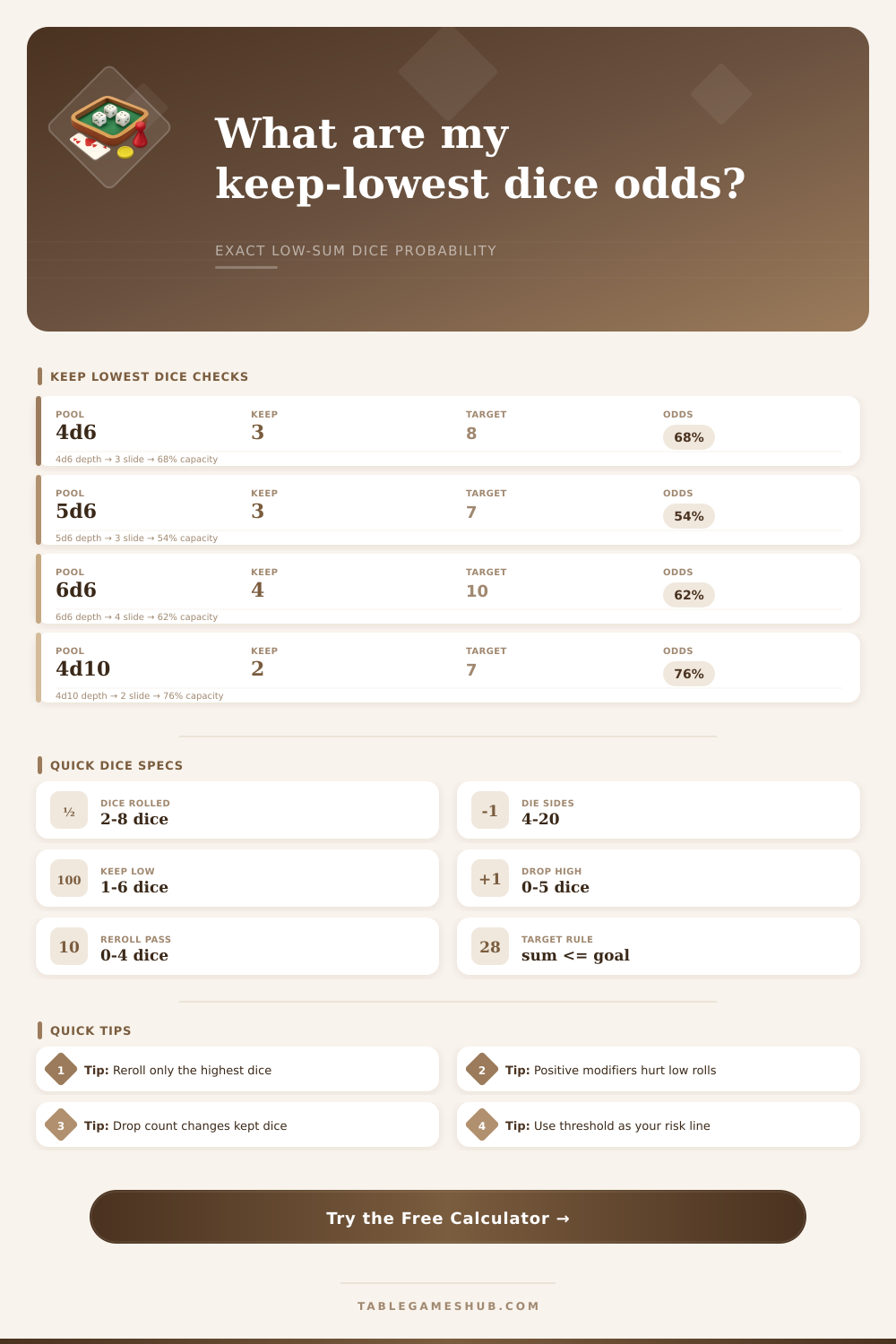
Calculate exact low-sum odds for roll-and-keep dice pools with dropped high dice, one-pass high rerolls, die sides, modifiers, target totals, and table-ready success thresholds.
| Pool | Keep | Drop | Typical use |
|---|---|---|---|
| 4d6 keep 3 low | 3 | 1 high | Soft low-stat or flaw checks |
| 5d6 keep 3 low | 3 | 2 high | Harder low-target checks with larger pools |
| 6d6 keep 4 low | 4 | 2 high | Wide pool where high dice are trimmed |
| 4d10 keep 2 low | 2 | 2 high | Percentile-style low-pressure table tests |
| Modifier | Effect | Dice-only target | Low-roll note |
|---|---|---|---|
| -2 bonus | Total falls by 2 | Target plus 2 | More successful low totals |
| 0 neutral | Total unchanged | Target as entered | Cleanest probability read |
| +2 penalty | Total rises by 2 | Target minus 2 | Fewer successful low totals |
| +5 severe | Total rises by 5 | Target minus 5 | Often needs drops or rerolls |
| Choice | Rerolled dice | Best with | Math treatment |
|---|---|---|---|
| No high reroll | 0 | Baseline checks | One exact first-roll enumeration |
| Reroll 1 highest | 1 | Small pools | Nested ordered reroll state |
| Reroll 2 highest | 2 | Medium pools | Two reroll dice weighted exactly |
| Reroll dropped highs | Drop count | Drop-high systems | Matches discarded high dice |
| Reading | Meaning | Lower is | Use at table |
|---|---|---|---|
| Success chance | Probability total is target or lower | Better | Pass/fail planning |
| Expected total | Average adjusted sum | Better | Long-run comparison |
| Median | Half of outcomes are at or below | Better | Typical roll result |
| P75 total | Three quarters are at or below | Better | Risk ceiling marker |
In a table top game when you roll for something and it turns out badly, you find out that bad luck isnt random enough to rely on without math. You throw the die, ignore high numbers, and end up with result that just doesn’t seem fair. After all, you didn’t use math; you relied on luck.
Your problem is that you think taking the lowest dice is about hoping they are the smallest. What it’s realy doing though is managing variance. Taking the dice that stray outside average is how you attempt to make a chaotic system produce the same outcome consistantly.
Why Math Beats Luck in Games
If you’d like to know exactly what the odds are that your plan will work, you can use the calculator above to help you figure them out rather than going off of gut feeling.
“A lot of people think that when you’re keeping the lowest three out of four, you’re just taking an average across the whole pool. But that’s wrong. The pool of six-sided dice has an uneven chance of different results; the lowest outcomes are relatively far away from center compared to the highest outcomes. Dropping high dice reduces variance as much as it changes the mean. That means a low total will be more likely then the “raw” average suggests. They’ll also be less unpredictable in a good sense: they’ll all clump together closely around a lower number.
There are more variables here than you might expect. What number of dice do you roll? How many do you keep? Each changes playing field. The difference between rolling four dice and five changes entire landscape of possibilities. That fifth one provides an additional opportunity to drop a high-roll that otherwise would of pushed you over the edge, making it easier to hit some strict rules. But on the other hand, it brings with it yet another variable that could bite you in the ass if mismanaged.
Modifiers also add even more twists. In a keep-lowest situation, a positive modifier hurt, as it increases your final result and drives you further away from whatever success goal you’re trying to reach. The calculator takes that into account, recalibrating the effective target so you can clearly see how much steeper your hill will be to climb.
Beyond that strategic element, there are also rerolls. For example, if you can reroll the top die and keep the bottom one, then you’re controlling for worst case. In other words, if rolling high will screw up your game, this gives you some control over that. The tool allows you to specify how many of these reroll passes you get and includes them in probability calculation. So it doesn’t assume you’ve done a few thousand rolls down one path but has calculated all the possible states of the dice pool. In other words, what you see as probability isn’t an approximation from a simulation; it is an actual probability. This makes big difference when you’re building out a character, doing competitive builds, etc.
Players often gets sucked into an idea that the more dice you roll, the greater chance for success. In keep-lowest systems, this is true only up to a point. If we add more dice but don’t include them in the keep, they won’t do us any good. They will come in handy as a cushion in case we botch one of our keeps. Depending on what pool of dice you use, there is often a better combination than others. The reference table on the page highlights some of the most popular combinations and how various pools behave. For instance, three out of five dice can be better than three out of four at times (based on target sum).
Just as critical as the percentage likelihood of success are the median and other percentile numbers it reports. Yes, knowing you have a sixty percent chance of success tells you half the story, but there’s also more to it. What will your bottom-of-the-bell-curve result be? What’s the 75th percentile? Will your worst “normal” outcome still work in your favor? If so, congratulations, you have yourself a solid strategy. If not, well, you’re shooting dice hoping to get lucky. That’s fine if it’s fun. But understanding where things fall along the curve can help you play for the long game instead of trying to score quick hits.
Ultimately, the idea is that you’re matching up the dice pool with the type of risk you want to take. You want a hard test? Design it to match. Looking for a tough fight? Use the numbers as guidance. You don’t have to understand all the statistical curves. Just be aware that when you adjust one thing, it will change the other. That’s what this calculator does. It turns those ideas into something usable.
So we began with bad luck. Bad luck is nothing more than a word for something happening that we don’t understand. If you can see what’s behind it, how things go into a pattern… Then the randomness fades away. Then you’re not afraid of the dice; you’re controlling the dice. They’re random. But now you don’t have to be.