Dice Rerolls Probability Calculator
Estimate target odds for dice pools with reroll limits, failure-only rerolls, whole-pool retries, exact-face hunts, keep-new rules, keep-better rules, and success thresholds.
| Preset | Dice | Target | Reroll profile |
|---|---|---|---|
| D20 Save Reroll | 1D20 | 11+ | One keep-better reroll |
| Yahtzee Sixes Chase | 5D6 | Exact 6 | Two failure-only rerolls |
| 2D6 Board 8+ | 2D6 | Total 8+ | Whole-pool retry after miss |
| Five-Die 5+ Pool | 5D6 | 5+ | Keep successes, need three |
| Policy | Best use | Formula idea | Risk note |
|---|---|---|---|
| Failure-only plus better | Dice pools | 1 - fail^(tries) | Successes lock in |
| Failure-only plus new | Forced rerolls | Same target filter | Only failed dice move |
| Whole pool plus better | Best-of attempts | 1 - miss^(tries) | Strong for totals |
| Whole pool plus new | Must accept reroll | Last attempt counts | Can lose a good roll |
| Die | Target 4+ | Target 5+ | Exact max face |
|---|---|---|---|
| D6 | 50.0% | 33.3% | 16.7% |
| D8 | 62.5% | 50.0% | 12.5% |
| D10 | 70.0% | 60.0% | 10.0% |
| D20 | 85.0% | 80.0% | 5.0% |
| Dice pool | Light target | Hard target | Reroll impact |
|---|---|---|---|
| 1 die | Need 1 success | Exact face | One reroll is simple advantage |
| 3 dice | Need 1 or 2 | Need all 3 | Failure-only helps hard targets |
| 5 dice | Need 2 or 3 | Need 4+ | Expected successes matter |
| 8+ dice | Need half | Need most | Whole-pool retries swing totals |
“Now it’s your decision. Is it worth the risk? Do you want to pay to reroll or do you accept that you failed?” Depending on what happens, if it was below some number, or didn’t quite hit the mark (then you have two choices: fail), or expend one of your resource to attempt again. That’s where the probability move from theoretical mathematics to strategic action. But most players make their decision by gut feel. And gut feels suck at working with compound odds. The calculator does the actual math. For you.
But it’s not just about reading the raw percent. What does that mean in terms of buying risk? How many times could this happen before it would matter? This distinction. Saving one die versus saving a whole pool, is where we need to start. Rerolling only your failed dice mean locking in your successes. It also provides an opportunity to re-roll your failures. It’s safe because it secures your existing win.
How to Use Rerolls in Games
But there’s a price to pay for that perceived security. The earlier you get some successes, the fewer dice you has left to help if later dice don’t perform as well. That’s counterintuitive to most players, who expect their dice pool to “play out” according to variance-based rules. If I’ve got three good dice, then reroll the other two? Sounds solid! But those two dice of potential have limited upside. They can only help you reach your threshold, not exceed it by a wide margin. They can only help you get to your threshold. They can’t push well past it.
On the other hand, rules that force you to completely reroll the dice if you fail can be very tough on your luck. That means you have to give up whatever good you got from initial roll. If your first dice are reasonably good but then your second are terrible, it’s possible this keeps-you-rolling rule could cost you what would of been a guaranteed victory. And that’s where keeping-better comes in. It’s your backup plan against bad rolls. Rather than having to ditch whichever one is better, you get to pick which to use. So, it removes the chance that you’ll do worse with second roll. You turn what used to be a calculated risk into something you control.
There is often a thematic reason why the game follows these rules. (a flavor thing), from a strictly probabilistic perspective, keeping the best dice nearly always give you a better shot at reaching a certain goal. And of course, there’s always the problem of hitting something exact. It’s far easier to hit or exceed a target than to hit a very specific number on a die. Depending on your game, maybe you have to roll a six. Maybe only then will you succeed. The base odds aren’t good.
And while rerolling certainly increases them, it doesn’t compound nearly as much as it would if you were aiming for a specific limit. You don’t get any partial credit toward hitting an exact match the way you do when chasing success counts. Every reroll is basically starting from scratch up a pretty steep hill. Often players over-estimate the effectiveness of rerolls here because they confuse the magnitudes for frequencies. Getting three shots at it doesn’t make a one-in-six less hard. The odds of failing are so high that multiple failures tend to bunch up more often then our intuition about randomness might expect.
The rest of what I’ve covered above hinges on that single variable: size of the pool. A big pool of dice tends toward leveling the sharp edges of individual dice rolls; it begins to even out the random fluctations of luck. Because you’re probably going to get your desired result just through volume, rerolls becomes less significant. As the pool increases, the returns on any additional reroll diminish. That’s why most games ration their reroll resources or at least dole them out sparingly during critical situations.
Without any restriction on how many dice can be rerolled, there’d be no such thing as strategy. Constraint is where the drama exists. Which dice should you save? What ones can you afford to spend? The page’s reference table makes all of this clear enough for typical situations, how rapidly the odds shift with a smaller vs. Bigger pool.
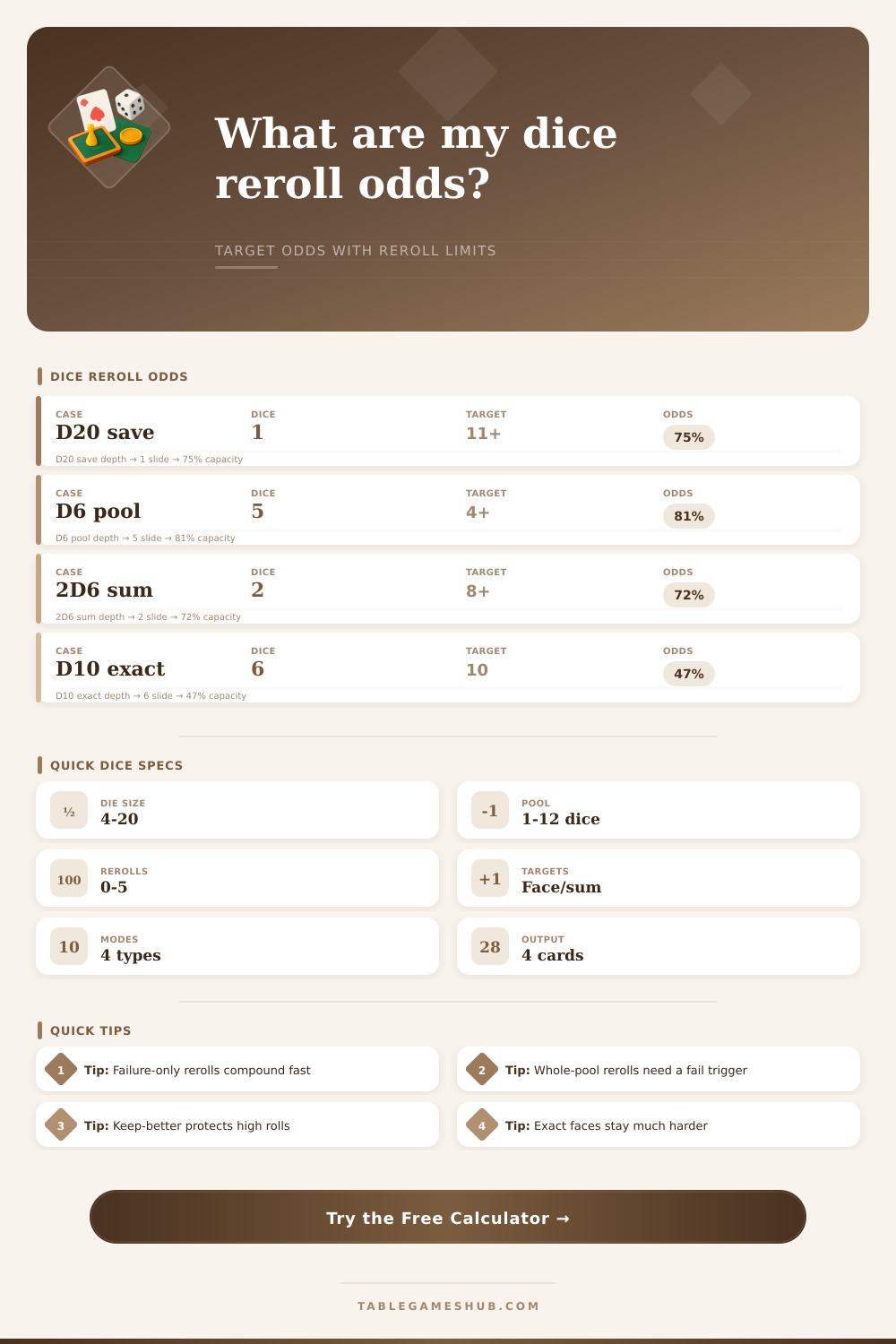
In the end, it’s more than winning the roll, it’s controlling the narrative risk of your rolls. Even at 75% that’s one in four. And that one in four changes the whole story. It’s up to you to decide whether you want to take that shot for the chance at greatness or be content with what you’ve got. The tool handles the arithmetic so you can focus on the decision. The tool is for deciding if you’re cool with taking that hit on an otherwise decent roll for the potential payoff of a great one. What you’re looking for is when to hold ‘em and when to fold ‘em.