Roll Over Probability Calculator
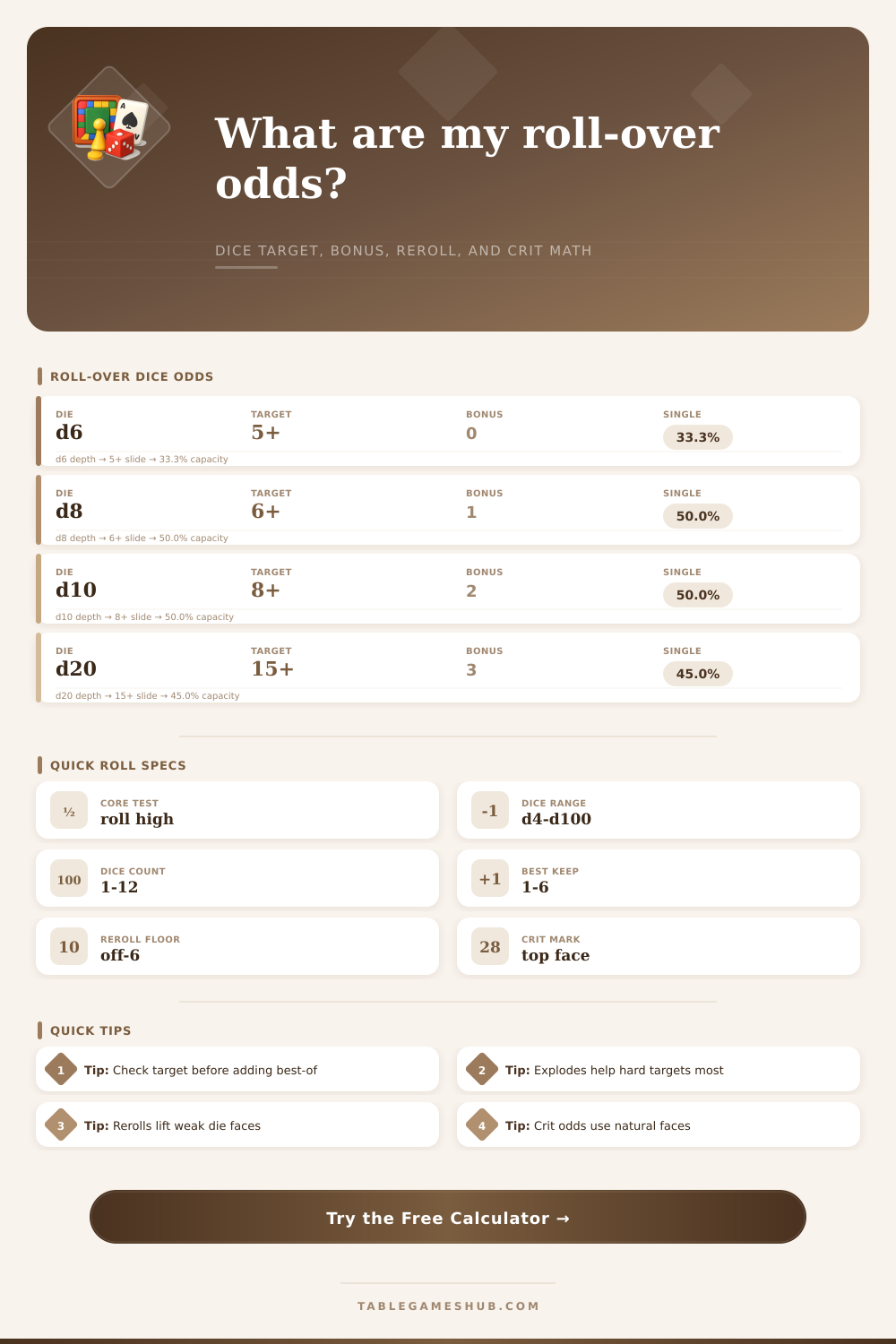
Calculate tabletop roll-over odds for a target number after modifiers, multiple dice, best-of selection, exploding dice, reroll floors, and natural critical thresholds.
P = winning faces / die faces
P(best succeeds) = 1 - fail^dice
P(worst succeeds) = success^dice
P(any success) = 1 - fail^checks
| Target | Need | Winning faces | Single d20 odds |
|---|---|---|---|
| 10+ | 10 or more | 11 faces | 55% |
| 12+ | 12 or more | 9 faces | 45% |
| 15+ | 15 or more | 6 faces | 30% |
| 18+ | 18 or more | 3 faces | 15% |
| 20+ | natural 20 | 1 face | 5% |
| Need | Single | Best of 2 | Worst of 2 |
|---|---|---|---|
| 8+ | 65% | 87.8% | 42.3% |
| 10+ | 55% | 79.8% | 30.3% |
| 12+ | 45% | 69.8% | 20.3% |
| 15+ | 30% | 51.0% | 9.0% |
| 18+ | 15% | 27.8% | 2.3% |
| Die | Average face | Top face odds | Typical check use |
|---|---|---|---|
| d4 | 2.5 | 25% | Small swing tokens |
| d6 | 3.5 | 16.7% | Board game tests |
| d8 | 4.5 | 12.5% | Skill die pools |
| d10 | 5.5 | 10% | Step dice checks |
| d20 | 10.5 | 5% | Target-number checks |
| Option | Best use | Math effect | Calculator note |
|---|---|---|---|
| Best 1 | Advantage or pool | Reduces fail chains | Uses 1 - fail^dice |
| Worst 1 | Disadvantage | Requires all dice pass | Uses success^dice |
| Reroll floor | Reliable rolls | Moves low face mass | One reroll only |
| Explode once | High target chase | Adds one bonus die | Max face triggers |
| Chain explode | Open-ended checks | Extends high tail | Limited to 4 chains |
But it’s all right there on the calculator (above). It calculate the math for you, including complicated probability distributions that otherwise require a spreadsheet during combat. It translates exploding dice, rerolling, best-of pools and more into easily understandable percentages.
Beyond that raw number (beyond whether or not you’ll pass/fail), look deeper at what makes those numbers tick. Most people stop at asking, “Will I pass? Will I fail?” No. That’s where the true power is: knowing which mechanical decision change your chances before die ever leaves your fingers.
Understanding Dice Probabilities
Raw vs. These are advantage modifiers. Many systems allows you to take best result out of multiple dice or to reroll any that come up badly. It’s modeled in the tool as comparing the best result from one die with results of several dice rolled together as a pool. If you’re taking the best of two d20s then it isn’t simply adding a flat bonus but it’s sliding the whole probability curve over towards better results. Because you only fail if both dice don’t hit their mark the odds of failing plunge. And they compound rapidly. For example, there is a forty-five percent chance on a single die, but that jumps to almost seventy percent if you get two tries. That sort of shift change a near-certainty of failure to a good chance of success without altering your character stats in the slightest.
So modifiers are not what they appear. Three seems like a good number to add to your check, but it’s all relative. What does it do? It all depends on where you begin with your chances. A small modifier may be squeezing out fractions of a percent if you have a good shot at something in the first place. But if you’re right up against edge, that same small bonus could double your percentage. That’s tricky because it’s a non-linear relationship. That’s why the reference table on the page is so clear when it comes to standard d20 check. You see exactly how each point of difficulty shifts field. It shows how much harder it become to push over one of those spikes in road.
Then there are special rules such as reroll floors and exploding dice which modify the shape of the distribution completely. Exploding dice increase the variance. They extend the tail end with extremely high results, which is good for difficult targets, but they offer no help on easy rolls. Rerolls do the reverse by cutting off bottom end and lifting up your average result. The point is that you have to understand what tool suits your problem. If you’re after consistency, then rerolls are king. If you’re looking for a miracle, then explosions gives you a fighting chance at upper bound.
Another wrinkle is critical thresholds. A natural twenty might be rare, but it completely alters the gravity of that moment. Success probability isn’t the same thing than critical frequency, and the calculator splits them out to help you understand where that line is drawn. Sometimes you have little-to-no chance of critting yet high odds of success. Knowing that tells you whether to go for broke with a spectacular ending or play it safe by settling for just getting by.
It’s all about probability play. You no longer see the dice as an adversary but rather see them as tools whose behavior is easy to predict. And you come to rely on the mathematics, despite your intuition telling you the dice have rolled incorrecty. Next time you’re staring at an intimidating check, recall that the number was predetermined long before you dug your hand in bag. All you must of do is read the situation.