Three D6 Sum Calculator
Check 3d6 odds across all 216 ordered outcomes with exact sums, thresholds, ranges, triples, modifiers, reroll policies, and keep-high or keep-low two-die totals.
| Sum | Ways | Chance | Shape note |
|---|---|---|---|
| 3 or 18 | 1 each | 0.46% each | Only a triple endpoint |
| 4 or 17 | 3 each | 1.39% each | One step from an edge |
| 5 or 16 | 6 each | 2.78% each | Small outer band |
| 6 or 15 | 10 each | 4.63% each | Growing shoulder |
| 7 or 14 | 15 each | 6.94% each | Common table targets |
| 8 or 13 | 21 each | 9.72% each | Near the center |
| 9 or 12 | 25 each | 11.57% each | High central band |
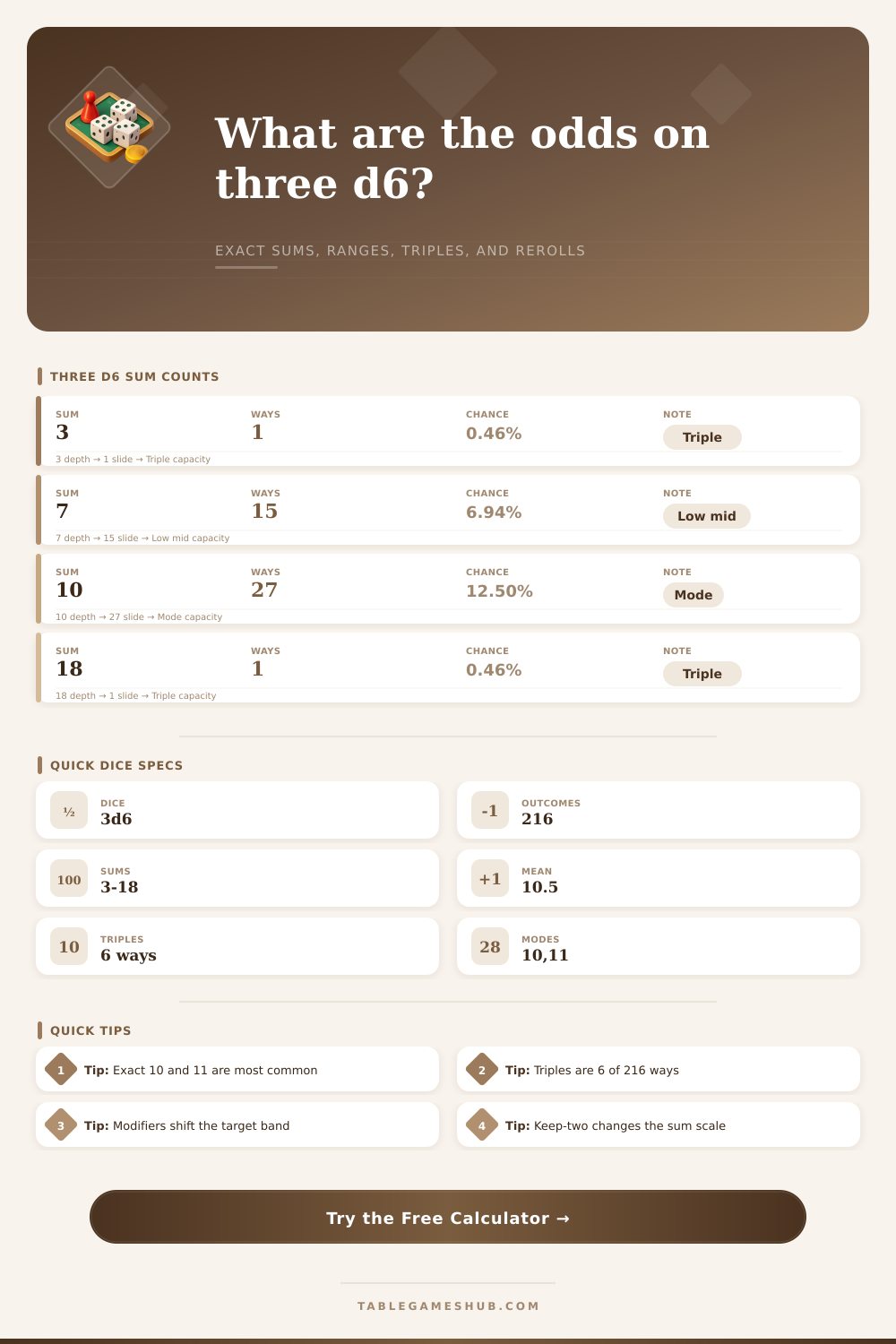
| 10 or 11 | 27 each | 12.50% each | Most likely exact sums |
| Question | Favorable | Chance | Quick read |
|---|---|---|---|
| At least 8 | 181 of 216 | 83.80% | Very likely |
| At least 10 | 135 of 216 | 62.50% | Better than even |
| At least 12 | 81 of 216 | 37.50% | Below even |
| At least 14 | 35 of 216 | 16.20% | High target |
| At most 7 | 35 of 216 | 16.20% | Low tail |
| 9 through 12 | 104 of 216 | 48.15% | Core middle band |
| Triples only | 6 of 216 | 2.78% | All dice match |
| Any pair or triple | 96 of 216 | 44.44% | Repeated face appears |
| Reroll setting | First roll basis | Branch count | Final total note |
|---|---|---|---|
| No reroll | 216 base rolls | None | Each ordered roll has equal weight |
| Reroll all ones | 216 base rolls | One branch per die showing 1 | Multiple ones reroll independently once |
| Reroll lowest | 216 base rolls | 6 branches per base roll | The first lowest position is replaced |
| Reroll highest | 216 base rolls | 6 branches per base roll | The first highest position is replaced |
| Keep mode | Raw span | Average | Best use in calculator |
|---|---|---|---|
| Use all three | 3 to 18 | 10.50 | Standard 3d6 sum questions |
| Keep highest two | 2 to 12 | 8.46 | Advantage-style totals |
| Keep lowest two | 2 to 12 | 5.54 | Penalty-style totals |
| Keep high plus low | 2 to 12 | 7.00 | Drop the middle die |
One of the oldest habits in tabletop gaming is rolling three six-sided dice. Shake ’em, drop ’em on the table, tally the pips. It seems random. It isn’t. Behind those plastic cubes is a hidden heavy bell curve, and knowing what it looks like alter your gameplay. Most people think all sums between three and eighteen has an equal chance of coming up. That common wisdom gets us making lousy decisions at the table.
It’s notoriously imbalanced towards the middle. There are two hundred and sixteen possible results, with sums of ten and eleven having the highest frequency at twenty-seven times apiece: while three and eighteen only occur once. In other words, they’re about twelve and a half percent likely on any given roll. Rolling an 18 or a 3 feels special because it’s so rare. These occur just once in two hundred and sixteen tries.
How Dice Rolls Really Work
If you want precise odds, you can use the calculator up there; it’ll do the math for you. That way, you don’t have to guess whether something falls within your range of possibility. Abstract probability becomes a concrete percentage that you can rely on. This whole curve shifts around based off modifiers. Does your character get a +2? That doesn’t change the shape of the curve. Instead, it just changes where your average land compared to a difficulty threshold. If you want a fourteen and you’re getting a +2 then think of it as if you were rolling a twelve on raw dice. The tool deals with that easy. You’ll be able to see the impact of small bonuses. How do they increase your odds by that little bit? It’s not just throwing a digit at something and hoping for the best. It’s being able to see how that digit pulls your likely results toward a better outcome. That allows the player to make informed choices between spending advantage points and taking things at face value.
Another wrinkle comes from dropping dice and rerolls. Dropping the low die makes the curve more flat at the bottom. It is the same with rerolls of ones. That’s good for some players. Heroic characters wants to never go below a certain number. But that also takes away dramatic tension when they could of failed critically. The calculator includes these weighted branches. It’ll display the chance of each band now and the expected result after that change. Then you can compare basic roll vs rerolls/drops. See how it affects your chances and if it really gives you what you need.
Another fun one is triples. There’s only about a two point eight percent chance that two hundred and sixteen rolls will result in getting three matching dice; they happens only six times out of two hundred and sixteen rolls. In some games, this is treated as a special event. Bonuses or penalties may be awarded. Or maybe you’re trying to filter for or against triples. That alters the total number of possibilities in your probability space and matters more if the game mechanics penalize uniformity then if you’re simply trying to get a high number. The exact frequency can help set reasonable expectations for when these rare occurrences might come up over the course of a long campaign.
You can always use the reference tables included with the tool as a quick guide for commonly used thresholds. But you don’t have to put in data manually each time. For instance, being able to see that approximately sixty-two percent of the time you’re going to be rolling at least ten gives you a great starting point for establishing your difficulty classes. Does this mean the challenge should be an easy hurdle or a test for only the most well-prepared characters?
On the surface the visual range seems intuitive, ranging from three to eighteen. But until you see those numbers laid out, it’s counterintuitive. But knowing doesn’t take away the fun in rolling. It only takes away the false sense of chance. Now when you consistently fail, you don’t attribute it to bad luck. Now you adjust your tactics. Now you realize how much more likely a 12 is compared to an 8 and its not random at all. The bell curve rewards average. It punishes extremes. With a calculator ready to check your assumptions before you roll the dice, you have a quiet advantage. You’re no longer playing blindly out of hope. You are playing with informed consent from moddern math that governs the game.