D4 Probability Calculator
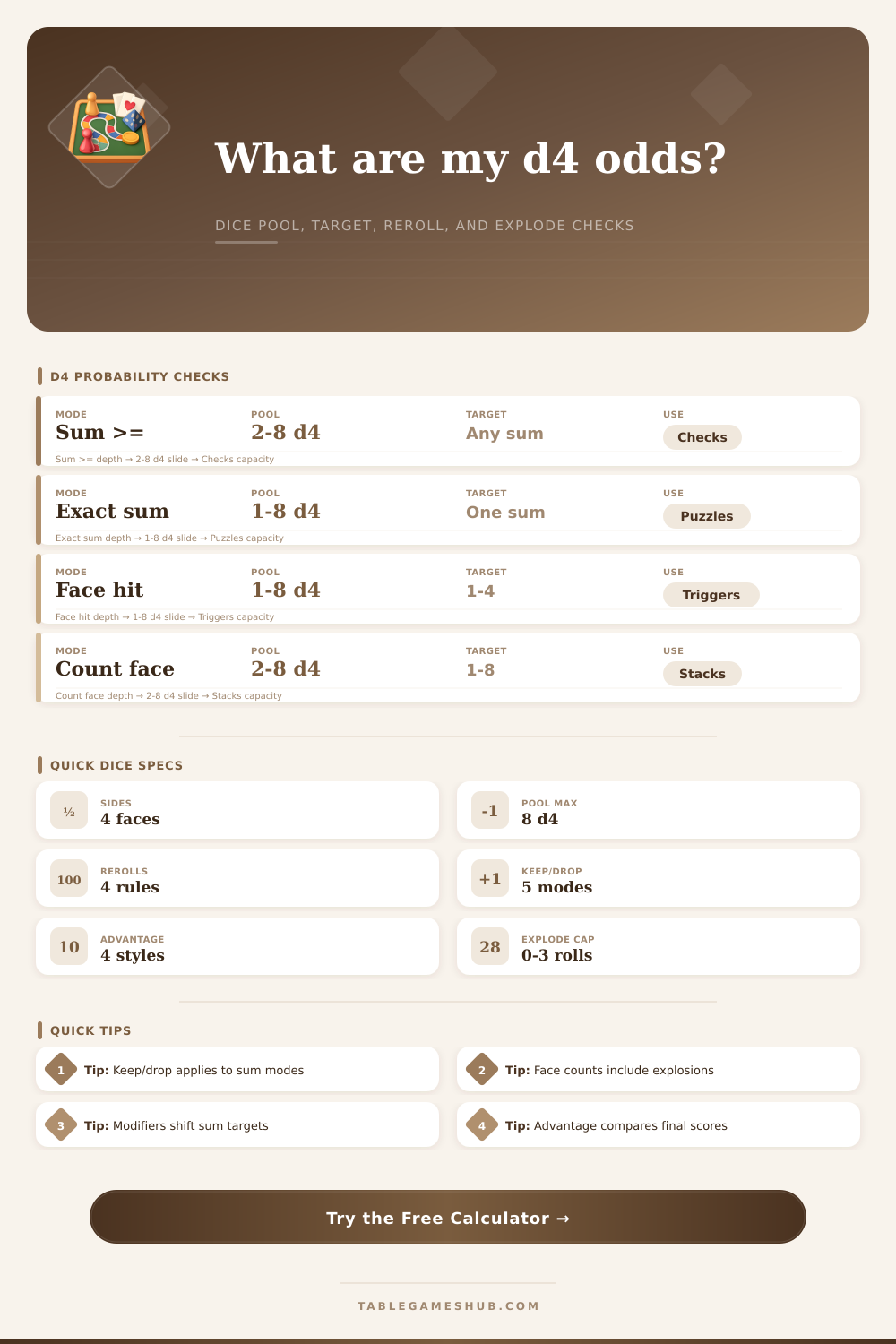
Calculate exact d4 odds for dice pools, target sums, target faces, rerolls, keep/drop rolls, modifiers, advantage-style checks, and capped exploding results.
| Reroll rule | P(face 4) | P(face 3+) | Mean result |
|---|---|---|---|
| No rerolls | 25.00% | 50.00% | 2.500 |
| Reroll 1 once | 31.25% | 62.50% | 2.875 |
| Reroll 1-2 once | 37.50% | 75.00% | 3.000 |
| Reroll below 4 once | 43.75% | 43.75% | 2.875 |
| Pool | Range | Mean | Benchmark chance |
|---|---|---|---|
| 1d4 | 1-4 | 2.5 | 3+ is 50.00% |
| 2d4 | 2-8 | 5.0 | 5+ is 62.50% |
| 3d4 | 3-12 | 7.5 | 8+ is 50.00% |
| 4d4 | 4-16 | 10.0 | 10+ is 58.59% |
| Option | Scored dice | Mean sum | Sample chance |
|---|---|---|---|
| Use all dice | 4 dice | 10.000 | 10+ is 58.59% |
| Keep highest 3 | 3 dice | 8.617 | 9+ is 54.69% |
| Keep lowest 3 | 3 dice | 6.383 | 8+ is 27.34% |
| Drop highest 1 | 3 dice | 6.383 | 8+ is 27.34% |
| Explosion cap | Max total | Mean total | Notes |
|---|---|---|---|
| Off | 4 | 2.500 | Standard d4 |
| Cap 1 | 8 | 3.125 | One extra d4 |
| Cap 2 | 12 | 3.281 | Two extra d4 |
| Cap 3 | 16 | 3.320 | Three extra d4 |
There’s a bag of four tetrahedrons on the table. Shake ‘em up. Roll an eight or higher to avoid having the dungeon door crush your rogue. But how good was that roll? How smart was that decision? In most games, the answer lies with player’s gut. And when that gut lets you down on big day, the feeling sucks.
Once you put a number in for the target roll and your pool size, the d4 probability calculator does the rest. Instantly, you know just what the odds are. It’s the concrete difference between brave gambles and game-losing blunders.
How the d4 Probability Calculator Works
A d4 has a steeper curve than any other polyhedral die. On a d4, each increment matter more than it does on a d6, let alone a d20. A four is incredibly good; a one is terribly bad. That leads to massive variance in small pools. Maybe your overall average looks okay. In reality though, its a jagged mess. You’ll swing from utter failure to critical success at a moment’s notice. There’s not a nice middle ground.
And that’s where people go wrong with their builds. They do things based off average, and average is misleading. The calculator tells you how wide the spread is. Does it tell you if you’re playing it safe by going for consistency? Or are you taking a gamble on a spike?
This also depends on size of the pool. If you have an additional d4, that changes the whole bell curve back to center. A character rolling one d4 has it much easier to get a low number compared to someone rolling two d4s. The more dice you have, the faster the possibility of really high/low numbers drops off. What results is a tighter distribution towards the average. This makes a difference for characters with smaller pools that need to reach moderate targets. Very frequently they’re faced with a binary decision: success or failure? There’s not a lot of in-between. Knowing what shape looks like can help you decide whether to take the chance or increase your pool size.
That’s where the modifiers come in. They bridge that unstable gap. +2 on a d4? That’s huge, and much less so on larger dice. In effect, it shifts all of your die rolls. What used to be a likely failure now becomes a likely success. After applying any keep/drop rules, the tool also applies the modifiers. You get to see what actualy happens. And this sequence makes a difference! Applying the modifier before dropping low dice creates one risk profile; dropping low dice first creates another risk profile entirely. Know how your game system works with this information. Which comes first? Your inputs can reflect those specific rules precisely.
Another wrinkle where instinct fails to help is reroll mechanics. Yes, rerolling one’s and two’s biases the result up, but it doesn’t do so uniformly. It reduces the chance of failure more substantially while increasing average results slightly. If you’re rolling them, you’re primarily purchasing downside protection from bottom-out rolls, not attempting to boost maxes. The page has some handy reference tables explaining this, showing how reroll rules change likelihood of any given face value being rolled. This is useful for gauging if a spell or feat that provides rerolls is going to be worthwhile in your play style.
An open-ended potential is added to a bounded system. Explosion dice extend the ceiling but not the floor. They add a long tail of high results from a four which causes an additional roll. With some pools, you go from mediocre to powerhouse every so often. But they don’t do so forever because of the explosion cap. That keeps the regressions finite and exact. In the calculator, you’ll see that it lets you set limits on how far a die can explode. Try it out and see if the occasional giant hit is worth giving up the consistent gain you have now.
These distributions get warped by advantage and disadvantage, which give you an additional chance at getting more or less of what you need. The best result of rolling twice isn’t simply adding a flat bonus; it helps you out more when your rolls are low without changing how good your high rolls are. This makes advantage feel great if you’re hovering around the edge of success, but not so great if you’re already likely to make it.
Finally, these scores are compared back to your goal with a clear indication of whether taking this tactical risk will be worth it. It’s all about probabilities. It changes your gameplay. You don’t guess anymore. You calculate your chances of success. When making a decision to attack that dragon, or when filling out a character sheet, knowing those exact numbers lets you know if it is worth it. That is where this calculator comes into play. Plug in what you need and see the chance of success. You’ll be able to make the move with your eyes wide open.