Forty Fives Card Game Calculator
Score a Forty-Fives or Auction 45s hand, compare table targets, test bid pressure, and keep the 30-point hand math visible while the scorekeeper settles the round.
tricks × 5 + bonus
3 tricks × 5 + 5 = 20 points.
hand points ≥ bid
20 points meets a 20-point bid.
made ? hand : -bid
Made bids add hand points; sets use your penalty.
P(make) × made + P(set) × miss
Risk estimate updates after calculation.
Score breakdown
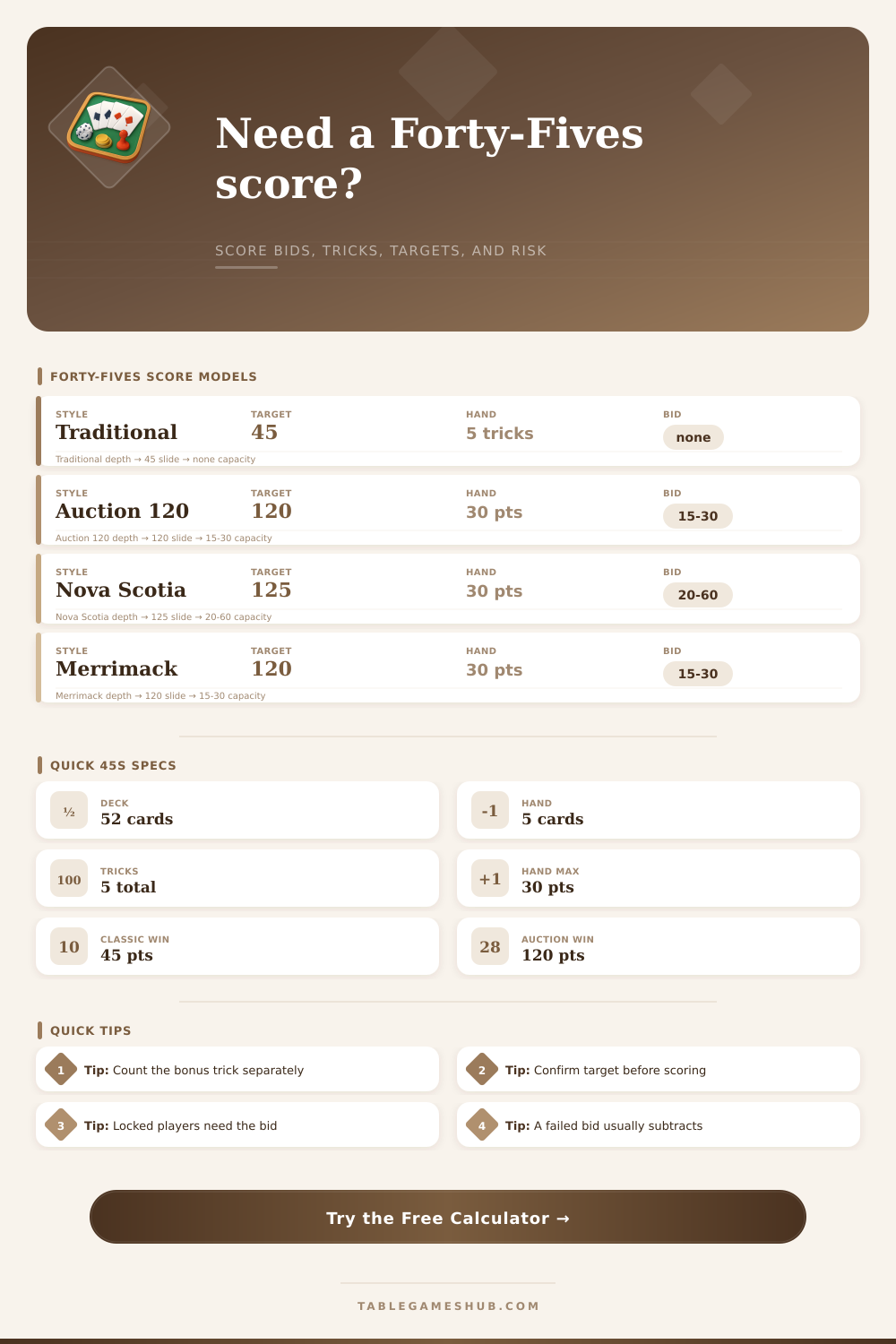
| Profile | Target | Normal hand value | Bid / lock note |
|---|---|---|---|
| Traditional Forty-Five | 45 | 5 or 10 by tricks; alternate differential scoring | No auction bid in the basic profile |
| Auction Forty-Fives / 120 | 120 | Five tricks plus bonus total 30 | Bidder must make the contract |
| Nova Scotia auction | 125 | Five tricks, 30 possible | Often uses 20, 25, 30, and 60-for-120 bids |
| Merrimack / house 120 | 120 | Thirty-point auction hand | Local dealer-hold and kitty rules vary |
| Bid | Practical need | Made score | Miss score |
|---|---|---|---|
| 15 | Three plain tricks or better | Add hand points | Subtract 15 |
| 20 | Usually 3 tricks plus bonus | Add hand points | Subtract 20 |
| 25 | Five tricks without bonus or 4 plus bonus | Add hand points | Subtract 25 |
| 30 | All five tricks plus bonus | Add 30 | Subtract 30 |
| Rank item | Calculator use | Score impact | Audit note |
|---|---|---|---|
| Five of trump | Usually best trump | Often wins bonus trick | Mark bonus holder |
| Jack of trump | High trump rank | Helps secure tricks | Not scored separately here |
| Ace of hearts | Special high trump | Can shift the bonus trick | Confirm local rank sheet |
| Off-suit winner | Plain-suit trick | Counts 5 points | Use trick count input |
| Target situation | Input pattern | Calculator message | Scorekeeper check |
|---|---|---|---|
| Classic finish | Target 45, no bid | Shows points remaining | Higher score wins same hand |
| On the green | Within 30 of target | Flags one-hand reach | Watch opposing bids |
| Locked at 100 | 100+ and not bidder | Blocks non-bidder points | Only bidder can improve |
| Bidder goes out | Both sides hit target | Applies selected tie note | Confirm house rule |
When the score hits ninety-five in Forty-Fives the pressure shifts in the room. The voices is lower and all of the cards seem weighted with gravity as the gap between right and wrong is nearly closed. That’s not simply a matter of psychology. Mathematically there is little room for misstep, so every point counts. Knowing that mathematics transforms panic into calculation. It turns guesswork into strategy.
Forty-Fives are all about the thirty-point hand. Five points per trick and bonus of another five if you hold the highest trump card. That’s what usually wins or loses a contract: who holds strongest trump. Because players are so intent on keeping track of their own plain tricks, they miss that part of game.
How Math Helps You Play Better
In Forty-Fives, you can be sitting there with three good trick but your partner doesn’t have anything, so you’re fighting over the bonus. If you ignore the bonus, you risk bidding when you should of stayed quiet and ending up getting set. The situation gets even more complicated when you’re dealing with auction variants such as 120 or Nova Scotia 125, where the game change focus from accumulating points to balancing risk.
With these auctions, players place bids on how many points their team will achieve during that hand. They are then awarded (or subtracted) those points if successful (or not). So now expected value matters. You may find yourself tempted to bid twenty points since you believe you’ll get at least that much if you have the bonus plus say three tricks. But what’s the probability that you do? What if it’s only a sixty-two percent chance you pull off the bonus? That means there’s only a thirty-eight percent chance you hit that twenty-point mark, which means that statistically it might be dumb to take the bid. By plugging those odds into the calculator above, you can see the expected point swing compared to how likely you believe you are to succeed.
It will force you to ask: Am I willing to risk losing to gain X number of points? Or am I better off betting safer and staying in the game longer? Another topic that gets discussed endlessly around local tables is lock rules, which penalize aggressive non-bidders toward the conclusion of a game. In most areas, once one player hits one hundred, that person can’t earn points for the round if he/she doesn’t bid unless his/her opponents miss their contract. It locks up the leaderboard for those who aren’t bidding by making them defensive players instead of competitors.
If you don’t hold the bid, there’s nothing you can do when your partner have the goods except hope the other side misses. That shifts the dynamics entirely since now you can’t count on your partner’s good hand to bail you out. You have to get the bid yourself or hope the other side miss their contract. The result is poor decision-making. For example, you might bid nineteen just because you don’t want to be locked out. Remember how quickly a missed nineteen-point contract pulls your score down compared to sitting out quietly.
This game has auction pressure, which makes it feel different than Traditional Forty-Fives where players plays to forty-five points without any auction pressure. Here, it’s just about outscoring your opponent by taking tricks and the bonus. It’s a more measured grind that tests your memory and patience. You remember: last round East took the last two trump cards, so he probably isn’t going to take the bonus again. You know West had to play his high honors early, so you lead away from yours. The calculator allows you to model such traditional rounds by setting the target to forty-five and leaving the bid at zero. It removes the auction anxiety and leaves only the trick-taking logic.
So in the end, learning how to play Forty-Five is more science than art. Every single card have a number on it. These numbers become important as you add them up, whether in a traditional match or when trying to win one in an auction game. The most successful players aren’t necessarily the ones with the best instincts, but the ones who understands exactly what is at stake before they even look at their cards. Knowing when to hold ’em, and when to fold ’em. They keep score not just to see where they sit, but to guess where their opponent might go.
When the math starts to click, the table quiets, and all that remains is the silent pleasure of a good hand.