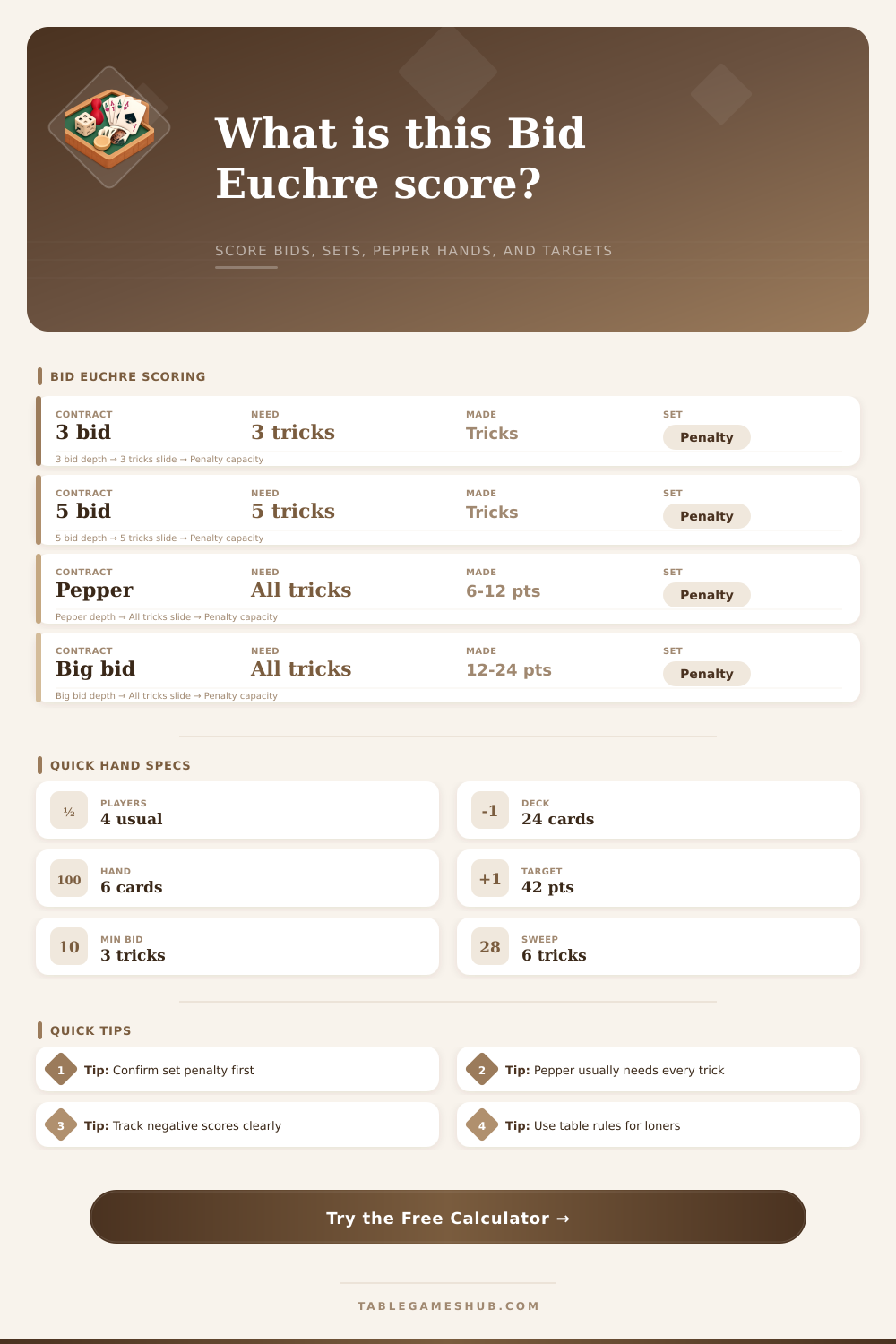
Bid Euchre Score Calculator
Total one Bid Euchre hand with contract scoring, set penalties, pepper bids, sweep rules, match targets, and current-score pressure.
| Profile | Made contract | Set result | Best use |
|---|---|---|---|
| Contract score | Bidders score tricks won | Bidders lose bid value | Bid Euchre scoring with bid-based sets |
| Six setback | Bidders score tricks won | Bidders lose 6 points | Tables where any failed contract is severe |
| Pfeffer style | Plain bids score tricks; pepper has fixed value | Failed plain bid loses 5; pepper loses more | Midwest Pepper or hickey sheets |
| Custom | Uses trick or special fields | Uses override penalty fields | Family or club score sheets |
| Bid type | Typical need | Risk note | Calculator input |
|---|---|---|---|
| Three bid | 3 of 6 tricks | Safer call, lower control | Normal, bid 3 |
| Four bid | 4 of 6 tricks | Common forced-dealer level | Normal, bid 4 |
| Five bid | 5 of 6 tricks | One lost trick still succeeds | Normal, bid 5 |
| Pepper | All tricks | Usually fixed bonus or loss | Pepper contract |
| Bidder tricks | Defense tricks | Four-bid status | Six-bid status |
|---|---|---|---|
| 6 | 0 | Made plus sweep | Made sweep |
| 5 | 1 | Made with overtrick | Set by 1 |
| 4 | 2 | Made exactly | Set by 2 |
| 3 or fewer | 3 or more | Set unless bid was 3 | Set heavily |
| Score gap | Target pressure | Bidder approach | Score check |
|---|---|---|---|
| Behind by 10+ | High | Count if a pepper swing is needed | Watch set penalty |
| Behind by 1-9 | Medium | Made five may swing the lead | Compare new totals |
| Ahead by 1-9 | Medium | Four bid protects against a set | Check target rule |
| Ahead by 10+ | Low | Exact scoring matters more than risk | Track defense trick points |
Euchre is half luck, half calculated risk. And there’s nothing quite as stressful as trying to keep score when playing the cards isn’t enough. Sometimes you have good cards (Aces and Jacks), sometimes you don’t. Your partner could lead poorly and your opponents takes some cheap tricks. Before long you’ve got a mess on the score sheet, you aren’t sure if you made bad bids and should suffer huge penalties, how many points are left to go, or which player led what.
There needs to be a way to manage it all without only using memory in partnership play.
Why Use a Bid Euchre Score Calculator?
Bid Euchre doesn’t have one canonical set of rules. Since each group has its own house rules, it is hard to use the same math for all players without a way to change it easy. For example, some tables uses a simple contract scoring model where made bids earn points equal to tricks won and failed bids lose the bid amount. Others are harder on people who fail to make their bid, penalizing them with five or even six points whether they win any trick or not. Certain special calls may require taking all the tricks but provide large bonus points if they succeed.
For all these variations, the Bid Euchre calculator lets you first choose your house profile, since the math shifts depending on what kind of table you’re at. Then, you can input details of each hand. That way, you don’t force someone else’s generic standard upon your game when everyone’s got a slightly different style.
That six-point penalty feels different than simply losing whatever you bid, and that feeling shifts the way you think about end game.
Target pressure is hard for casual players to grasp. In common variants, where the winning total is typically forty-two, every trick counts twice when your score is close to the winning total. If you’re down by a few points, you could go safe with a three-bid to save it from being worse then losing, but you won’t gain any ground unless the deck reshuffles first. To turn things around, you must make aggressive calls that may be more risky; these give you better chance of shifting momentum.
This tool visualizes target pressure by illustrating exactly how many points you need based on your position and whatever hand you are dealt. No longer does it matter if you don’t want to do math in your head; now you only need to judge whether a five-bid makes sense with your hand strength and what partner signaled. With the knowledge of the exact amount at stake, you can play aggressively rather than gamble desperatly.
Beyond just the basics, there are some special contracts such as Pepper whose value and risk aren’t captured well in typical scorekeeping. Pepper isn’t a bid unless you’re planning to win them all; it’s one of the riskiest moves you can make because any good hand can still miss a trick if the bower is concealed. A successful Pepper can turn around multiple lost hands and erase a deficit immediately. But a botched Pepper can be disastrous, depending on the rules at your table, the penalty could be huge.
Rather than having to recalculate based off your particular house rules, the calculator offers a way to specify penalties for Pepper and other special contracts, so you don’t need to manually tweak everything each time your group decides that failed Peppers lose twenty points instead of ten. It’s a nice recognition that house plays are nuanced but gets you clear picture of what happens right now.
Also worth noting are sweep bonuses. A lot of teams gives extra points if they get a shutout on their regular bid (winning all six tricks). An extra point can determine if you stay in the game or are knocked out. This matters in a close game when both sides is racing to reach the target. Disputes over the final score at the end of the night often come down to little things, so paying attention to them avoids inaccurate score sheets.
Including bonuses and sweep penalties in the calculation makes sure every part of the hand is thought about from the first bid to the last trick counted. It turns what could be a crazy evening into a well-structured path to victory or defeat.
It is all about the flow of the game and maintaining a fair score in Bid Euchre. If the rules are followed and there is agreement as to points, then not only does the game move more smoothly, but it gets more competitive too. Your mind is off of the math, and instead on your partner’s lead card and distribution of trump cards.
How many trump cards were available? What will my partner do with that card? Clarity brings clarity, and if we can eliminate the frustration of having to calculate by hand, we can get back to playing the game for what it was meant to be: taking risks, remembering, and working together. Less time worrying about the numbers when you know how they’re going to be counted means more time enjoying the adrenaline rush of placing your winning bid, you would of loved the excitement.