Knock Rummy Score Calculator
Score a knock, undercut, gin, or big gin hand with layoff checks, house-rule bonuses, Oklahoma doubles, and match-target tracking.
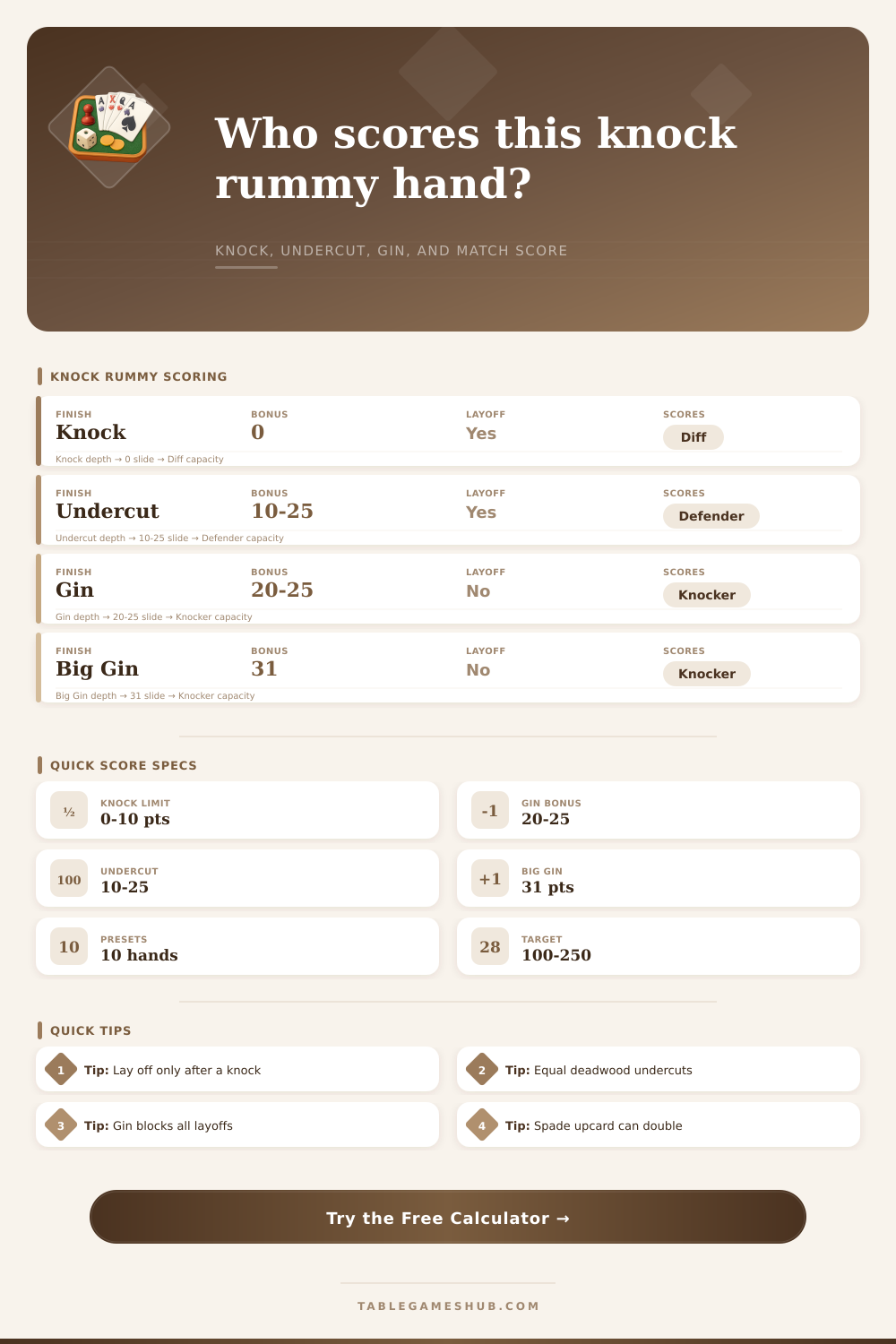
Score = defender deadwood after layoff - knocker deadwood
Defender score = bonus + knocker deadwood - defender deadwood
Score = gin bonus + defender deadwood, with no layoff
Doubled hand = full hand score x 2 after bonuses
Aces count one point in standard gin-style scoring.
Number cards count their printed rank value.
Jacks, queens, and kings count ten deadwood points.
Cards in valid sets or runs are not entered as deadwood.
| Ruleset | Knock limit | Gin bonus | Undercut bonus | Target note |
|---|---|---|---|---|
| Classic gin-style score | 10 or less | 20 | 10 | Often played to 100 points |
| Modern club score | 10 or less | 25 | 25 | Common house-rule bonus set |
| Oklahoma Gin | Upcard value | 25 | 25 | Often played to 150 points |
| Hollywood-style match | 10 or less | 25 | 25 | Box bonuses matter at match close |
| Hand ending | Knocker deadwood | Defender after layoff | Bonus used | Hand score |
|---|---|---|---|---|
| Clean knock | 7 | 15 | None | Knocker scores 8 |
| Equal-count undercut | 6 | 6 | 10 undercut | Defender scores 10 |
| Modern undercut | 9 | 4 | 25 undercut | Defender scores 30 |
| Classic gin | 0 | 18 raw | 20 gin | Knocker scores 38 |
| Big gin | 0 | 22 raw | 31 big gin | Knocker scores 53 |
| Upcard rank | Knock limit | Spade effect | Calculator setting | Score note |
|---|---|---|---|---|
| Ace | 1 | Doubles if spade | Limit 1, double yes or no | Very tight knock threshold |
| 2 through 9 | Rank value | Doubles if spade | Use the shown number | Variable knock threshold |
| 10, J, Q, K | 10 | Doubles if spade | Limit 10 | Same limit as standard gin |
| Non-Oklahoma | House rule | No spade double | Double no | Use the rule announced before play |
| Reference point | Used here | Reason | House-rule control | Audit check |
|---|---|---|---|---|
| Knock difference | Lower deadwood wins the difference | Core knock-rummy scoring | Editable deadwood and layoff | Compare after layoff |
| Undercut | Equal or lower defender wins bonus plus gap | Common gin-rummy underknock rule | Editable bonus | Equal count still undercuts |
| Gin | No defender layoff, bonus plus raw deadwood | Gin hand blocks layoff | 20 or 25 preset | Knocker deadwood should be 0 |
| Oklahoma | Upcard knock limit and optional spade double | Popular scoring variation | Limit and double switch | Double after bonus |
Gin is a special kind of quiet among the rest of the cards at the table. You get points for the hand. There is also a sense that momentum shift as soon as somebody says “gin.” That one good undercut or knock throws the score in your favor before anybody has even finished there drink. Letting the calculator do the math frees up your mind to strategize about the move itself.
Deadwood is the total point value of the cards remaining in your hand after you have created runs and set. Face cards scores 10 points; aces are counted at one point. The closer this number get to zero, the better. If you choose to knock, you do so when you think it’s low enough to put pressure on your opponent, but high enough to keep them guessing about how far behind you actualy are.
How to Score in Gin Rummy
It gets dicey when there is more than a few points at play. With mismatched cards, one player may have a deadwood count of 7 points and another player might have 18, so now what? Do you lay off some of those cards onto the other players’ melds, lowering your score but still hoping to get rid of that card?
It’s very dynamic scoring different than static scoring. You enter the layoff reduction into the calculator as a separate item since it affects the winner of the hand. If the opponent lays off enough to drop their score under your score, then he or she has undercut you. It is different if there’s an undercut involved. Then it’s all different. The difference between your knock and his become a bonus for him along with original difference in deadwood.
How much? It depends on house rules. Ten points is the classic penalty for being underknocked, though some people play with a more steep twenty-five point swing. Agreeing to this set of rules prior to dealing the first card makes all the difference since a misunderstanding can turn a simple hand into a battle. With this tool, you can switch between these rule sets and we both know what happens when someone gets undercut with a low knock.
Scoring involves another jump into gin. That signifies no deadwood, giving your opponent no opportunity to lay off any cards. The usual bonus is just above the actual value of their deadwood points (usually twenty or twenty five). That’s a huge score in a single round.
Big gin is when the winner of the round do so with all cards picked up from the stock pile instead of discarded ones. In addition it scores the bigger bonus (thirty-one points is common). It is harder to do and typically ends a long game that may have lasted for hours.
It gets a bit more complex in Oklahoma gin, where the knock limit are tied to the upcard’s face value. Two knocks means no more than two points of deadwood when the upcard’s a two. You get ten points if it’s a queen. You can’t guess how many points is in your opponents’ hands; now you have to adjust your level of aggression depending on what they’ve got showing. And at some tables, the stakes are doubled if the upcard is a spade. A careful game becomes a risky balancing act.
It’s not easy keeping all this in your head. You have to keep up with your own melds and remember who owes what from three hands back but you also need to read the other players’ tells. That’s where the score calculator comes into play. Acting like an umpire, it will calculate the total score so far in a match. It takes into account previous scores and box bonuses which add additional points to a game based off how well you did. From there you can get an idea when to take a chance at under-cutting someone or when to play it safe to keep control of target score.
It’s all about the probabilities; with a little discipline in cutting losses. It sounds complicated. But it realy isn’t. The math behind it is simple add/subtract. And those numbers has an element of psychology to them. When you draw that last card, knowing just how much is riding on it alters your response. Get the dispute settled so you can clear your head for the part of the game where skill comes into play. What’s your opponent going to do?